Jon Stewart on Entertainment-Conglomerate Management: “I Don’t Know That You Feel the Other Humans in the Room Anymore”
Jon Stewart may still be tossing dynamite with his Monday comedy diatribes against Donald Trump on The Daily Show. But that doesn’t mean he thinks the people paying him to do so are filled with the same passion. “I don’t know that you feel the other humans in the room,” Stewart said of management at…
Jon Stewart may still be tossing dynamite with his Monday comedy diatribes against Donald Trump on The Daily Show. But that doesn’t mean he thinks the people paying him to do so are filled with the same passion.
“I don’t know that you feel the other humans in the room,” Stewart said of management at the current Paramount Global and other entertainment companies, comparing it unfavorably to the leadership of several decades ago. “Working at Viacom at that time you felt…the other humans in the room.” Stewart, who began working for Viacom 35 years ago this spring, hosted several MTV and Comedy Central shows before taking the desk at TDS in 1999.
Former Viacom chief executive Tom Freston agrees. “We’re drowning in data,” Freston said. “You put a show up and [executives] have all this data saying, ‘You shouldn’t do this, you shouldn’t do that.’”
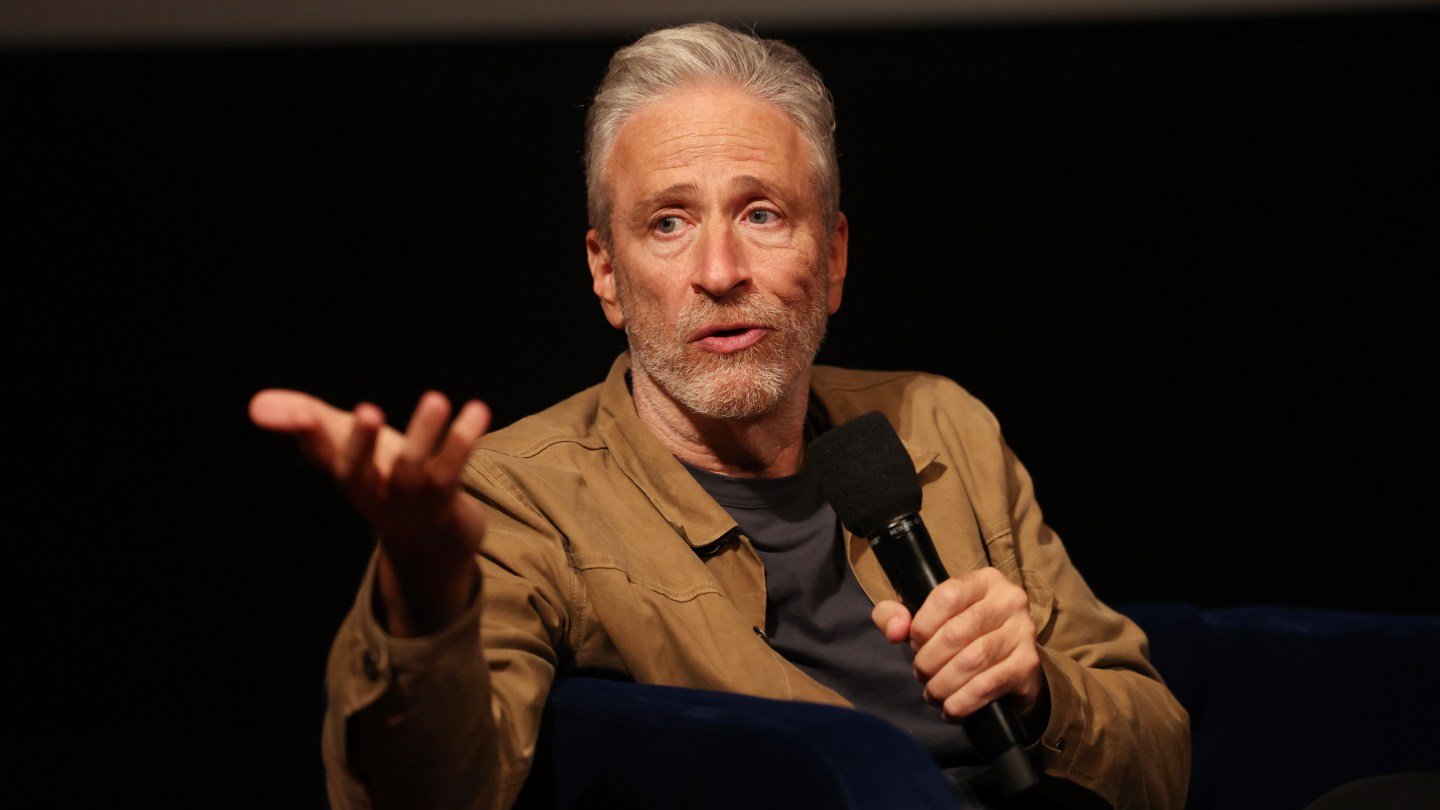
Stewart was interviewing Freston on stage at the 92NY in New York, part of an informal reunion among the Viacom cable execs from back then that include Judy McGrath, Doug Herzog, Van Toffler and John Sykes. They form a kind of cable-television disruptor gallery, and a number of the group turned up in the audience for the ad hoc reunion.
Part of the discussion turned to the gloomy state of management by algorithm. “You seemed to have a connection to the artist and artistry,” Stewart said to Freston. “The Silicon Valley ethos is more steeped in efficiency. They would walk in and go, ‘How many people work here? Eight thousand. Good, make it two.’ It’s not really tied to the value.”
Freston echoed the thought. “They didn’t come to their jobs with a desire to do storytelling.”
Stewart noted he believed it was possible to hew to the principles of good business without totally giving in to the spreadsheet. “You obviouslyhad to stick to budgets and parameters and all of that sort of thing,” he said to Freston. “[But] you seemed to manage from the heart, always being thoughtful.”
The comic had just reupped as part-time Daily Show host for another year, allowing him to maintain the host chair through 2026 and the all-important midterms. Never one to hold his tongue on bosses, Stewart’s closing on a new deal seems to have liberated him to talk even more freely.
The comic had pointed words for David Ellison, Paramount’s new owner and his current boss, referencing at one point the mogul’s interest in Warner Bros. and the Ellison family’s seeming pro-White House stance. When Freston said that it “looks like Warner Bros. is going to disappear and get gobbled up by Paramount,” Stewart cut in wryly: “Which is a fantastic company. I cannot speak more highly of them. I think they should gobble up all of them — and hand them directly to the president.”
At another point, after Freston noted consolidatory and Wall Street pressures and “billionaires” controlling media companies, Stewart said: “We will all end up working for just one person. And it will be an Ellison, most likely.”
Stewart made some jokes at his own expense, pausing at one moment to ask, “Am I being fired? Talk-show host is a very tenuous business right now.” He added: “I don’t know if there was a tweet that went out from the FCC right now,” alluding to chair Brendan Carr’s habit of using platforms to target Jimmy Kimmel and, on Saturday, Seth Meyers.
The night was filled with nostalgia for a pre-Silicon Valley era of Hollywood leadership, with Stewart noting “a time of possibility when the right things were being highlighted” in the 1990s and 2000s era of cable television. “That ended. It’s over. I don’t think that still exists anymore.”
Freston doubled down. “It’s sad. That was a time of optimism,” he said. “The world [of media] was sort of ascendant and there could be a lot of opportunity to do things. You could make unusual moves. But nowadays, I don’t know.” (Left unsaid were the world of creators, where unusual moves happen all the time, albeit under the watchful eye of the world’s largest companies that platform them. Freston did cite A24, Neon and Searchlight as companies that can offer more handcrafted work in the current climate.)
The executive, who turns 80 next week, has a new book out about his long and colorful career (which involved fashion in Asia before running the likes of MTV and Comedy Central in their heyday). He left Viacom some 20 years ago amid one of numerous management shake-ups at the drama-heavy entertainment firm.
Freston said he was rueful about what executive teams were like then as opposed to now. Data, he said, “brings in a cast of different kinds of characters to run the show. And the soulfulness that we felt and enjoyed has melted away a little bit.”