US Supreme Court agrees to hear case challenging birthright citizenship
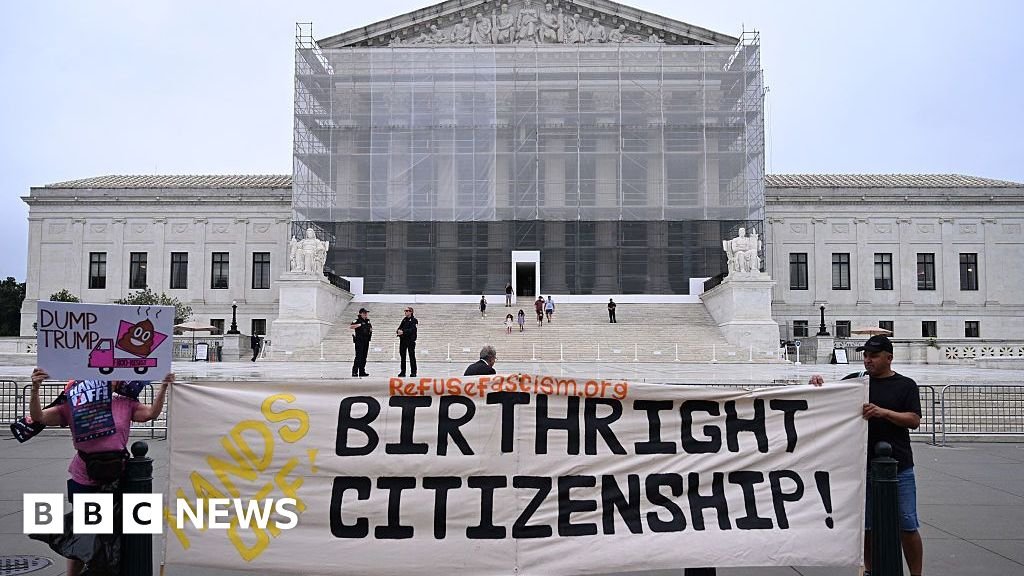
The US Supreme Court has agreed to hear a case on whether the long-standing constitutional right of guaranteed citizenship for those born in the US will remain. On his first day in office in January, President Donald Trump signed an order to end birthright citizenship, but the move was blocked by lower courts after it…
The US Supreme Court has agreed to hear a case on whether the long-standing constitutional right of guaranteed citizenship for those born in the US will remain.
On his first day in office in January, President Donald Trump signed an order to end birthright citizenship, but the move was blocked by lower courts after it was challenged over its constitutionality.
The Supreme Court’s eventual ruling will either back citizenship rights for the children of migrants who are in the US illegally or on temporary visas, or end it.
Next, the justices will schedule a date to hear oral arguments between the government and plaintiffs which include immigrant parents and their infants.
For nearly 160 years, the 14th Amendment of the US Constitution has established the principle that anyone born in the country is a US citizen, with exceptions for children born to diplomats and foreign military forces.
The language of the amendment states: “All persons born or naturalized in the United States, and subject to the jurisdiction thereof, are citizens of the United States.”
Trump’s executive order seeks to deny citizenship to the children of people who are either in the US illegally or are in the country on temporary visas. It is part of the Trump administration’s broader effort to reform the nation’s immigration system and combat what they have called “significant threats to national security and public safety”.
The administration has argued the 14th Amendment clause “subject to the jurisdiction thereof” means the amendment excludes children of people who are not in the country permanently or lawfully.
Cecillia Wang, national legal director of the American Civil Liberties Union, which is representing the plaintiffs in the case, told the BBC’s news partner CBS that no president can change the 14th Amendment’s fundamental promise of citizenship.
“For over 150 years, it has been the law and our national tradition that everyone born on U.S. soil is a citizen from birth,” Ms Wang said in a statement.
“We look forward to putting this issue to rest once and for all in the Supreme Court this term,” she added.
The US is one of about 30 countries – mostly in the Americas – that grant automatic citizenship to anyone born within their borders.
After legal challenges were brought to Trump’s executive order, several federal court judges ruled that it violated the Constitution, while two federal circuit courts of appeals upheld injunctions blocking the order from going into effect.
Trump then went to the Supreme Court to fight the injunctions. In a win for Trump, the court ruled in June that the injunctions issued by the lower courts exceeded their authority, though it did not address the issue of birthright citizenship itself.
The 14th Amendment was passed in the wake of the US Civil War in order to settle the question of the citizenship of freed, American-born former slaves.
US Solicitor General D John Sauer has argued that the amendment was adopted “to confer citizenship on the newly freed slaves and their children, not on the children of aliens temporarily visiting the United States or of illegal aliens”.
He has said it’s a “mistaken view” that birth on US soil confers citizenship and has argued that that understanding has had “destructive consequences”
About 250,000 babies were born to unauthorised immigrant parents in the US in 2016 – a 36% decrease from a peak in 2007, according to The Pew Research Center.
By 2022, the latest year that data is available, there were 1.2 million US citizens born to unauthorised immigrant parents, Pew found.
A study published in May by the thinktank Migration Policy Institute and Pennsylvania State University’s Population Research Institute suggested that repealing birthright citizenship could increase the size of the unauthorized population in the US by an additional 2.7 million by 2045 and by 5.4 million by 2075.