
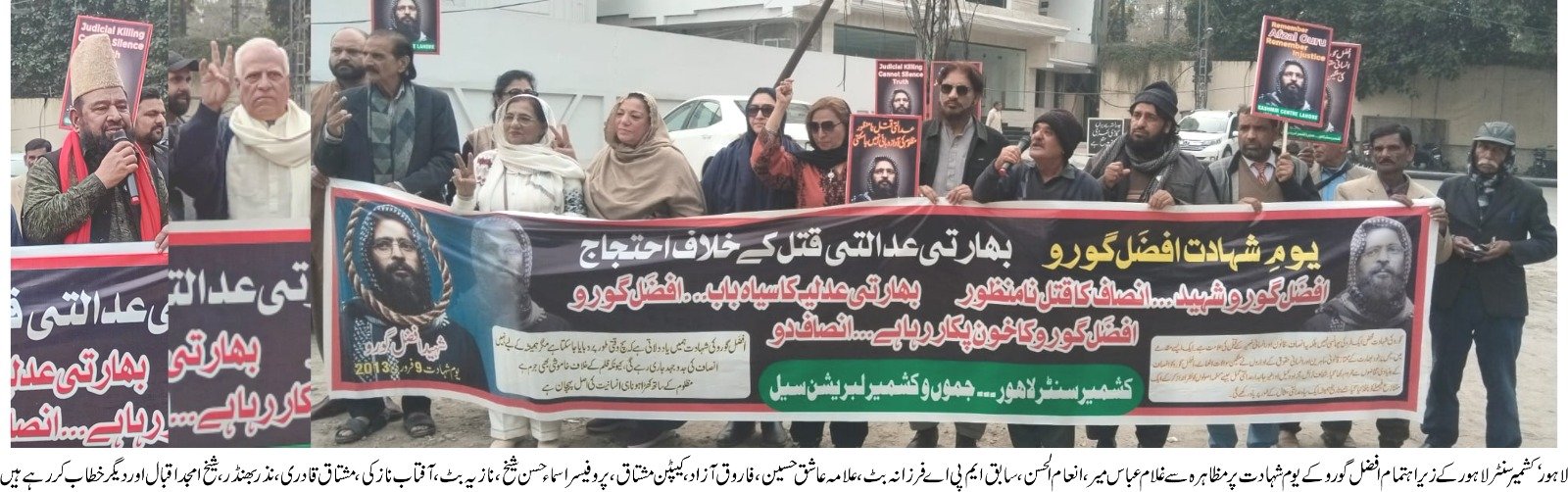
Protest Held at Lahore Press Club on Martyrdom Anniversary of Kashmiri Leader Afzal Guru
By Farzana ChaudhryLahoreLAHORE: A protest demonstration was held outside the Lahore Press Club on the 13th martyrdom anniversary of prominent Kashmiri freedom fighter Muhammad Afzal Guru, organized by the Kashmir Center Lahore.The event was addressed by senior Pakistan Peoples Party leader Ghulam Abbas Mir, Kashmir Center Incharge Aam-ul-Hassan Kashmiri, former MPA Farzana Butt, prominent PML…
By Farzana Chaudhry
Lahore
LAHORE: A protest demonstration was held outside the Lahore Press Club on the 13th martyrdom anniversary of prominent Kashmiri freedom fighter Muhammad Afzal Guru, organized by the Kashmir Center Lahore.
The event was addressed by senior Pakistan Peoples Party leader Ghulam Abbas Mir, Kashmir Center Incharge Aam-ul-Hassan Kashmiri, former MPA Farzana Butt, prominent PML leader Begum Safia Ishaq, noted religious scholar Allama Ashiq Hussain, Secretary Kashmir Action Committee Farooq Azad, Captain Mushtaq (retd), Professor Asma Hassan Sheikh, Kashmiri leader Nazia Butt, Poll Front leader Aftab Nazqi, Allama Mushtaq Qadri, renowned intellectual Nazar Bhandar, Sheikh Amjad Iqbal, Mehmood A Tarazi, and several other prominent figures.
The speakers strongly condemned the execution of Afzal Guru by Indian authorities, describing it as one of the gravest violations of human rights and a mockery of justice. They recalled that Afzal Guru was hanged in Delhi’s Tihar Jail on February 9, 2013, despite the Indian Supreme Court itself admitting in its verdict that there was no concrete evidence directly linking him to the crime.
The participants asserted that the Indian judiciary sentenced Afzal Guru to death merely to satisfy public sentiment, proving that constitutional protections, legal principles, moral values, and human rights hold no real value in India. They described Afzal Guru as a shining symbol of the Kashmiri freedom struggle — a man who abandoned his medical education to take up arms for the liberation of his homeland.
The speakers categorically rejected Indian claims of Afzal Guru’s involvement in the 2001 Indian Parliament attack, alleging that Indian agencies themselves orchestrated the incident as a false flag operation to defame and discredit the Kashmiri resistance movement. They pointed out the glaring contradiction in the Supreme Court’s judgment: while acknowledging the lack of solid evidence, the court still awarded the death penalty — raising serious questions about the nature of justice and rule of law in India.
They further alleged that Afzal Guru was not even accused of directly participating in the attack but was convicted only on charges of providing assistance to the attackers. The speakers maintained that Indian institutions frequently stage such incidents themselves and then implicate innocent Kashmiris, sentencing them to harsh punishments.
Referring to the recent Pahalgam incident, the speakers claimed it was another false flag operation engineered by Indian agencies with the intent of maligning Pakistan. They noted that, despite intense Indian media propaganda, the people of Kashmir refused to blame Pakistan and instead held Indian institutions responsible.
The speakers paid rich tributes to Afzal Guru’s unwavering commitment and ultimate sacrifice, stating that his execution sent a powerful message to the world that Kashmiris are ready to offer every kind of sacrifice for the achievement of their right to self-determination.
They reiterated their longstanding demand that the ashes of Afzal Guru Shaheed and Maqbool Butt Shaheed — both buried inside Tihar Jail — be handed over to the Kashmiri people so they can be laid to rest with dignity in their own homeland.
The protest concluded with renewed calls for justice, freedom, and an end to what the participants described as India’s continued oppression and human rights violations in occupied Kashmir.


