Koreas market plunge is just the start of Asias Iran pain
TOKYO – The panic sweeping through South Korea’s trading floors this week amid fast-developing fallout from war in the Middle East might not be as isolated as many investors hope. On Tuesday and Wednesday, the hottest stock markets among the globe’s major economies took a wild tumble as US-Israeli attacks on Iran destabilized the region….
TOKYO – The panic sweeping through South Korea’s trading floors this week amid fast-developing fallout from war in the Middle East might not be as isolated as many investors hope.
On Tuesday and Wednesday, the hottest stock markets among the globe’s major economies took a wild tumble as US-Israeli attacks on Iran destabilized the region. The Kospi index fell 18% over the two days.
It’s a reminder South Korea’s trade-reliant economy is highly vulnerable to the coming trade chaos and surging oil prices. And though the market bounced back on Thursday, fear is in the air.
Artificial intelligence worries abound, too. Last week, the Kospi’s 139% rally over the previous 12 months had the global AI trade written all over it. The AI boomhas been very, very good for Samsung Electronics andKorea’s broader economy.
AI fever had retail investors piling into the Kospi with borrowed money. There are now concerns that uncertainty and rising oil prices could halt AI investment globally.
Korea is far from the only Asian economy on the frontlines of the Iran war. Economies from China to Japan to Indonesia are scrambling to assess vulnerabilities to exploding geopolitical risk – and to sandbag economies should the Iran-related chaos unleash financial contagion effects.
This conflict could cause “the largest oil supply disruption in history,” says Jim Burkhard, head of crude oil research at S&P Global Energy. “If the reduction in tanker traffic continues for a week or so, it will be historic. Beyond that, it would be epochal for the oil market with prices rising to ration scarce supply and impacts in financial markets.”
Economist William Jackson at Capital Economics says that even a short-lived conflict will keep Brent crude prices around $80 a barrel, the same peak amid the 12-day war in Iran last June. A longer conflict could send prices to roughly $100, adding about 0.6-0.7 percentage points to global inflation, he predicts.
In Asia, oil price movements are the primary channel through which energy shocks and geopolitical risks are transmittedto economies.
“In the last year, the global economy has been resilient, and the impact of geopolitical shocks was rapidly absorbed,” says Michael Lok, chief investment officer at Union Bancaire Privée.
“Now, however, the length and the magnitude of a major regional conflict in the Middle East looks more uncertain and the negative impact could potentially be higher for the Middle East, Europe and Asia, particularly as the latter two regions are heavily energy- and import-dependent.”
Daniel Sternoff, senior fellow at Columbia University’s Center on Global Energy Policy, tells Reuters that the biggest question is whether Iran damages oil and gas facilities around the region.
“All of this looks like a deliberate Iranian choice to escalate really quickly against its neighbors and to try to use world energy markets and prices as a pressure point,” Sternoff says, referring to the attacks in Saudi Arabia and Qatar. “We are really quickly into a really dangerous phase here of which there is no precedent.”
Hence, the fast-rising level of angst in Asian capitals. “For energy import-dependent Asia, this raises a specter of supply disruption that could significantly impact energy availability and affordability — depending on the severity of the disruption and its duration,” says economist Priyanka Kishore at Asia Decoded.
Morgan Stanley economists note that every $10 per barrel increase on a sustained basis “will hit Asia’s GDP growth directly by 20-30 bps.” India, Morgan Stanley writes, “could be especially vulnerable.”
“India’s current account deficit, which is 1.2% of its GDP, would be widened by 50 bps for every $10/bbl rise in oil price, the analysts said. “Thailand, Korea, Taiwan, and India,” they add, “would be more exposed to downside to growth on account of their wider oil and gas balances.”
Alicia Garcia-Herrero, chief Asia Pacific economist at Natixis, says “the economic impact on Asia goes beyond oil, with consequences for mobility, construction, finance and defense.”
A prolonged conflict, Garcia-Herrero says, can turn temporary re-routing, delays and freight rate surges into permanent conditions, leading to higher import costs and inflation. “Rising energy prices can hurt airlines’ profit margins,” she says. “It will make Asia-Europe flights more expensive and reduce affluent Middle Eastern tourist spending in Asia.”
From one perspective, Kishore argues, Asia’s direct dependence on Iranian crude is limited, having fallen significantly since the US withdrawal from the nuclear deal in 2018 and the reimposition of sanctions on Tehran.
True, China has sought to circumvent the sanctions through shadow fleets and transshipments. China takes over 90% of Iran’s oil shipments, accounting for around 14% of China’s total imports. But there is little evidence of other Asian economies engaging in such practices to maintain meaningful commercial ties with Iran.
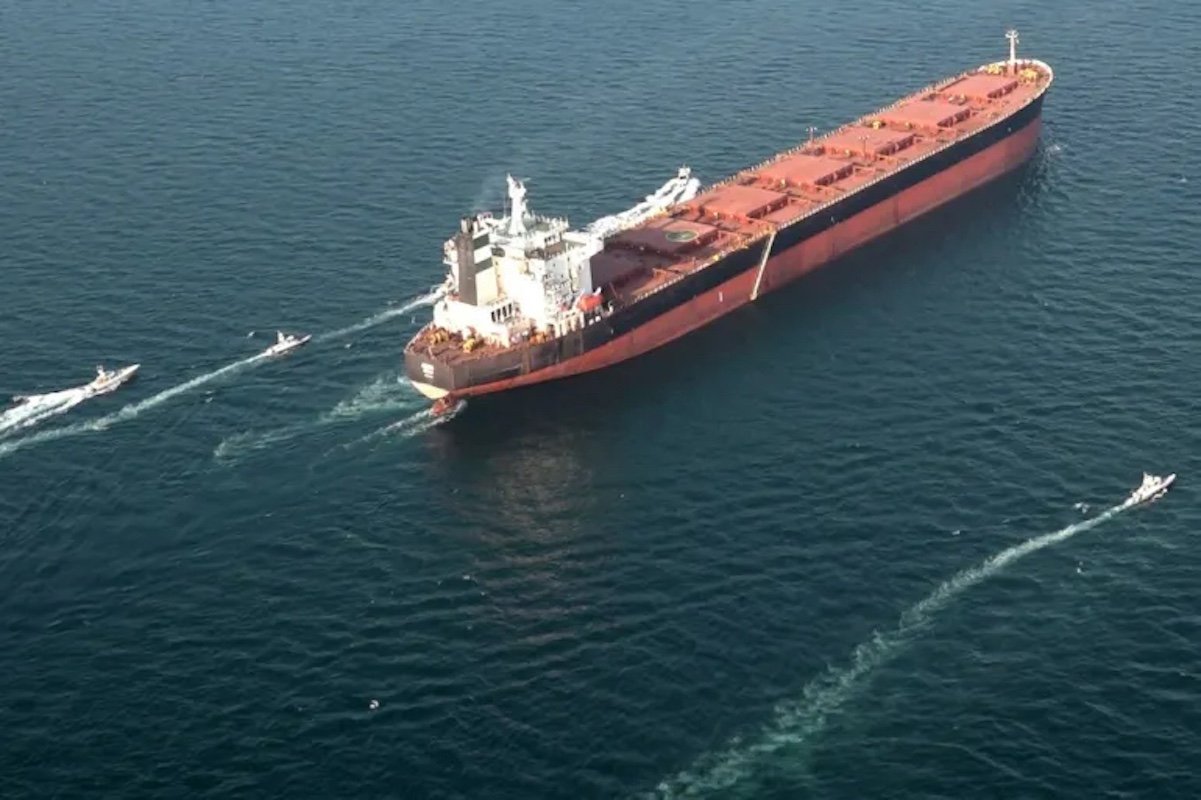
“Still, this doesn’t insulate the broader region from supply shocks,” Kishore says. “At the heart of the matter is Iran’s stranglehold on the Strait of Hormuz, through which about one-fifth of the world’s oil and natural gas supply flows every day.
“It is also the primary route for energy shipments from the Middle East to Asia, and has come to a standstill amid rising security risks, compounded by growing hesitance of insurers to provide war coverage to vessels passing through the Strait.”
Though US President Donald Trump says US naval ships will escort oil tankers if needed, setting up such convoys would take considerable time and put US military personnel at risk of being easy targets for Iranian retaliation.
“While President Trump’s comments about insurance and tanker escorts caused a pullback in oil prices, we question how much planning has been done on the insurance backstop thus far and think there could be a number of challenges in executing this plan quickly,” RBC Capital Markets analysts said in a note.
Kishore notes that “these developments are likely to keep energy prices under upward pressure until concerns about tightness in the physical market ease.”
If there are any silver linings here, it’s that stock markets that have become overvalued will enter a correction mode, though they won’t necessarily crash, analysts say. “Strategically, we remain positive and view short-term weakness as an opportunity to build positions in key themes including defense, power, and shareholder return,” says Goldman Sachs analyst Timothy Moe.
Yet the ways Trump’s Iran gamble upends geopolitical dynamics in Asia could be profound — starting first and foremost with China. Since early January, Xi Jinping’s Communist Party has watched Trump carry out attempted regime change in two of the nations in which Beijing had invested heavily for decades: Venezuela and now Iran.
All this is surely a major discussion point at this week’s annual “Two Sessions” meetings in Beijing. On Thursday, China announced it is lowering its 2026 GDP target to between 4.5% and 5%.
“Economically, the Middle East supplies roughly half of China’s crude oil imports, leaving Beijing highly exposed to regional instability, especially in the event of a prolonged conflict or disruption to key shipping lanes,” warns Oxford Economics strategist Yan Wang.
Wang expects the negative impact of the oil shock on the Chinese economy to be limited and manageable, as it currently anticipates the war to last only a few weeks, at most one to two months.
“Meanwhile, China has significantly expanded its strategic petroleum reserves and commercial inventories through state-controlled oil majors, providing an important buffer against potential supply disruptions,” Wang notes.
Yet, even if the Iran war’s impact onChina’s economy looks manageable at this point, as Bloomberg Economics analyst Chang Shu believes, it could lead to higher inflation and intensifying headwinds for China’s all-important export engine.
And “geopolitically, the damage may be larger and more lasting,” Shu argues, adding that “it’s a similar pattern to January, when the US captured former Venezuelan President Nicolas Maduro.”
The conflict is remaking Japan’s 2026 in a hurry. Already shaken by Trump’s tariffs and their inflationary effects, Japan now confronts higher energy costs amid an undervalued yen.
More than 60% of Tokyo’s oil imports are transported via the Strait of Hormuz. And unlike previous “risk-on” periods in markets when the yen acted as a safe haven, the Japanese currency is actually falling this week.
Prime Minister Sanae Takaichi faces quite a balancing act with Trump, to whom she’s so far cozied up. The Iran attack probably won’t be popular with Japan’s 125 million people. Takaichi risks losing public support if she appears onboard with Trump’s military adventurism.
At the same time, China is tightening the screws on Takaichi’s economy over her support for Taiwan.
“Japan faces a trade war launched by its two biggest customers: China and the US,” explains economist Richard Katz, who publishes the Japan Economy Watch newsletter.
“Beijing is escalating its restrictions on exports to Japan over Taiwan issues. Meanwhile, Trump has threatened higher tariffs on Japan and others if they try to reduce the 15% tariffs they previously agreed to, despite the Supreme Court overruling Trump’s legal justification for those tariffs. China and the US together buy almost two-fifths of Japan’s global shipments,” Katz said.
For now, Tokyo’s main strategy is to diversify its export destinations and increase its role in free trade agreements. Efforts include getting the European Union to join the Comprehensive and Progressive Agreement for Trans-Pacific Partnership (CPTPP).
At the same time, Tokyo, in an apparent effort not to anger Trump, claims it will stick to the 15% tariff and the $550 billion investment package. Or is Takaichi looking for a diplomatic way to walk away from those burdens?
In the meantime, Takaichi is quickly realizing that 2026 isn’t going to the year of bold reforms she promised. More like a year of fending off a recession. Nor does the Bank of Japan look set to help out her government with increased liquidity as global inflation threats increase.
“Diversification may sound good, but it’s not so easy in a world of globally integrated supply chains,” Katz. “How much Japan sells to China and the rest of Asia depends on their own sales to the US. Together, the US, China, and the rest of Asia account for almost three-quarters of Japan’s exports. So, the higher Trump’s tariffs against China, the more Japan will suffer.”
In Seoul, 2026 may be slipping away from President Lee Jae Myung even faster. The Kospi’s stumble is just one data point. Lee called a hastily arranged cabinet meeting to discuss the turmoil. Bank of Korea Governor Rhee Chang Yong also convened policymakers for an emergency meeting as the won fell to a 17-year low.
Finance Minister Koo Yun-cheol says Seoul authorities are closely monitoring foreign exchange movements. Rhee’s team notes that “we will closely watch if won exchange rates and bond yields deviate excessively from domestic fundamentals even with external factors in consideration.”
Yet Asia’s year depends on where Trump takes an increasingly aggressive US foreign policy – and its fallout for the US economy and beyond.
“A pillar of our 2026 outlook was the observed ‘fading of caution’ regarding US policy,” says Joseph Lupton, an economist at JPMorgan. “Early-year data suggested that businesses were moving past the paralysis in hiring and non-tech capex and beginning to deploy their resilient profits and capital. This nascent recovery is now at risk. A military war, layered on top of the ongoing US ‘war on trade,’ could reignite concerns over global stability.”
Follow William Pesek on X at @WilliamPesek