Everybody to Kenmure Street Director on Putting the Spotlight on a Spontaneous Act of Civil Resistance and Emma Thompsons Role in the Doc
A film telling the story of “one of Scotland’s most spontaneous and successful acts of civil resistance in recent memory” deserves a title full of urgency. And documentary maker Felipe Bustos Sierra found one: Everybody to Kenmure Street. Executive produced by two-time Oscar winnerEmma Thompson, who also has a surprising other role (more on that…
A film telling the story of “one of Scotland’s most spontaneous and successful acts of civil resistance in recent memory” deserves a title full of urgency. And documentary maker Felipe Bustos Sierra found one: Everybody to Kenmure Street.
Executive produced by two-time Oscar winnerEmma Thompson, who also has a surprising other role (more on that later), recently opened the 22nd edition of theGlasgow Film Festivalafter its world premiere at Sundance. On Wednesday, it screens at CPH:DOX, theCopenhagen International Documentary Film Festival, before debuting in cinemas in the U.K. and Ireland via Conic on Friday, March 13.
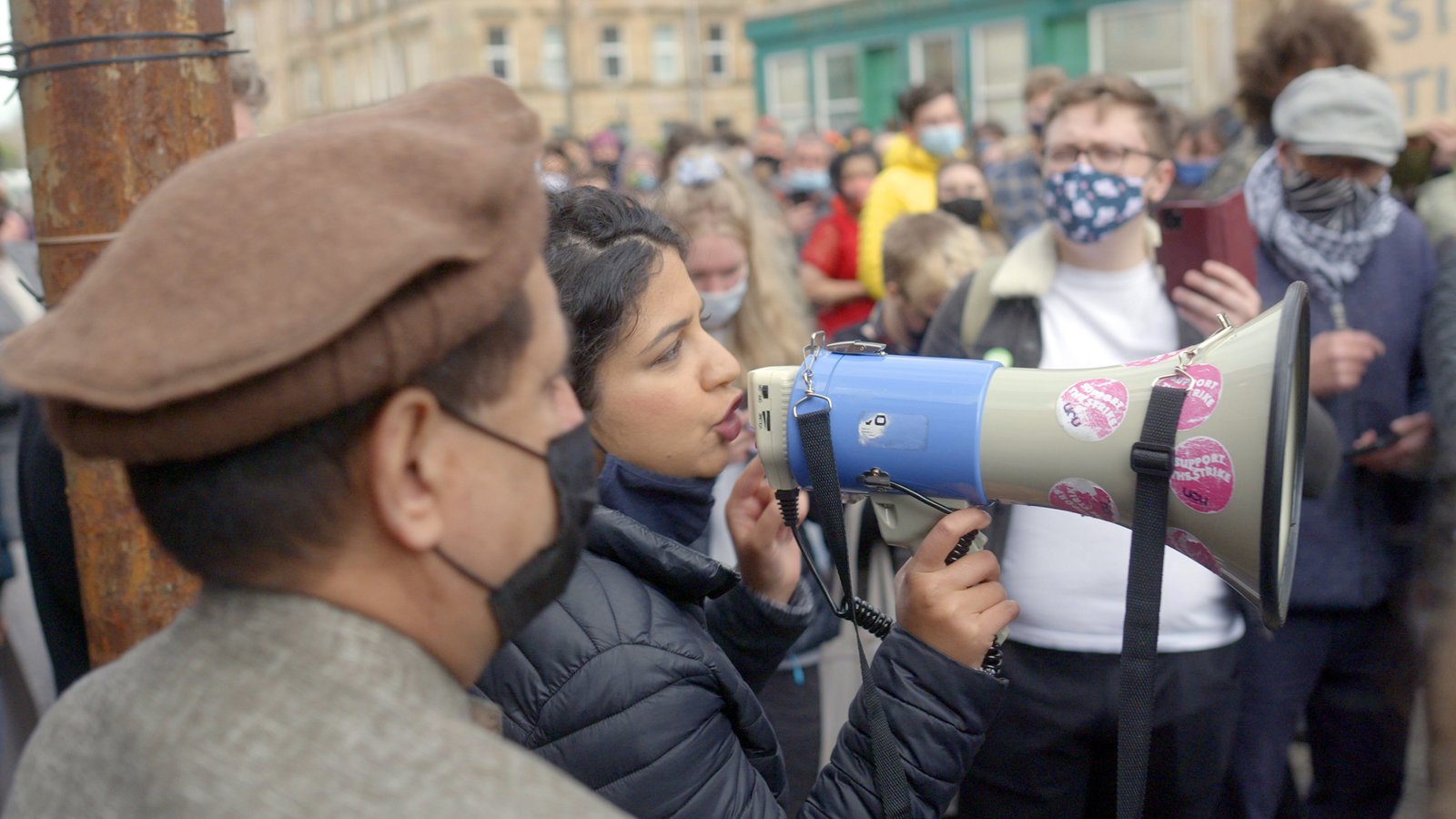
Everybody to Kenmure Street tells what at first seems like a David and Goliath story. In May 2021, a U.K. Home Office dawn raid in the Glasgow district of Pollokshields, one of Scotland’s most diverse neighborhoods, prompted local residents to rush to the streets to stop the deportation of two neighbors. “As word spread in the early morning of what was Eid celebrations for many locals, a handful of protestors swelled to hundreds of people, flooding Kenmure Street and making it impassable to the immigration enforcement van” that was looking to take away the two Sikh men of Indian origin, notes a synopsis. “The eight-hour stand-off madeinternationalheadlines as the community organized itself in an extraordinary act of peaceful solidarity.”
The film uses crowd-sourced footage from the day, along with archive film and “set-designed scenes” captured by cinematographer Kirstin McMahon, featuring actors “relaying verbatim the testimonies of contributors who wished to remain anonymous” (again, more on that later)
Bustos Sierra is a Chilean-Belgian filmmaker based in Scotland. His 2018 debut docNae Pasaran told the story of how a boycott of Scottish Rolls Royce factory workers helped end General Augusto Pinochet’s regime in 1970s Chile and won the best film honor at the BAFTA Scotland Awards.
Everybody to Kenmure Streetwas produced by Ciara Barry of Glasgow-based production company barry crerar, in association with Bustos Sierra’s Debasers Films. Mark Thomas of Screen Scotland served as executive producer alongside Thompson. The film also features an original score by Barry Burns of Mogwai.
“Everybody to Kenmure Street beautifully and powerfully demonstrates the innate and deep decency of our people whilst also highlighting the institutional mannerisms and structures that are the opposite of this,” Thompson says in the press notes for the doc, which she describes as an “urgent film.”
Bustos Sierra talked to THR about putting the spotlight on solidarity in a divided world, reliving a peaceful protest he missed by making a film about it, getting Thompson, Kate Dickie, and another Scottish actress involved in his doc, and what’s next for him.
When and why did you decide to make this film, and why did it feel so important to you?
It came out of personal curiosity because I lived 10 minutes away, and I received the message that most people there received that morning. It was a message with a picture of a van and a few people around the van. Looking back, it was just so difficult to see a positive outcome to that picture. There are just so many instances of police reaction to protests or crime events being so violent.
I grew up with solidarity movements. And I saw the footage that went viral the day when 10 million people saw the van doors opening up. There was something in my brain. I couldn’t believe that this happened, that this was reality, that it was so joyful, and that I had missed that when it was so close to me.
How did you end up getting all the footage we see in the film?
I was keeping track of the situation on social media. So, obviously, social media became our first source to find footage and build the spine of the film, visually.
The day after, I was on the streets talking to the people. It was COVID at the time, and lockdown was pretty strict in Glasgow, so there wasn’t much opportunity to do any real filming of proper interviews and sitting down with people in their flat. So I started just going for walks around the local park for months. That gave us a lot of time not just to talk about the mechanics of the day and how the day evolved, but also really figure out the bigger questions, such as: who has time for this type of thing in our lives? You know, we’re all trying to keep a roof above our heads, work in a place that doesn’t demean us, have a voice somehow and keep our family together. But in this case, you got this idea of people dropping everything for two people they know nothing about, just because they’ve been caught, and they find that abhorrent.
So those first few months of us not being able to make a film allowed us to make the film that it’s become, because it just created so much headspace to think about it, how to make it and what to ask.

‘Everybody to Kenmure Street,’ courtesy of barry crerar/Debasers Films
How did you get all the footage from the day for the doc?
Part of it was the organic process of getting to know people who were on the streets. Most of them were filming on the day just for social media, because its purpose at the time was to bring more people to the protests. I think nobody was really filming with the idea that this was for posterity. So, my editor Colin Monie and I had months of going through that frame by frame, saying: “There’s that person who is filming! How do we get to that person?” Or asking who has an angle of that same moment that is maybe better. We did that in batches as we were getting more funding.
We ended up doing a Kickstarter campaign. So most of the footage has been crowd-sourced. We’re very lucky that a couple of cameramen who lived in the area went to film with their smartphones and then realized there was something bigger happening. And they just went back and came back with [professional] cameras. So we have about 20 minutes of broadcast-quality footage.
[Spoiler warning: The next question and answer contain spoilers about some of the people featured in the film.]
Everybody to Kenmure Street was executive produced by Emma Thompson. And she also plays the man who decided to lie under the van to stop it from leaving. And then I saw Kate Dickie and Keira Lucchesi as well. How did they get involved?
As you can imagine, the character of “Van Man” became a bit of a mystical figure around Glasgow. And so by the time I got to talk to him, he had this issue. He said, “I was useful for 15 minutes, right? My power was basically being at the right place at the right moment when the two guys were being detained in their flats. It was a split-second decision. I’m just going to go under there and hold up the van and give time for more people to come.”
Eventually, the guys were released, and there was just so much joy around it, and he became this larger-than-life character. People just put people on a pedestal. And he was like: “I don’t want to be on a pedestal. I think anybody could have done this. It could have been a nice old lady. It could have been a 12-year-old boy. It could have been anyone. I don’t want my identity to be known and for it to become bigger than it was.”
And then there was this [off-duty] nurse who looked after him and brought him water and helped to keep him making all these movements and exercises so he wouldn’t go into shock. When I got to meet her, she said essentially: “I’m a nurse, sort of a public figure, and I want to be able to do this type of thing again. And I think if people know my face, it might make that more difficult.”
So it was very clear that I wanted to have their testimonies in the film, and show their personalities and give a sense of their defiance and their mischief, and also humor.

‘Everybody to Kenmure Street,’ courtesy of barry crerar/Debasers Films
I had an existing relationship with Emma Thompson. She’d seen my previous film, which was about solidarity for Chile from Scotland, and sent me a really lovely letter about how much she appreciated it. So we’ve been in conversation ever since.
And one of the things that I was really loving about making this film was the element of surprise that kept turning up, and people finding ways to buy time, take up space, diffuse attention. So having Emma Thompson was this WTF element that brings a sense of humor to it. And that mirrors Glasgow’s history of civil disobedience, which is steeped in really colorful people just finding solutions to their problems.
There’s a certain level of intimacy at times in the protest between people who didn’t know each other. So it was lovely to [express this sort of] moment of intimacy between Emma and Kate, where it almost feels like it’s the only thing that matters in that moment. And I think it’s something we would have missed out on. Kate lives in Glasgow and is from Glasgow, so she was well aware of the protest as it was happening. And Keira is also an actress in Glasgow. So it’s all very homegrown.
Yes, I haven’t been to Glasgow in years, but the film felt deeply rooted there, while at the same time touching on very timely and universal themes.
Yes. We’ve been making the film for four and a half years, and soon it will be five years since the protest. We felt maybe it might lose its resonance the further away from it we would get. But of course, sadly, we’re very aware that the topic of immigration is going to keep being brought back.
There has been this feeling in the U.K., in Scotland, that the police have at times been over the top in a way that maybe we’re not used to, but obviously it’s nothing compared to what Americans have to endure with ICE and the prevalence of guns.
I think in the times that we live in, everybody assumes that the film has a sad ending. But the people in Glasgow did not know that it was going to be a happy ending, and they turned up anyway.
What reactions have you received from Glaswegians about the film?
A guy told me, “I was at the protest, and I love the film. I realize that there’s so much of the day that I missed, even though I was at one end of the street. And I recognized so many people.” So I thought that some people are able to see themselves. It’s a bit like “Where’s Waldo?”
Do you know what film you will work on next?
There’s another act of protest, based in Scotland, that I’m looking at from the perspective of fictionalizing it.