No decision about Japan navy to Hormuz as Takaichi wins budget
Japan’s House of Representatives on Friday passed the FY2026 budget, setting the stage for a fight in the upper house — where the government lacks a majority — as opposition parties seek to delay the budget’s passage (they can’t block it indefinitely) and deal a political blow to Prime Minister Sanae Takaichi. The prime minister…
Japan’s House of Representatives on Friday passed the FY2026 budget, setting the stage for a fight in the upper house — where the government lacks a majority — as opposition parties seek to delay the budget’s passage (they can’t block it indefinitely) and deal a political blow to Prime Minister Sanae Takaichi.
The prime minister ducked a question about dispatching warships to the Persian Gulf. And the Bank of Japan looks likely to hold interest rates steady at its policy board meeting next week.
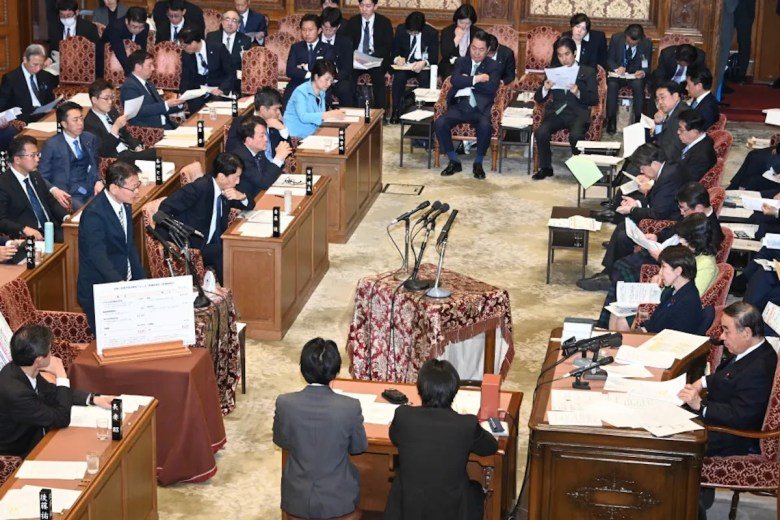
The ruling parties succeeded inpassingthe budget in the House of Representatives on Friday, 13 March, afterrejectingan opposition bid to delay a vote with a motion proposing to remove the budget committee chair. The lower house alsoapprovedbond issuance and tax reform bills.
The bitterness among lawmakers is palpable.Mainichidescribesone veteran lawmaker as so angry as to have been “ venting steam from their ears.” The lawmaker said, “In my long years this is the first time I’ve seen a Diet that was a like a runaway train.
The newspaper notes that the opposition is particularly angry not only at thecursory amount of time for debatebut also thelack of subcommittee meetingsfor the first time since 1989.
Opposition members have also criticized theprime minister’s avoidance of direct questioning, with cabinet ministers stepping in to answer even though the ruling and opposition parties agreed last year to reduce the amount of time cabinet ministers would need to be involved in budget committee deliberations.
Liberal Democratic Party (LDP) lawmakers may share the sense of unease about the government’s approach, but dissenting opinions have been all butsilenced.
In a sign of friction to come as the budget moves to the upper house,the Takaichi government did not receive votes from any of the opposition parties.
The Democratic Party for the People (DPFP), after itsofferto support the budget if the government scheduled the vote for next week was rejected by the ruling parties,opposedit. DPFP leader Yuichiro Tamakisaidthat the government was prioritiizing its “honor” – fulfilling a commitment to pass the budget before the end of the fiscal year – instead of pausing to acknowledge changing conditions and preparing a provisional budget that could address the situation in the Middle East while the Diet deliberated on the general budget at its ordinary pace.
Centrist Reform Alliance (CRA) leader Junya Ogawa, meanwhile, urged the government to take a humbler stance in its management of the legislature. Team Mirai, which had once hinted at the possibility of supporting the budget,joinedwith the CRA to file the dismissal motion against budget committee chair Tetsushi Sakamoto and voted against the budget.
Despite lacking a majority in the upper house, the government is determined to press on and pass the budget before March 31, ignoringwarningsfrom LDP officials that its approach in the lower house could not only jeopardize the budget in the upper house butcomplicate the legislative process beyond the budget.
Without a majority and with at most ten days of legislative business before the end of the fiscal year, the government has virtually no margin for error – and by not preparing a provisional budget, the government is going into the upper house deliberations next week with little room to compromise.Any delay will force a scramble to assemble a provisional budget. That would reflect poorly on the prime minister.
The LDP and the Constitutional Democratic Party (CDP) agreed Friday that debate would begin on Monday, March 16, but there are major questionshangingover upper house deliberations. Generally, the House of Councillors spends less time than the lower house – approximately 70%-80% as many hours – but with the lower house spending a historically short amount of time the opposition does not find that standard appropriate and wants at least sixty hours of deliberations.
For some budget-related bills – though not the budget itself – the government will also have to grapple with committees controlled by the CDP.The government’s best chance of succeeding is, of course, convincing an opposition party to support the budget, but after the process of moving it through the lower house there may not be an easy pathway to finding a partner among the opposition parties.
With the budget passed by the lower house, it will take effect on April 11 even if the upper house were to block it entirely; for the same reason, however, because Takaichi made passing the budget by March 31 a mark of her authority, she has given the opposition parties ample reason to resist in the upper house, particularly now that they want revenge for her disregard for parliamentary norms.
Takaichi: ‘Nothing has been decided’ about dispatching Self-Defense Forces to Hormuz

During the final round of questioning in the budget committee Friday,Prime Minister Takaichisaidthat “nothing has been decided” regarding the dispatch of Self-Defense Forces (SDF) ships to escort vessels in the Strait of Hormuz. She said that she intended to explain Japan’s position on the Middle East directly to US President Donald Trump in their summit on March 19.
Meanwhile,the Centrist Reform Alliance and its partner partiespetitionedthe government to take steps to ensure that safety and well-being of the crews of Japan-affiliated vessels– there are reportedly 59 – stuck in the Persian Gulf with Iran’s closure of the strait.
Bank of Japan will likely hold
Amid uncertainty about the economic impact of the US-led war against Iran,the Bank of Japan (BOJ)appearsunlikely to hike interest rates again when its policy board meets on 18-19 March.
The BOJ is by no means ruling out additional rate hikes – April remains possible, particularly once the full results of spring wage negotiations are in – butmarket volatility and uncertainty about the duration of the war and its impact on inflation could induce caution by the bankas it seeks clarity on the direction of Japan’s economy.
Meanwhile, in her post-cabinet press conference Friday, Finance Minister Satsuki Katayamawarnedthat with the yen nearing the JPY 160/USD threshold,the government could take any measure at any time to reduce the impact of a jump in crude oil prices.She also noted that finance ministry authorities are in “closer” contact with US authorities, alluding to the possibility of further joint efforts to stabilize exchange rates.
Tobias Harris’sJapan Foresight LLC originally published this article, which Asia Times is republishing with permission. For more information about Japan Foresight’s services or for information on how to sign up for a trial or schedule a briefing, visit its website orreach outto him.