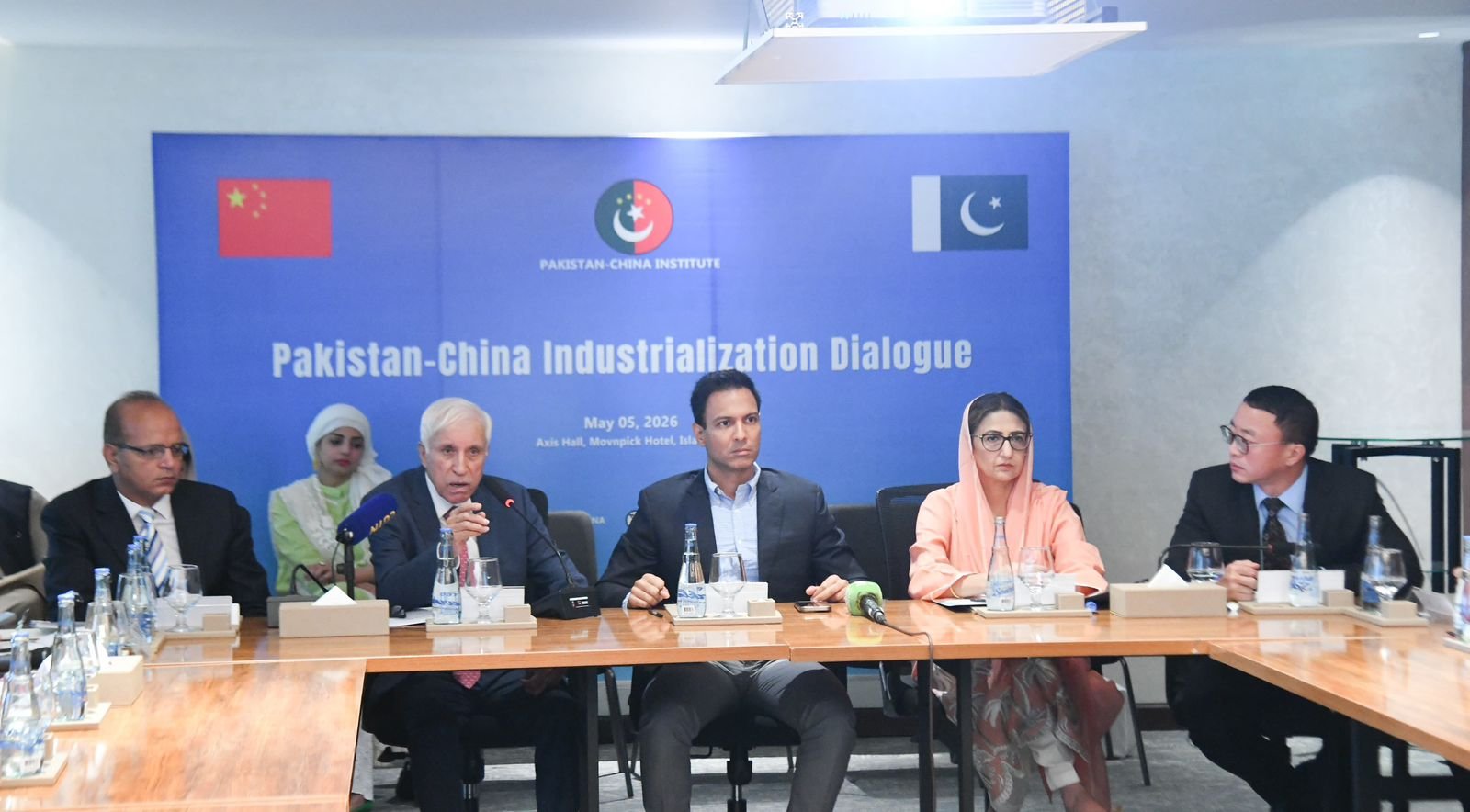
Qaiser Highlights B2B Export-Led Growth Strategy at Pakistan–China Industrialisation Dialogue
By Farzana Chaudhry | Lahore, PakistanISLAMABAD: The Pakistan–China Industrialisation Dialogue was held in Islamabad, bringing together policymakers, diplomats, business leaders, and development experts to chart the next phase of economic cooperation under the China-Pakistan Economic Corridor (CPEC).The session began with opening remarks by Mustafa Hyder Sayed, who welcomed participants and acknowledged the presence of Federal…
By Farzana Chaudhry | Lahore, Pakistan
ISLAMABAD: The Pakistan–China Industrialisation Dialogue was held in Islamabad, bringing together policymakers, diplomats, business leaders, and development experts to chart the next phase of economic cooperation under the China-Pakistan Economic Corridor (CPEC).
The session began with opening remarks by Mustafa Hyder Sayed, who welcomed participants and acknowledged the presence of Federal Minister for Privatization and Chairman Board of Investment Qaiser Ahmed Sheikh. He highlighted the transition of CPEC from infrastructure development in Phase I to industrialisation and business-to-business (B2B) collaboration in Phase II.
Speaking on the occasion, Qaiser Ahmed Sheikh said Pakistan and China share an “iron-clad friendship” and a common vision for economic progress. He noted that CPEC, initially valued at $46 billion in 2015, has grown into Pakistan’s largest foreign investment initiative, with around $30 billion already realized and over 261,000 jobs created.
He stated that Phase I of CPEC addressed major infrastructure gaps, including the addition of over 8,000 MW to the national grid and the development of extensive road networks, laying the foundation for industrial expansion. “Pakistan is now entering a decisive phase under CPEC 2.0, focusing on industrialisation, export-led growth, and stronger B2B partnerships,” he said.
The minister emphasized that Pakistan must transition from an import-driven economy to one based on value-added production and exports. He highlighted Special Economic Zones (SEZs) offering tax incentives, including income tax exemptions of up to nine years, aimed at attracting investment.
He also mentioned efforts to facilitate the relocation of Chinese industries to Pakistan to boost manufacturing capacity and exports. Referring to recent international engagements, he said overseas Pakistanis and foreign investors have shown growing interest in Pakistan’s economy, noting an improving global perception of the country.
Qaiser Ahmed Sheikh further outlined reforms by the Board of Investment, including regulatory simplification, the Business Facilitation Centre, and the “Asaan Karobar Act” to improve ease of doing business. He added that under the leadership of Prime Minister Shehbaz Sharif, Pakistan is prioritizing stronger economic ties with China, with a high-level visit expected this month.
Minister of State Dr. Shezra Mansab highlighted climate-friendly industrial cooperation and green development initiatives, while Chinese Counsellor Yang Guangyuan stressed cooperation in agriculture, IT, pharmaceuticals, and manufacturing, reaffirming China’s support for Pakistan’s industrial agenda under CPEC Phase II.
Qaiser Ahmed Sheikh also raised concerns regarding difficulties faced by Pakistani businessmen and tourists in obtaining Chinese visas, urging their resolution. In response, Chinese Counsellor Yang Guangyuan reiterated that Pakistan-China relations are “deeper than oceans and higher than mountains,” stating that doors remain open for Pakistanis due to the historic nature of bilateral ties.
The dialogue concluded with a reaffirmation of Pakistan and China’s commitment to industrial cooperation, export growth, and regional connectivity under CPEC Phase II.