Greening Pakistan Through Habitat Restoration by Pakistan Army & Houbara Foundation
By Muhammad Shahzad | Lahore, Pakistan LAHORE: Pakistan Army and Houbara Foundation International Pakistan jointly carried out the aerial broadcasting of seeds of desert plants over the Cholistan Desert this morning, marking the 28th consecutive year of the habitat restoration initiative. Wildlife habitats are being degraded across the world due to deforestation and the cutting…
By Muhammad Shahzad | Lahore, Pakistan
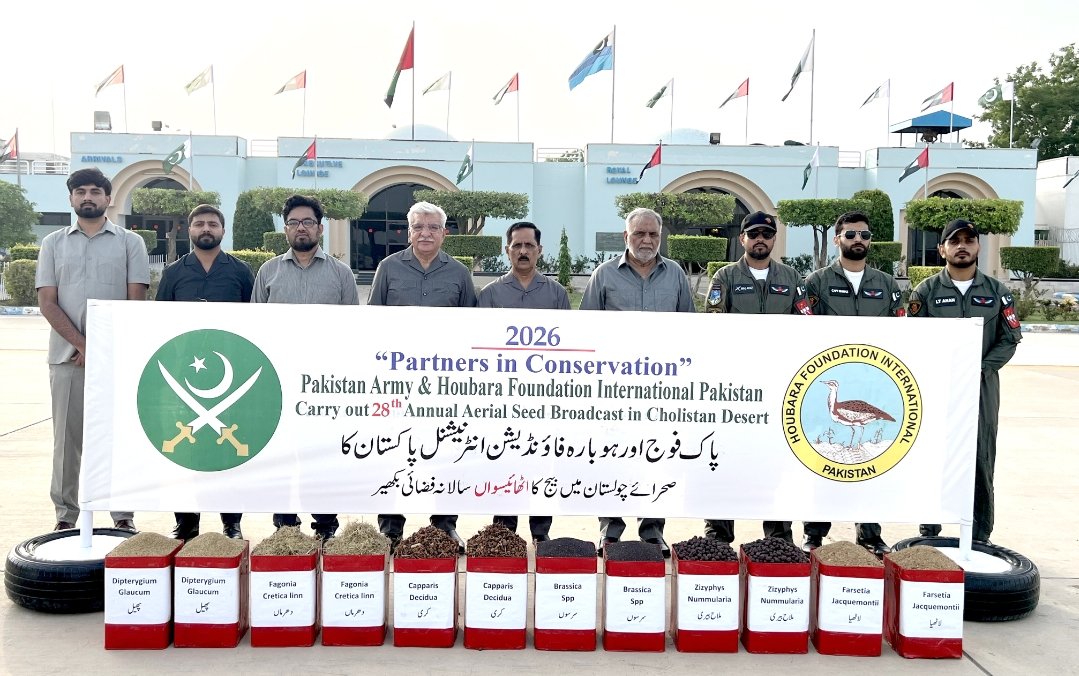
LAHORE: Pakistan Army and Houbara Foundation International Pakistan jointly carried out the aerial broadcasting of seeds of desert plants over the Cholistan Desert this morning, marking the 28th consecutive year of the habitat restoration initiative.
Wildlife habitats are being degraded across the world due to deforestation and the cutting of vegetation by local communities. As a result, wild animals and birds are increasingly facing shortages of their natural food sources, contributing to declining wildlife populations and ecological imbalances.
In 1998, Houbara Foundation International Pakistan, in collaboration with the Pakistan Army, launched an initiative to strengthen the diminishing vegetation of the Cholistan Desert through the aerial broadcasting of seeds of indigenous desert plants. The Cholistan Desert is an important wintering habitat for the Houbara Bustard and other wildlife species.
This year, 110 kilograms of seeds of indigenous plants and grasses were broadcast over the desert, taking the total quantity of seeds distributed through the initiative over the past 28 years to more than 3,437 kilograms.
Regular monitoring of the restored habitat has shown encouraging results, with improved vegetation growth and higher germination yields expected as the project continues.
Restoring an entire ecosystem is a long-term and challenging process. With the continued support of the Pakistan Army, Houbara Foundation International Pakistan aims to sustain the initiative, strengthen desert vegetation, restore ecological balance and support the growth of wildlife populations in the Cholistan Desert.
The initiative reflects the importance of collaborative conservation efforts in protecting Pakistan’s fragile desert ecosystems and preserving biodiversity for future generations.