Iran Reportedly Invited to Join Mecca Defense Pact
Amid Saudi-Houthi tensions, Iran has reportedly been invited to join the Mecca Defense Agreement signed by Saudi Arabia, Turkey and Pakistan, as Tehran weighs the prospect of a regional security framework.TEHRAN: Iran has reportedly been invited to join the Mecca Defense Agreement concluded on August 7 between Saudi Arabia, Turkey and Pakistan. The development was…
Amid Saudi-Houthi tensions, Iran has reportedly been invited to join the Mecca Defense Agreement signed by Saudi Arabia, Turkey and Pakistan, as Tehran weighs the prospect of a regional security framework.
TEHRAN: Iran has reportedly been invited to join the Mecca Defense Agreement concluded on August 7 between Saudi Arabia, Turkey and Pakistan. The development was first reported by Lebanese media outlet Al-Manar, and Pakistan’s Samaa TV said Tehran is currently weighing the offer.
Iran’s Foreign Ministry has not yet confirmed whether it received an invitation to join the mutual defense pact. However, Mehdi Rahimi, head of the Iranian parliament’s Khane Mellat news agency, said Iran has received an invitation to join the Mecca agreement and that the matter is under review.
Rahimi said countries in the region are seeking a regional security umbrella, calling the invitation “a win for Iran,” since Tehran has long pushed for such an arrangement. However, details of the invitation remain unclear, as Rahimi did not specify which country extended it, and no country has officially confirmed the development.
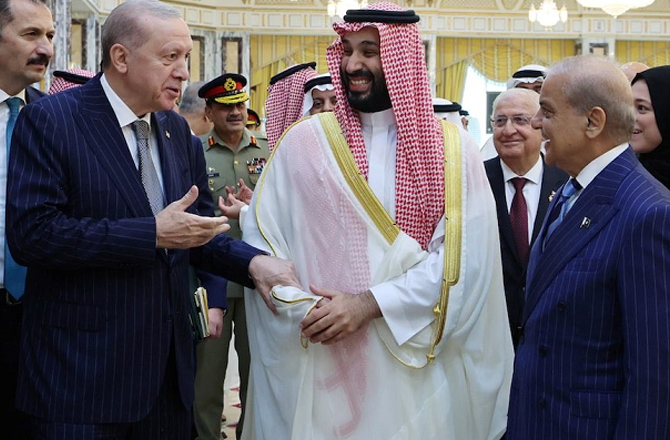
The Mecca Defense Agreement, signed by Saudi Crown Prince Mohammed bin Salman, Turkish President Recep Tayyip Erdogan and Pakistani Prime Minister Shehbaz Sharif, includes a NATO-style mutual defense clause under which an attack on one member would be treated as an attack on all.
Turkey has previously expressed publicly that it wants Egypt included in the pact, while Pakistan has said it does not want the agreement to become an exclusive club. However, the pact does not establish a NATO-style integrated military command and contains very few specific military commitments.
Meanwhile, Tehran has reacted cautiously to the alliance, seeking a regional security umbrella independent of Washington’s influence. Iranian Foreign Ministry spokesman Esmaeil Baghaei said on August 10 that Tehran has “no cause for concern” over the formation of the alliance.
Although the pact emerged from the US-Iran war crisis, regional analysts and Israeli security officials view it primarily as a deterrent against Israeli aggression — a sharp departure from the pre-war, US-brokered vision of a “New Middle East” in which ties with Israel were a central condition.
Notably, the Houthis are reportedly preparing to seize territory along the Bab al-Mandab Strait, potentially threatening this critical maritime route. Saudi Arabia relies entirely on Red Sea ports for its oil exports amid the Hormuz crisis, making the reported invitation to Iran particularly fraught, since the Houthis could become the alliance’s most immediate test. Analysts say for such inclusion to succeed, both Saudi Arabia and Iran would need to compromise on Yemen and the Houthi issue and exchange concrete concessions.