Trumps Donroe delusion
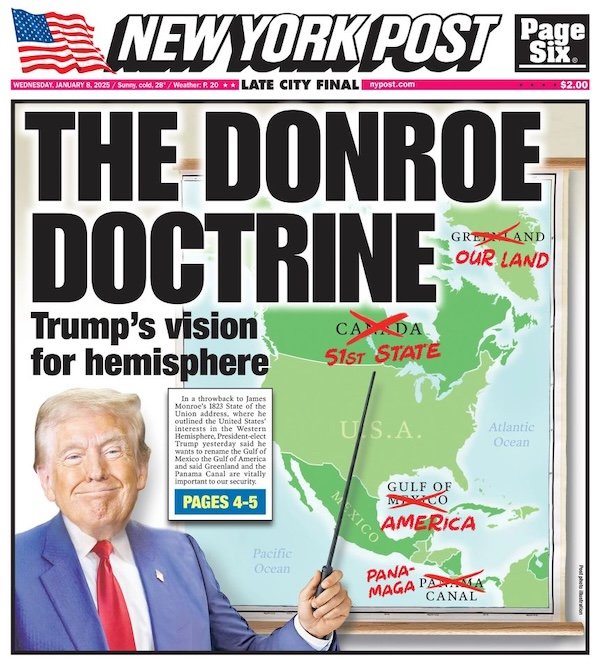
President Trump’s resurrection of the Monroe Doctrine – now rebranded as the “Donroe Doctrine” in an act of geopolitical ego-branding – represents yet another example of Washington’s chronic inability to adjust its strategic ambitions to the realities of American power in the 21st century. The president’s recent declaration of a “Trump Corollary” asserting that “the…
President Trump’s resurrection of the Monroe Doctrine – now rebranded as the “Donroe Doctrine” in an act of geopolitical ego-branding – represents yet another example of Washington’s chronic inability to adjust its strategic ambitions to the realities of American power in the 21st century.
The president’s recent declaration of a “Trump Corollary” asserting that “the American people – not foreign nations nor globalist institutions – will always control their own destiny in our hemisphere” might play well with nationalist sentiment at home, but it fundamentally misreads the economic and political dynamics that have transformed Latin America over the past three decades.
Let’s be clear about what we’re witnessing: This is a neo-imperialist vision that asserts the Western Hemisphere must be controlled by the United States politically, economically, commercially, and militarily. The problem is that such control is no longer available to Washington, regardless of how many aircraft carriers it deploys or how many tariffs it threatens.
The China reality
Consider the most glaring contradiction in Trump’s hemispheric strategy. The administration frames China as one of three primary threats in the region and explicitly aims to weaken China’s influence in the Western Hemisphere. Yet China is now the leading trade partner of every country in South America except Colombia. This isn’t the result of some nefarious Beijing plot – it’s the natural consequence of China’s economic rise and Latin American countries’ pursuit of their own national interests through economic diversification.
The irony is rich: Trump’s own trade policies have inadvertently strengthened China’s position. When the administration imposed tariffs on Chinese goods, China responded by halting purchases of US soybeans and buying them in Argentina instead. In attempting to reassert American dominance through economic coercion, Washington is actually accelerating the very trends it claims to oppose.
The infrastructure fallacy
Perhaps nothing better illustrates the strategic incoherence of the Donroe Doctrine than the call to push out foreign companies that build infrastructure in the region. Latin America desperately needs infrastructure investment. China has been willing to provide it. The United States has not matched this commitment with comparable resources or financing mechanisms.
What exactly is Trump’s alternative? Threats of military intervention? Tariffs on countries that accept Chinese investment? This is strategic malpractice dressed up as Monroe Doctrine nostalgia. In an age of interdependence, attempting to turn back the clock by blocking investment flows from extra-hemispheric powers is futile.
The intervention trap
The military dimension of the Donroe Doctrine is equally problematic. The administration’s National Security Strategy calls for targeted military deployments and strikes against cartels, and it hints at regime change in Venezuela. This is intervention-creep repackaged as border security and counter-narcotics operations.

History offers a harsh lesson here. The original Monroe Doctrine and its Roosevelt Corollary served as justification for US intervention in Cuba, Nicaragua, Haiti and the Dominican Republic. Those interventions created exactly the kind of instability, resentment and anti-American sentiment that undermines US interests today.
Does anyone seriously believe that bombing cartel targets or threatening Caracas will produce better long-term outcomes than Iraq and Afghanistan?
The sovereignty question
The deeper issue is one of legitimacy and consent. Hegemony requires cooperation from subordinate states that see benefits in the arrangement. Domination through military threats and economic coercion breeds resistance. Latin American nations have diversified their international links and benefit from trade, investment and financial cooperation from across the planet, and they’re not about to surrender that autonomy because Washington demands it.
Trump’s approach reflects a refusal to be apologetic for past US behavior that has long fed deep resentments against the United States. Rather than building partnerships based on mutual interest, the Donroe Doctrine doubles down on the assumption that American power alone can dictate outcomes in its “sphere of influence.”
A strategy for decline
The ultimate paradox is that the Donroe Doctrine, presented as a restoration of American strength, may accelerate American decline in the hemisphere. By treating Latin American countries as objects rather than partners, by demanding they choose between Washington and Beijing, and by threatening military action as a first resort rather than a last one, the United States is pushing regional actors toward exactly the kind of hedging and diversification strategies that will reduce American influence.
What Latin America needs – and what genuinely serves American interests – is not a revival of 19th-century imperialism with 21st-century branding. It needs a realistic partnership based on economic cooperation, development assistance and respect for sovereignty. That requires resources, patience and diplomatic skill – commodities apparently in short supply in an administration that prefers ultimatums to engagement.
The Monroe Doctrine was always more about American mythology than strategic effectiveness. The Donroe Doctrine appears destined to prove that when you add presidential ego to historical nostalgia, you get neither good history nor good strategy. You get overextension, backlash and the gradual erosion of precisely the influence you claim to be restoring.