Russias use of Oreshniks was a response to 3 recent provocations
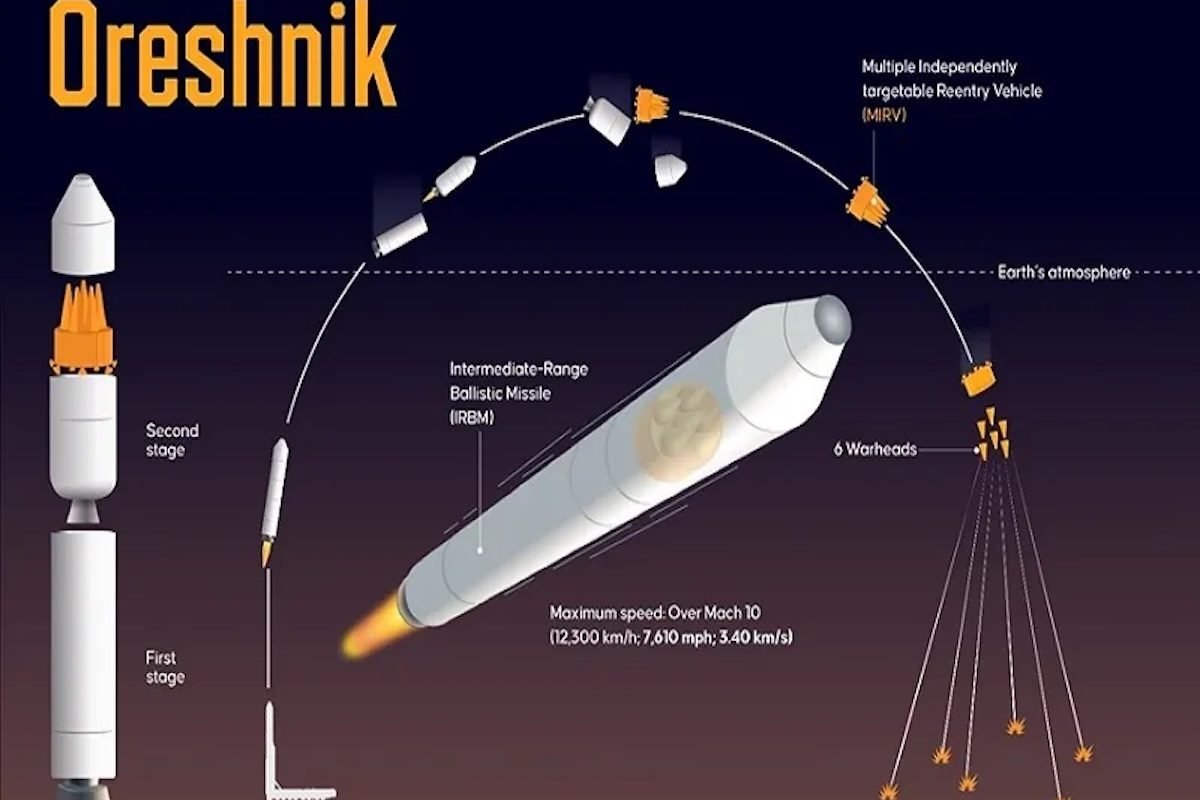
After several missiles were fired at targets in western Ukraine’s Lvov region, the Russian Defense Ministryconfirmedon Friday morning that its formidable new Oreshniks had been used – for only the second time. Reports indicate that the Stryigas fieldandgas storage facilitywere among Ukrainian targets that were hit. Thefirst useof the hypersonic Oreshniks, featuring hard-to-defend-against MIRV payload,…
After several missiles were fired at targets in western Ukraine’s Lvov region, the Russian Defense Ministryconfirmedon Friday morning that its formidable new Oreshniks had been used – for only the second time.
Reports indicate that the Stryigas fieldandgas storage facilitywere among Ukrainian targets that were hit.
Thefirst useof the hypersonic Oreshniks, featuring hard-to-defend-against MIRV payload, was in November 2024 after the US and UK allowed Ukraine to use their long-range missiles for strikes deep inside of Russia
Three recent provocations arguably were responsible for their second-ever use.
Moscow’s confirmationexplicitly mentionedthat Ukraine’s attempted large-scale attack against Putin’s residence in Russia’s Novgorod Region right before New Year’s was what prompted this retaliation.
Moving along, even though the Russian Defense Ministry didn’t mention any other recent provocations as being responsible for the country’s second-ever use of the Oreshniks, it can be reasonably argued that Putin probably had two others in mind, too, when he gave the authorization for this latest strike. These are:
Each is provocative in its own way.
Putin himselfwarnedas recently as September that Russia would deem Western troops in Ukraine “legitimate targets for destruction.” Although Russia’s Foreign Intellilgence Service (SVR) revealed later that same month that British and French troops were already in Odessa, that’s not comparable to the conventional deployment that those two have now committed to.
Even more concerning,US Special Envoy Steve Witkoff backed their plans, thus possibly making Russia wonder whether the US mightreverse its official positionthat Article 5 won’t extend to NATO troops in Ukraine.
As for the third provocation that Putin probably had in mind when he authorized Russia’s second-ever use of the Oreshniks, the United States’ seizure of a Russian-flagged tanker in the Atlantic carried the painful optics of Washington extraterritorially imposing its domestic law on Moscow.
If Russia didn’t send a strong message afterward – however indirect and asymmetrical the message might be – then the US might be emboldened to seize more of Russia’s “shadow fleet” elsewhere across the world including in the Baltic and Black seas.
These last two admittedly speculative motives behind the latest Oreshnik strike explain why targets in Lvov Region were hit instead of others anywhere else across Ukraine. Russia arguably wanted to show France, the UK and their shared US patron that it’s capable of swiftly hitting targets within NATO without detection if the need arises.
This could occur if an unprecedented crisis followed the first two’s planned troop deployment to Ukraine or the Americans’ hypothetical seizure of more Russian ships did the same.
Putin isalmost pathologically averseto escalating in Ukraine, due to the risk that it could spiral out of control into World War III, so it’s significant that he just authorized the second-ever use of the Oreshniks in spite of that.
He didn’t even do this after Ukraine’s “Operation Spiderweb,” which Trumpmight have known aboutin advance, targeted Russia’s nuclear triad last summer. This shows how seriously he’s taking Ukraine’s attempt to assassinate him and probably the other two provocations too.