Takaichi win expected as Japan campaign enters final, snowy day
The sixteen-day general election campaign enters its final day of campaigning with the country in the throes of heavy snowfall and plunging temperatures. The Japanese Meteorological Agencypredictsthat heavy snowfall will peak on election day, with anuncertainimpact on election day turnout. The snowfall leading up to election day already appears to have depressed early voting in…
The sixteen-day general election campaign enters its final day of campaigning with the country in the throes of heavy snowfall and plunging temperatures. The Japanese Meteorological Agencypredictsthat heavy snowfall will peak on election day, with anuncertainimpact on election day turnout. The snowfall leading up to election day already appears to have depressed early voting in snow country.
Prime MinisterSanae Takaichiwill spend the final day of the campaign in Tokyo, rallying alongside candidates in the closely contested capital — the margins of victory in 20 of 30 Tokyo constituencies were within ten points in 2024 — before holding a final night rally in Futako Tamagawa Park in Setagaya. Liberal Democratic Party (LDP) policy chiefTakayuki Kobayasbi and Defense MinisterShinjiro Koizumi, among her most in-demand surrogates, will be in Hokkaido, Tokyo, Chiba, and Kanagawa respectively.
Centrist Reform Alliance (CRA) co-leaderYoshihikoNoda will rally in six districts across Tokyo before holding a rally by the east exit of Ikebukuro Station. (Japanese Communist Party leaderTamura Tomokowill hold a rally on the west side of the station.)
In a frankly impressive feat of endurance, Democratic Party for the People (DPFP) leaderYuichiro Tamakiwill hold twenty rallies with DPFP candidates across Tokyo, culminating in his party’s favorite site at Shimbashi Station.
Sanseitō leaderSohei Kamiyawill campaign in Miyagi, Saitama, Gunma, Chiba and Kanagawa before a final night rally in Tokyo’s Shiba-koen.
Ishin no Kai, naturally, will conclude its campaign in Osaka.
Consensus on defense spending but not how to pay for it
There is a broad consensus across parties in favor of retaining higher levels of defense spendingaccordingtoNikkei’s candidate survey. Among the 1044 candidates who responded – out of 1284 total – 36% say that they favor keeping defense spending at roughly 2% of GDP, while another 22% favor raising it further. Only 21% want to reduce defense spending.
The LDP is mostly split between maintaining and raising spending, while Ishin no Kai is almost entirely in favor of raising defense spending. The DPFP is, like the LDP, split between the two positions. The Centrist Reform Alliance, meanwhile, has a miniscule percentage of candidates who want to go beyond 2% of GDP, with the remainder split between maintaining or reducing (and roughly half of the party’s candidates did not reply). However,other data shows that there is less of a consensus on how to pay for it: althoughAsahinotesthat while a majority [53%] of LDP candidates are willing to accept higher defense spending even if it mean a greater burden for taxpayers, only 10% of Ishin no Kai candidates agree.
The survey also asked candidates about their attitudes towards the Trump administration. While the second-most common response was “I cannot say,” nearly half of respondents agreed with the statement “We should criticize foreign policy actions that disregard the rule of law.” Only 47 respondents (5%) said, “We should support the Trump administration’s foreign policies [uncritically presumably]”; another 70 (7%) said “We should take an ambivalent stance towards matters that do not directly effect Japan.” Generally speaking, the more conservative the party, the greater the number of candidates who ducked the question.
An unwelcome endorsement?

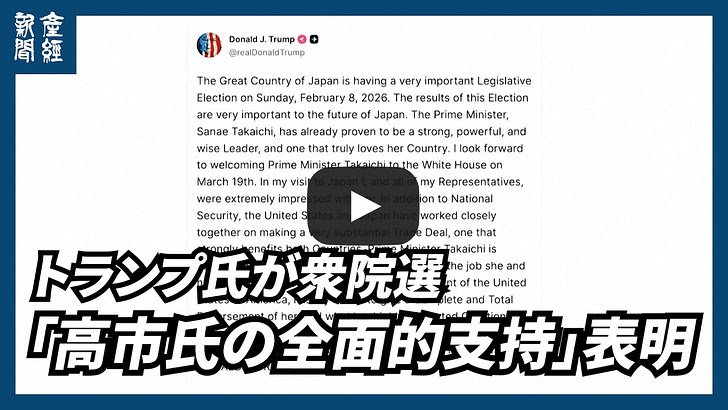
After US President Donald Trump posted an endorsement of Takaichi on social media – and casually mentioned that she wouldvisit the White House on March 19 –opposition candidates werequickto turn the message against the prime minister.
Centrist Reform Alliance (CRA) co-leader Yoshihiko Noda joked that Trump must be really fond of her to have posted such an unusual message just days before the election – and said that Trump’s assessment is premature since “she has not accomplished anything yet.”
Meanwhile, Japanese Communist Party (JCP) leader TomokoTamura saidthat it constituted “unacceptable interference in domestic affairs” and criticized the Takaichi government for being America’s “yes man.” She demanded that the Takaichi government protest the undue interference, saying that if she just passively accepts the endorsement, she will show that Japan is a “vassal state.”
A Foreign Ministry official told Kyodo that the gesture was “unwelcome,” putting the Japanese government in the difficult position of figuring out an appropriate response without looking like a lap dog.
Prime Minister Takaichi has overwhelminglyattractedmore eyeballs onlinethan any rival, including more than 100 millionviewsfor a video message posted on YouTube before the start of the campaign.

Longtime Japan politics and policymaking analystTobias HarrisheadsJapan Foresight LLC.
This article was originally publishedon his Substack newsletterObserving Japan.