With three contestants, the globes New Great Game is on
In the 19thcentury, Great Britain and Russia fought for control of the vast territory of Central Asia in a struggle known as the Great Game. Britain wanted to keep Russia away from India, its prime Asia colony, while Russia desired to expand its Tsarist empire southward. A similar contest is underway now, political analysts say,…
In the 19thcentury, Great Britain and Russia fought for control of the vast territory of Central Asia in a struggle known as the Great Game. Britain wanted to keep Russia away from India, its prime Asia colony, while Russia desired to expand its Tsarist empire southward.
A similar contest is underway now, political analysts say, although instead of a pair it involves a trio of powers playing what commentators call the New Great Game: the United States on one side versus China and Russia on the other.
The territories at issue are spread much farther apart than was the case in the original Great Game. Central Asia is once again a location, but the Middle East and parts of North America and East Asia are in play, too.
The adversaries’ primary goal is less the takeover of surface territory than gaining guaranteed access to riches beneath: fossil fuels and rare earth minerals, both of which are needed to power a burgeoning cyber economy worldwide.
Hardheaded leaders are avid participants. US President Donald Trump has become a hyperactive player. Just over a year into his latest term in office, he seems to focus on little else.
Twentieth century US presidents often justified foreign interventions in terms of defending democracies everywhere. Trump drops the democracy focus and instead favors a self-centered nationalism embodied in his favorite slogan, “Make America Great Again.”
If less loudly, China and Russia have also been active contestants with similar objectives – the striving for national greatness. Only American global hegemony stands in the way.
Specifically, Russia’s Vladimir Putin aspires to restore an imperial Russia that he sees as needed to make the country count in international affairs. Chinese leader Xi Jinping wants to take China into a “New Era” in which it supplants the US in power across the world.
The competition has broken down 80 years worth of global institutions designed to prevent the catastrophic warfare that had engulfed the 20th century world. “The axioms of the neoliberal order are rapidly being replaced by something closer to the law of the jungle,” noted Quillette, an Australian political and cultural journal. “In this world, increasingly naked self-interest will prevail over moral agendas.”
All the key participating countries are military powers, and China has made itself a major economic presence on every continent. Yet, the US has an advantage: its economic and military reach developed during and since World War II. Even China, with its impressive economic growth and investment in armed might, does not yet match America’s power and influence.
“The American sphere now stands alone,” Michael Beckley, a professor at Tufts University near Boston, wrote in Foreign Affairs magazine.
“China and Russia cannot consolidate control over their own regions, much less project sustained power into the United States’ backyard. They can intimidate neighbors and sow disruption, but their influence quickly runs into resistance and chokepoints. The result is not multipolarity but stark asymmetry: one consolidated American sphere.”
The Trump Administration seems to believe US power is unassailable. A statement made by Stephen Miller, a close associate of Trump’s and currently his deputy chief of staff, puts it in playground bully language:
“You can talk all you want about international niceties and everything else,” he recently told a TV interviewer. “But we live in a world that is governed by force, that is governed by power. These are the iron laws of the world.”
Take the current buildup for an attack on Iran. Trump has dispatched a variety of naval ships to the Persian Gulf, the Indian Ocean and Mediterranean Sea. The flotilla includes a pair of aircraft that carry dozens of jet bombers and are accompanied by other vessels armed with sea-to-shore and anti-aircraft rockets.
Trump initially attributed the buildup to anger over the deaths of Iranian demonstrators being shot down in by the Tehran government. He then left that issue behind and instead put a strategic spin on the operation.
He said Iran must end its efforts to produce nuclear weapons and also stop sponsoring anti-Israeli armed groups in Lebanon, Yemen and the Gaza Strip. Israel had already rained bombs to crush Hamas after Palestinian commandoes attacked southern Israel.
The Iranians fear that Trump at heart wants to overthrow or at least tame Islamic rule in Tehran. They have offered to talk about their nuclear program, which they insisted is for peaceful purposes. Everything else the Americans want is off limits.
Iran has pledged to strike back in case of an attack. It will launch missile attacks on US allies in the Middle East, including Arab countries along the Persian Gulf coast.
But Tehran may be playing a weak hand. Its defenses were heavily damaged last June during twelve days of Israeli bombing The attacks were in response to Iran’s support Hamas, the Palestinian Islamic movement that ruled the Gaza Strip, from which it attacked Israel on October 7, 2023. The US added a climactic rocket assault on an underground Iranian nuclear facility.
In the context of the New Great Game, the assault on Iran exposed the limits of Tehran’s alliance with Russia and China. Each had declared that it had a “strategic partnership” with Iran, which meant nothing when bombs fell on Iranian cities.
“Oft-cited warnings about declining US influence notwithstanding, recent events in the Middle East expose a more complex picture,” wrote Jonathan Roll, a researcher with the Hoover Institution public policy think tank at Stanford.
“From the perspective of International Relations balance-of-power theory, mild reactions by Russia and China represent a ‘dog that didn’t bark’ moment. Consequently, the US may enjoy greater freedom of action, at least in some contexts, than previously envisaged.”
China and Russia, as if to make up for their show of weakness, are sending ships to the Strait of Hormuz to join Iran in a naval drill. The strait is the narrow entrance to the Persian Gulf.
Iran’s defense ministry announced that the activity is designed “to test coordination, tactical readiness and rapid-response procedures in the strait.”
Russian officials lowered the temperature, saying only that Iran and Russia were holding a naval drill “to ensure the safety of civilian navigation.”
Russia’s and China’s benefits from their alliance with Iran are endangered.
Moscow sells weapons to Iran, which has returned the favor by supplying Russia with thousands of drones used to drop bombs on Ukraine. But regime change in Tehran probably would cost the Russians a customer.
Iran is a customer for Chinese-made weapons, too. More important are Iran’s oil exports, which provide 14% of China’s annual needs. They are sold at cut-rate prices, in gratitude for Beijing’s willingness to breach economic sanctions imposed on Iran by the US, the European Union and the United Nations. A docile Iran freed from sanctions might end the deliveries and sell elsewhere.
Revenue from China’s purchases amounts to about 80% of Iran’s export earnings.
China has been constructing a road through Iran to carry freight to and from the Middle East. It would ease access to Europe through the Red Sea as well as to Africa, avoiding US ships that patrol the Indian Ocean. The project is part of Xi Jinping’s Belt and Road Initiative, a program meant to encourage infrastructure development and trade with partner countries.
Iran might make the road a dead end if if the country falls under American tutelage.
There’s a Central Asia angle, as well. Washington had already been trying to gain influence east of Iran in Central Asia. Trump’s predecessor, Joe Biden, had launched an economic cooperation program meant to rival Belt and Road. The grouping includes the five nations that make up Central Asia: Kazakhstan, Uzbekistan, Tajikistan, Kyrgyzstan and Turkmenistan.
Under Trump, the US is busily signing contracts to gain access to rare earth minerals mined in the region.
Washington’s newfound attention suits most Central Asian countries that are eager to balance Russian and Chinese influence in the region. Some are worried about Russia’s possible appetite for control by force.
Putin set a worrying example when his list of Russia’s justifications for invading Ukraine included persecution of ethnic Russians who live there. Tens of thousands of ethnic Russians also live within the borders of Uzbekistan and Kazakhstan. Kazakhstan criticized Russia’s invasion of Ukraine.
Last year’s seizure of Venezuela’s President Nicolas Maduro by a team of US commandos, which put Iran on guard, also sent a message to Russia and Beijing as Trump officials boasted of having ended the drive by Moscow and Beijing to make Venezuela a strategic Caribbean client.
Russia and China provided military weapons to the Maduro government. Last year, China bought about 400,000 barrels of oil a day from Venezuela, about 4% of Chinese petroleum needs. As it does in Iran, China paid sub-market prices in its own yuan currency.
Trump said the US will control development and sales of Venezuelan oil “indefinitely.” Its not clear whether oil will be sold the China and under what conditions.
Trump carried out “an audacious move in Venezuela and came out of it with flying colors,” said Mark Jones, an expert on Venezuela at Rice University in Texas. “What Venezuela signaled is that, when the Trump Administration says it will remove or kill a target, that threat now carries more weight. Credibility is central to the threat of force.”
The Venezuela foray was Trump’s way of asserting traditional US dominance of the Caribbean, and by extension, all of Latin America. For him, and many of his supporters, that means controlling the Panama Canal.
The US built the canal, and its locks that carried ships over mountains, before World War I. In 1977, President Jimmy Carter agreed to give the waterway to Panama. The handover occurred in 1999.
In 2016, China inaugurated a pair of wider additions to allow behemoth freighters to pass through the canal.
Last year, China took what, in Trump’s eyes, was a step too far. China closed a deal with a Hong Kong company to take over two ports, one at each end of the canal. Aides to Trump viewed the move as a way for China to set up a military and espionage presence at the canal.
While the purchase was still pending, Trump sent Secretary of State Marco Rubio to Panama to advise the government that China’s presence at the canal constituted a “direct threat” to US security. Secretary of War Pete Hegseth visited Panama City last year, warning that the US will keep the canal “free from foreign interference.”
In January, the Panamanian Supreme Court annulled the purchase. The ports were later sold to American buyers.
China reacted furiously. It called the cancellation “shameful and pathetic” and warned that Panama will pay “heavy prices both politically and economically.”
Trump may not be finished. He has banned oil shipments from Venezuela to Cuba. Suddenly, Cuba is running out of fuel. Even before the crisis, the island already suffered from massive power outages due to its inability to pay for energy imports. People were sifting trough garbage to look for food; now there are no scraps worth picking, a Havana resident told Asia Times.
Trump hasn’t said exactly what he wants to get from Cuba. Invasion was unnecessary, he said, because the country is in such bad shape it is “ready to fall” by itself. The Cuban government says it is willing to negotiate to find ways to ease the economic blockade the US had long imposed on the country, but nothing else.
Trump has concurrently set his sights 60 degrees of latitude north of Havana, on the Arctic Ocean. Russia and China have been holding naval maneuvers in the frigid waters. In the face of such activity, Trump thinks both NATO and Denmark, which administers Greenland, have underestimated the strategic value of the giant island.
Trump said he wanted to buy it but, if it’s not for sale, to simply take it over. Denmark, a NATO ally of the US, was horrified. It rejected Trump’s demand to buy it and offered to talk about defense issues. After a theatrical arrival of a clutch of NATO soldiers on Greenland, the issue faded, and talks were to take place. Now he has added a new element: an offer to send a US Navy hospital ship.

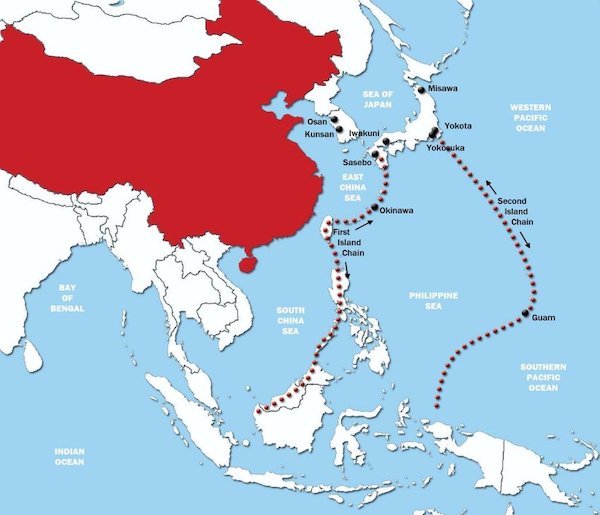
Finally, Trump has moved gingerly into countering China’s own New Great Game maneuvers. Beijing’s primary goal is to take over Taiwan. But US officials say it also seeks to dominate waters in the Taiwan Strait and intimidate Japan and the Philippines, both of which are pieces of the so-called “first island chain” opposite China’s coast.
China has fortified its multiple maritime claims with concrete aggressive action, especially against Taiwan, which China claims as its own.
Since Xi’s rise to power in 2013, and especially intensively from 2022, China has carried out stealth “gray zone” acts of sabotage and disinformation aimed at unsettling the government and population of Taiwan. Here’s a paratial list of those hostile if low-intensity activities:
- From 2016 to mid 2020, Chinese military incursions numbered less than 100, according to numbers compiled by the Institute for Regional Security, an Australian think tank.
- In response to Taiwan’s 2020 reelection of President Tsai Ing-wen, candidate of the separatist-minded Democratic Progressive Party, the China’s Peoples Liberation Army Air Force quickly carried out 380 incursions into Taiwan airspace.
- The next year, the number of incursions increased to 972.
- By 2022, they jumped to 1,737, carried out by a whopping 1,714 individual jets.
- The 2024 presidential election of Lai Ching-te was greeted by ‘”ustice Mission 2025,” an air and sea drill that simulated a blockade of Taiwan. It was the biggest-ever show of force aimed at the island ever.
War rhetoric has also become commonplace. In 2023, Defense Minister General Li Shangfu warned: “If anyone dares to split Taiwan from China, the Chinese military will resolutely safeguard China’s national sovereignty and territorial integrity, at all costs.” President Lai was labeled a “dangerous separatist,” an upgrade from charges lodged against previous DPP leaders of being simply separatist.
Beijing has laid claim to an oval semi-circle of reefs and islets ringing the Taiwan Strait that make the passage a Chinese owned seaway. In 2023, a pair of Chinese jets shadowed a US and Canadian warship passing through the strait.
Farther afield, the China Coast Guard spent 335 consecutive days in the waters around the Japanese-administered Senkaku Islands, which Beijing calls Diayu. Confrontations also took place between China Coast Guard ships and South Korean vessels in the Yellow Sea. Chinese aircraft frequently challenge Australian and Philippine air patrols.
“The evolution of Chinese efforts,” warned the Institute for Regional Security, “suggests that more aggressive measures, including military border incursions, threats of force, and large-scale drills, are increasingly coming to the fore.
“It is essential not to underestimate the risk of a Chinese military attack on Taiwan, as Russia’s invasion of Ukraine in February 2022 unequivocally demonstrated. Traditional warfare is here to stay.”
Sam Mullins, a researcher at the Inouye Asia-Pacific Center for Security Studies in Hawaii, said China is using “military intimidation, economic pressure, cyber and information operations and calibrated shows of force from the Senkaku Islands to the Tasman Sea” aimed at “reshaping the regional order and exposing the faults of fragmented, reactive deterrence.”
Trump made his first stab at challenging China in its backyard when his admiistration signed a $40 billion military weapons sale with Taiwan.
The proposed transaction enraged China. Its Defense Ministry complained: “The ‘Taiwan independence’ separatist forces, at the cost of the safety and well-being of Taiwan compatriots, use the hard-earned money of ordinary people to fatten US arms dealers in an attempt to ‘seek independence by relying on military force’.”
Joe Biden had saved for Trump the problem of trying to get allies to defend against a possible China threat. South Korea and Japan increased defense spending and the US is beefing up its presence in the Philippines. The actions caught Xi’s attention. He accurately called the actions an effort to “contain” China.