Danantara at one: promise, peril and vexing questions
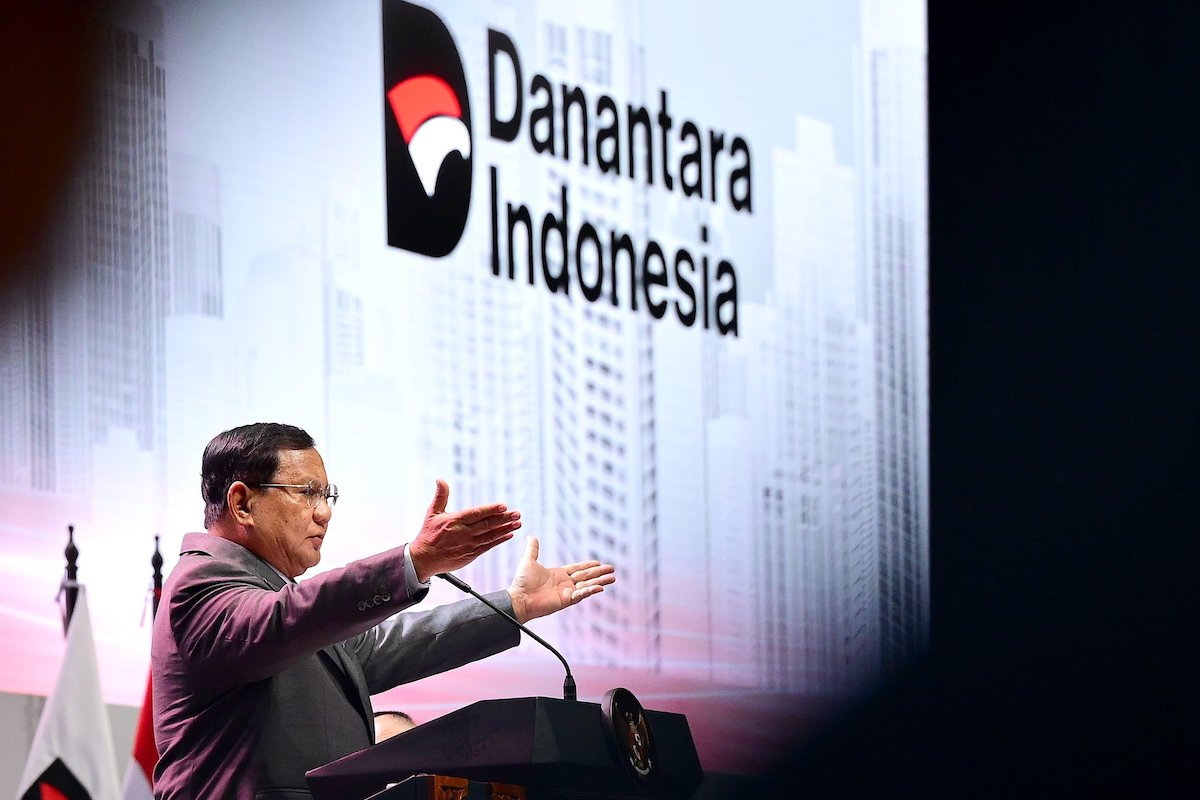
This month’s celebration marking the first anniversary of the Daya Anagata Nusantara Investment Management Agency, better known as Danantara, became a stage for Indonesian President Prabowo Subianto to showcase a set of numbers that, at first glance, appeared revolutionary. In his speech, the president claimed that the performance of state-owned enterprises under Danantara’s coordination had…
This month’s celebration marking the first anniversary of the Daya Anagata Nusantara Investment Management Agency, better known as Danantara, became a stage for Indonesian President Prabowo Subianto to showcase a set of numbers that, at first glance, appeared revolutionary.
In his speech, the president claimed that the performance of state-owned enterprises under Danantara’s coordination had surged dramatically, with net profits rising fourfold compared with 2024.
Born as perhaps the most radical institutional experiment in Indonesia’s modern political economy, Danantara was designed as a “super-holding” that pulls strategic assets away from sectoral ministries and places them under a single command structure.
The ambition is sweeping: to consolidate more than 1,000 state-owned entities—from parent companies down to multiple layers of subsidiaries—in order to eliminate the bureaucratic inefficiencies long blamed for holding back growth. Yet behind the triumphant narrative lies a set of anomalies that merit careful scrutiny.
On one hand, the government celebrates extraordinary gains in efficiency. On the other, the restructuring concentrates an enormous amount of economic power within a single institution directly accountable to the president.
The central question is whether the reported performance surge reflects a genuine transformation in corporate professionalism or merely an accounting illusion created by restructuring momentum.
The consolidation also raises concerns about deeper state dominance in the economy, potentially triggering a “crowding-out” effect that sidelines the private sector in domestic markets.
After one year in operation, Danantara has sent mixed signals to capital markets and to Indonesia’s fiscal outlook. Although the share prices of several strategic state firms—such as Krakatau Steel and PT Timah—soared by hundreds of percent throughout 2025, investor sentiment remains cautious.
Uncertainty lingers over the sustainability of corporate debt and the transparency of governance within a body that now controls assets worth thousands of trillions of rupiah. Danantara stands at a crossroads, it could evolve into a genuine engine of growth or become a fortress protecting the intertwined political and economic interests of elite groups.
The exponential illusion
One of the headline claims in Danantara’s first-year report is the dramatic rise in return on assets (ROA), which is said to have increased by more than 300% compared with the period before the institution began operating.
Such a figure warrants skepticism. Much of the apparent surge can be explained by a classic low-base effect: prior performance levels among state-owned enterprises were extremely weak due to inefficiencies and social mandates imposed by the government.
When Danantara consolidated balance sheets and unified financial reporting, the statistical jump in profitability became almost inevitable. The striking percentage increase is therefore largely the result of administrative restructuring rather than a reflection of a fundamental expansion in real business activity.
President Prabowo has set ambitious targets for the institution. Danantara is expected to achieve a minimum ROA of 10%—considered the benchmark of a “great company”— while the current target sits between 5-7%. If those goals are met, Danantara is projected to contribute around US$50 billion, or roughly 800 trillion rupiah, annually to the state treasury.
Fiscal realities, however, reveal a significant gap. The government aims for 150 trillion rupiah in annual dividends from state firms, yet the ten largest contributors currently generate only about 107.7 trillion rupiah, leaving a shortfall of roughly 42.3 trillion rupiah.
Without substantial value creation from subsidiaries and lower-tier affiliates, the 800 trillion rupiah contribution target risks becoming little more than a political aspiration that places heavy pressure on corporate management.
Criticism of Danantara’s efficiency drive also extends to its streamlining process. Through Danantara Asset Management, overlapping state enterprises have been merged or liquidated to simplify corporate structures. While this approach may strengthen balance sheets, its implications for employment remain unclear.
The government promises that Danantara will generate millions of jobs, yet operational efficiency often runs counter to large-scale labor expansion in industrial and service sectors. Without the creation of new strategic business units, aggressive efficiency measures could actually narrow economic opportunities for the broader public.
Who reaps the windfall?
During its first year, Danantara launched around 18 to 20 national strategic projects with investment commitments reaching hundreds of trillions of rupiah. The focus is largely on mineral downstream processing, renewable energy, and food security.
Among the flagship initiatives are a 60 trillion rupiah aluminum smelter project in Mempawah and a 16 trillion rupiah bioaviation fuel facility in the Cikarang–Karawang industrial corridor. The rationale behind these ventures is pragmatic: ensuring that mineral value-added remains within Indonesia and reducing dependence on imported fossil fuels.
Yet the most contentious aspect of Danantara’s expansion is the extensive involvement of Indonesia’s leading conglomerates, particularly through a financing instrument known as “Patriot Bonds.”
These bonds have reportedly raised 51.75 trillion rupiah from 46 prominent Indonesian tycoons. Major business figures—including Anthoni Salim, Prajogo Pangestu, Sugianto Kusuma of Agung Sedayu Group, and Franky Widjaja—have each pledged investments of around Rp3 trillion.
Although the initiative is framed as an expression of “economic patriotism,” the partnership also deepens the symbiotic relationship between state power and large-scale private capital.
One illustration is the 13.4 trillion rupiah caustic soda plant project, developed through collaboration between Danantara, the Indonesia Investment Authority, and Chandra Asri, a company linked to Prajogo Pangestu. Such arrangements have raised concerns that strategic state projects may increasingly become arenas dominated by a small circle of politically connected business elites.
Another controversy surrounds the “Indonesian Hajj Village” project in Mecca. Danantara secured an 80-hectare land concession in the Jabal Hindawiyah area to develop facilities estimated to generate 2.5 trillion rupiah annually. The initiative aims to redirect spending by Indonesian pilgrims—traditionally captured by Saudi service providers—toward state-owned enterprises.
Critics argue, however, that overseas property acquisitions may represent a misplaced priority for an investment agency that should focus primarily on building domestic industrial capacity.
Meanwhile, the awarding of waste-to-energy projects in Bekasi and Denpasar to Chinese companies such as Wangneng Environment and Zhejiang Weiming has ignited debates over technological sovereignty and the long-term fiscal risks associated with service fee guarantees embedded in the projects.
Shadow of economic centralization
Danantara’s transformation has also reshaped the legal architecture governing state-owned enterprises. Law No. 1 of 2025 explicitly adopts the Business Judgment Rule (BJR), granting legal protection to directors and managers against criminal corruption charges for business losses, provided decisions are made in good faith and with due diligence.
In theory, the doctrine is intended to empower executives to take strategic risks without fear of criminalization by law enforcement authorities. In practice, however, Indonesia’s political economy remains vulnerable to systemic corruption.
Critics worry that such legal immunity could evolve into a protective shield, allowing incompetence or even misconduct to be justified as business risk.
Public concerns are further reinforced by governance structures that blur the line between regulator and operator. The presence of active ministers in supervisory roles, alongside former presidents in advisory positions, injects a strong political dimension into Danantara’s leadership framework. The fact that key executive posts are simultaneously held by serving government officials deepens fears of potential conflicts of interest.
This dual role has drawn criticism for potentially violating Indonesia’s laws on ministerial responsibilities and weakening institutional checks and balances. A minister tasked with regulating a sector can hardly be expected to exercise independent oversight over investment operations within the same domain. Such arrangements risk undermining the institution’s credibility in the eyes of global markets.
The consequences may already be emerging. Fitch Ratings recently revised Indonesia’s sovereign outlook to negative, citing concerns partly related to Danantara’s ambitious spending plans and the possibility of new debt burdens that could strain fiscal stability.
Financial markets are also wary of a potential crowding-out effect, as large-scale Danantara projects could absorb significant banking liquidity, making it harder for private firms and small businesses to access financing. Danantara claims to have implemented 27 governance policies aligned with international standards. Yet public audit transparency remains a crucial requirement that has not been fully satisfied.
In essence, Danantara’s first year reflects the state’s sweeping ambition to break through bureaucratic inertia and push economic growth toward eight percent. History, however, repeatedly shows that bold institutional leaps without robust accountability often end in painful failure.
If Danantara continues to operate under the shadow of political patronage and excessive legal immunity, it risks becoming not the “Daya Anagata”—the power of the future—promised to the Indonesian people, but rather a mechanism for the concentration of wealth among a narrow circle of elites.
Strong oversight from civil society will therefore be essential to ensure that this vast pool of national assets does not drift into opaque management. Independent audits and full transparency in the use of public funds must be enforced without compromise if the promise of professionalism is to mean anything beyond ceremonial rhetoric.
One year may be only the beginning, but the direction of the wind is already visible. Danantara must move swiftly to resolve conflicts of interest involving ministerial roles and open its governance to genuine transparency.
Without these reforms, the institution risks repeating the troubled history of centralized state asset management—where power accumulates at the top while accountability steadily erodes. What the public now awaits is not dazzling percentages in financial reports, but tangible economic benefits shared far beyond a privileged few.
Ronny P Sasmita is a senior international affairs analyst at the Indonesia Strategic and Economics Action Institution, a Jakarta-based think tank.