How the Aston Martin F1 Team Turned a Cultural Phenomenon Into Engagement Gold
In 2018, Formula One‘s social media footprint sat at a healthy 18.7 million followers. A large portion of today’s grid were just making a name for themselves in the fastest motorsport competition in the world —others were still, well, children — and only around 13 percent of that global fanbase was under the age of…
In 2018, Formula One‘s social media footprint sat at a healthy 18.7 million followers. A large portion of today’s grid were just making a name for themselves in the fastest motorsport competition in the world —others were still, well, children — and only around 13 percent of that global fanbase was under the age of 35.
In 2025, F1’s social following sits at well over 100 million, and the number of F1 fans under the age of 35 has tripled. Want to take a guess which genre-defining Netflix docuseries hit our screens around seven years ago?
Drive to Survive put F1 —once considered an exclusive sport, geared towards men and expensive to follow —on our doorstep. The show, following each of the 10 teams around the globe through the soap opera politics, high-speed thrills and Real Housewives-esque fallouts that shaped the sport, is now deemed one of the most successful docs of all time; an Emmy-winning piece of television with a cumulative 700 million viewers.
What the teams have done since is some of the shrewdest business ever brokered in sports history. “F1 is a cultural phenomenon. It transcends sport,” begins Rob Bloom, chief marketing officer at Aston Martin Aramco Formula One team. “It’s entertainment on a global level and I think it’s done that better than any other sport in the last decade, largely driven by [U.S. media conglomerate] Liberty Media and their approach, which is very fan-first. But I also think that teams are further driving that agenda.”
Aston Martin is owned by billionaire businessman Lawrence Stroll, who pioneered the team’s 2021 rebrand after some years known as Racing Point. It is now the fastest-growing team on the grid. Per Nielsen, Aston Martin —fronted by two-time drivers’ champion Fernando Alonso and younger talent Lance Stroll — now has a total fan tally of 454 million, up 68 percent from five years ago. “There was the Drive to Survive era,” continues Bloom. “[But] we really want to be the team that says: Look at what Aston Martin’s done to take that opportunity and run with it.”
And run with it they have. Aston Martin’s fans are now younger than the F1 average, according to the team’s data: over half (54 percent, to be exact) are under the age of 35, compared to an average of 44 percent for the rest of the grid. As if the numbers couldn’t get any more impressive, nearly a third of Aston Martin’s fans are women; a demographic accelerating faster than the cars and one that the team are unpatronizingly and actively pursuing.
So what’s the strategy? Put simply, Aston Martin’s marketing branch are doing cultural collabs like no other team. By pulling the brand into music, fashion and film, they’re making good use of the now thousands of global brands desperate to get in on the frenzied —and lucrative —F1 action (see: Apple and Brad Pitt, who are around $629 million richer after the release of F1: The Movie).
Among some of Aston Martin’s more recent pair-ups are events with Nigerian singer-songwriter Tems, a merchandise pop-up in London with The Rolling Stones and a Miami house party, headlined by Aussie DJ Dom Dolla, for 700 fans in Wynwood. One of the more buzzier collabs, a team-up with Pixar’s Toy Story announced last week, has limited-edition Aston Martin helmets, hoodies, and mini Buzz Lightyears up for grabs to “get outside of that sporting story.” Continues Bloom: “It’s about us driving that agenda of how we can embrace newer, younger fans and give them opportunities to engage in the sport and Aston Martin in unexpected ways.”
This kind of cultural literacy outside of the sport has allowed Aston Martin to seduce fans who might otherwise have deemed F1 an out-of-reach experience. And what’s really got the ball rolling is the celebration of their female fanbase through first-of-its-kind collabs in beauty and social media.

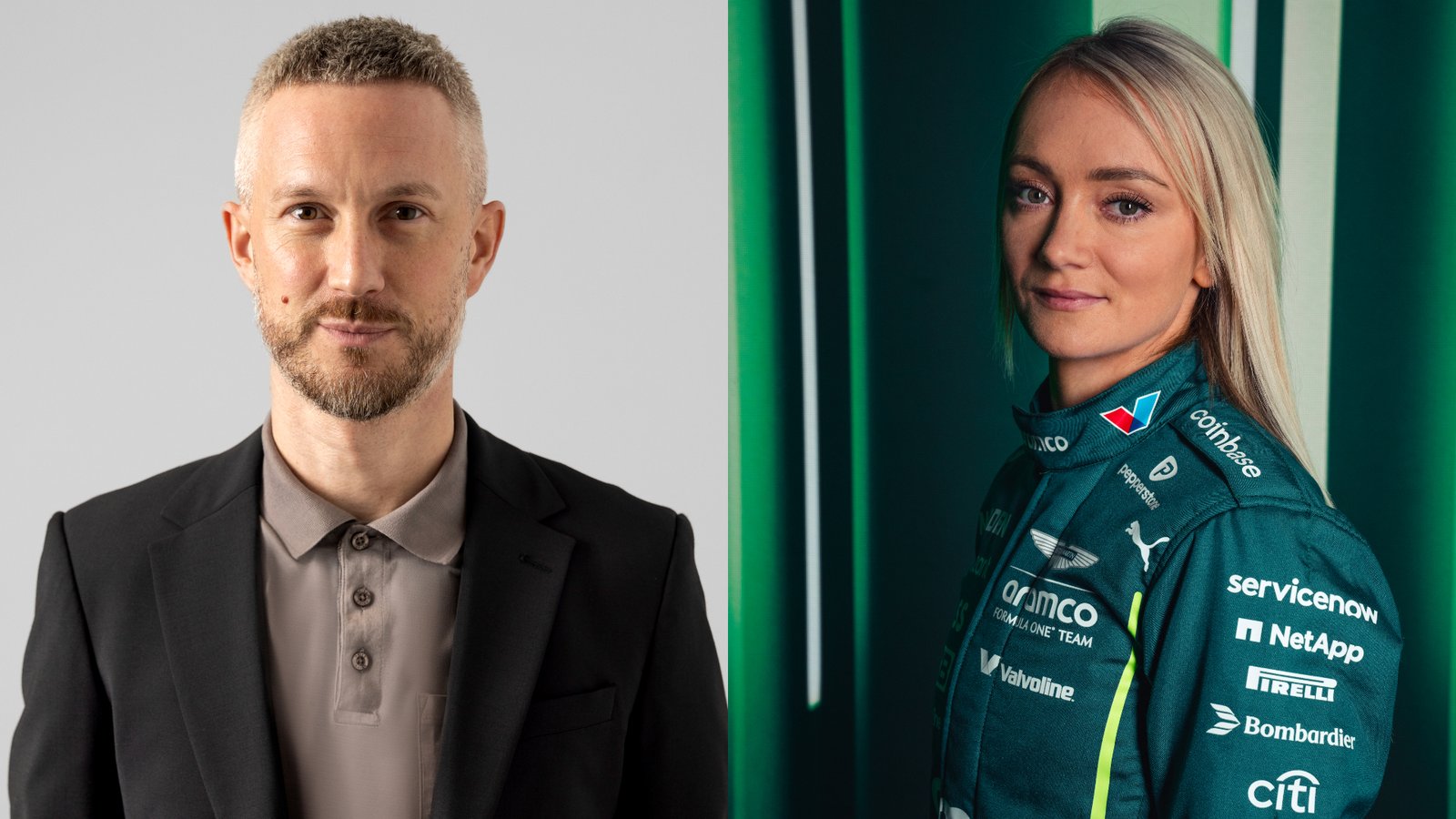
Rob Bloom (L) and Jessica Hawkins for Aston Martin.
Aston Martin Aramco F1 Team
Earlier this year, Aston Martin made British brand ELEMIS its first official skincare partner, kicking off a multi-year partnership that blends the science of skincare with the high-performance world of F1. “These are global consumer brands who are recognizing that the sport has this broader appeal to a newer, younger, increasingly female audience,” beams Bloom. “But if they’re going to partner with the team, they’re choosing Aston Martin, because we’re showing up in far more interesting ways.”
“Us announcing ELIMIS… That was a breakthrough moment,” says Jessica Hawkins, Aston Martin’s head of F1 Academy and driver ambassador, and the face of the ELIMIS deal. “It was a really nice touch to see my two worlds colliding —my world as a woman that is interested in skincare along with my passion and my sport. The two have, typically, never been aligned, but I think that just shows how far the sport has come.”
Hawkins was the first woman to drive a modern F1 car in almost half a decade. After an early foray into single-seater racing, she switched to stunt driving before joining W Series, the all-female motor racing championship that had its last season in 2022. Hawkins is in her sixth year with Aston Martin and, among other responsibilities, mentors the team’s F1 Academy driver, the 19-year-old star of Netflix’s F1: The Academy series Tina Hausmann.
“If I think back to how I started, [it’s] because I saw [people karting] in the distance one day, and I begged my dad to let me have a go,” says Hawkins about paving a path in motorsport as a woman. “If I hadn’t seen that kart circuit in the distance and asked my dad to let me have a go, would he have taken me karting? The answer is probably no —not because he’s a bad dad, but because maybe I was female and he presumed that I wouldn’t be interested in motorsport. It was seen as such a male-dominated spot. Which it still is, to some degree. But,” she continues, “we’re a lot further forward than what we were a few years ago. I think that women are starting to see Formula One and realize that it’s a sport for them as well.”
At an Aston Martin pop-up in July last year in honor of the British Grand Prix, hundreds of fans were asked to come grab an “Aston Matcha” —the internet’s new favorite drink, a bright green powder made from tea leaves —and a gift bag while inspecting a real F1 car in the middle of Covent Garden, one of London’s busiest tourist hotspots. Around 70 percent of attendees were women.
A week later, Aston Martin dropped AMR25 Exact Match: a world-first collaboration with nail polish brand Glaize for fans to pick up a nail gel matching the vivid racing green of the team’s beloved car. The inspiration? The 30-odd billion views on a TikTok hashtag called #nailtok.
“What’s really important to me is that the whole team is dialed into what’s happening in culture right now,” says Bloom about building a team that’s tapped into trends, viral crazes and the ever-noisy social media conversation. “It doesn’t mean that I personally have to be across everything, but I really want the team to be coming forward saying, ‘Look, I’m seeing this. I’m hearing this. This has just happened in the world around us —here’s an opportunity.’”
“We’re getting brilliant feedback from our fans,” he continues, lauding the team’s partnerships with TikTok and the app’s top creators (the 44-year-old Alonso, by the way, was crowned Spain’s best public figure on TikTok at an awards ceremony in 2023). “The response to the Toy Story drop was amazing on social media, and it’s all contributing towards us being the fastest-growing fan base in Formula One.” Granted, the on-track success “hasn’t kicked in,” says Bloom, but significant new regulations coming into play 2026 have the entire team decidedly confident.
For Hawkins, a driver still in touch with the young girl that begged her father to let her go karting, Aston Martin is exactly where she wants to be. “We’re leaving a positive change [wherever] we go,” she tells THR. “We’re always at the forefront, and they’re putting the trust in women to do it.”