Perseid meteor shower: When, where and how to catch a glimpse
Maddie Molloy Climate and science reporter Getty Images Stargazers will soon be treated to what could be one of the year’s most dazzling displays, with the Perseid meteor shower reaching its peak on Tuesday night. The shower lights up the skies each summer, and is known for its bright, fast-moving meteors – often dubbed “shooting…
Climate and science reporter

 Getty Images
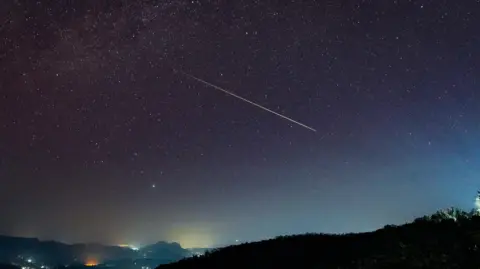
Stargazers will soon be treated to what could be one of the year’s most dazzling displays, with the Perseid meteor shower reaching its peak on Tuesday night.
The shower lights up the skies each summer, and is known for its bright, fast-moving meteors – often dubbed “shooting stars”.
However, visibility could be affected by bright moonlight from the recent Sturgeon Moon, making it harder to see the fainter streaks.
The Perseids are visible to the naked eye – but local weather will play a major role, so check your forecast before heading out.
What is the Perseid meteor shower?
Meteor showers occur when Earth passes through trails of dust and debris left behind by comets or asteroids.
The Perseids come from a comet called Swift–Tuttle, which orbits the Sun once every 133 years.
The comet’s dust particles enter Earth’s atmosphere at speeds of about 37 miles (59 kilometres) per second.
As they do so, they burn up, creating the bright flashes we call meteors.
The Perseids have been observed for nearly 2,000 years, with some of the earliest records from ancient China.
They are named after the constellation Perseus, from which the meteors appear to originate.
How and when can you watch the Perseids?
The peak night for the Perseids in 2025 falls on 12–13 August.
Meteors tend to increase after midnight, with the best viewing just before sunrise, though some may be visible as earlier in the night.
But this year the peak coincides with a bright Sturgeon Moon, which reached its full phase on 9 August and will still be quite luminous during the peak.
“This year’s peak unfortunately lines up with a full moon meaning even in dark sky areas it will be impossible to see the full 100 meteors per hour,” said Finn Burridge, science communicator at the Royal Observatory Greenwich.
“However, [the Sturgeon Moon] is no reason not to go out and enjoy the shower – it is still likely that you will see at least 1 or 2 fireballs per hour, even with a full moon,” he added.
For darker skies, consider viewing on nights between 16 and 26 August, though meteor activity will be lower.
“Dates nearer to the shower’s peak offer the best chance, but this also coincides with the full moon,” said Mr Burridge.
“After the full moon is more likely the better time to view, since the Moon will rise later in the night, so I would recommend the peak nights as well as weekend of 16 and 17 August,” he added.
Mr Burridge gave a few tips to “maximise your chances of seeing a shooting star”.
- Make sure you can see as much of the sky as possible, with no buildings, trees, or hills blocking your view.
- Lie on your back and look upwards, as meteors can appear anywhere in the sky.
- View from somewhere away from the bright lights of towns or cities – but make sure you have some water, a charged phone, and that you have told someone where you are going.
- Be patient. The more time you spend outside, the more likely you are to see one. It takes at least 20 minutes of dark conditions for your eyes to adapt to the dark.
Will the weather cooperate?
Tuesday will be hot during the day for much of the UK, and overnight temperatures into Wednesday are likely to be above average too.
The current forecast suggests there should be clear skies for large areas of the country, although clouds could build through the night in some places.
Check BBC Weather for the forecast in your area.