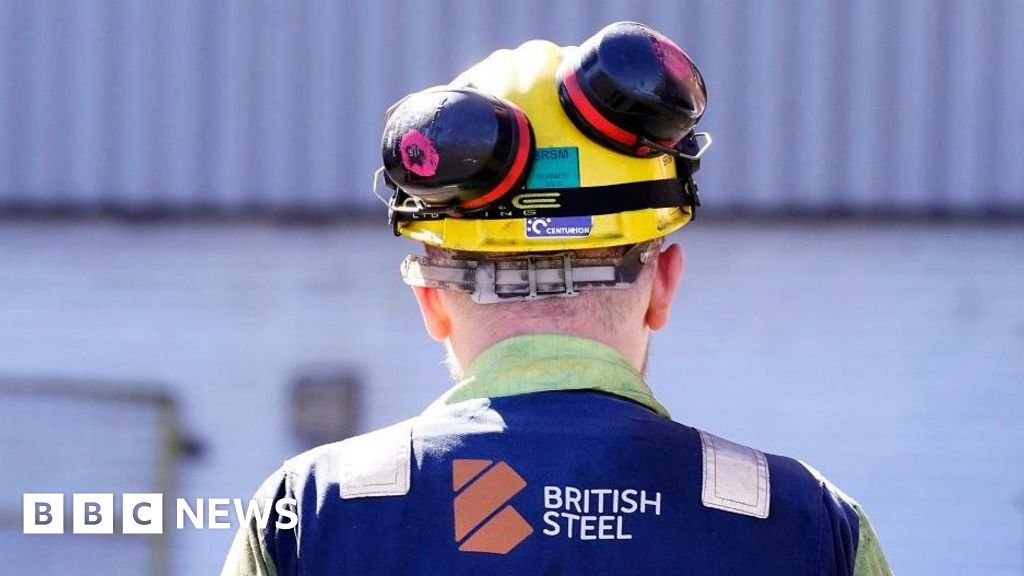
UK says British Steel's Chinese owners demanding millions

Similar Posts

  • 14 terrorist facilitators held in KP’s Bannu locality operation: police

    Amid a spate of terrorist and quadcopter attacks, police on Friday carried out a search and targeted operation alongside security forces in Hoveed and Wazirabad areas of Khyber Pakhtunkhwa’s Bannu, arresting “14 terrorist facilitators and destroying three hideouts”.

    Over the past few months, multiple areas of KP — including Bannu, Peshawar, Karak, Lakki Marwat and Bajaur — have seen a series of attacks, particularly targeting police personnel in Bannu in July.

    Bannu police spokesperson Khanzala Quraishi said in a statement: “Pakistan Army and police conducted a joint operation in Hoveed and Wazirabad areas based on intelligence inputs and arrested 14 facilitators of the banned organisation, while 3 hideouts of terrorists were demolished.”

    Quraishi added that the operation was carried out on information about the presence of terrorists in Wazirabad and Tudonar along the Tuchi River, where five suspected targets were cleared. Security forces also seized three vehicles, which included two motorcycles and a rickshaw.

    “Joint patrols were also conducted in Hoveed Bazaar and its surroundings to ensure the presence of security forces in the area,” the police spokesperson added.

    In a statement issued earlier today, Quraishi had said: “This operation has been launched on the basis of intelligence reports, the main objective of which is to cleanse the area from the scourge of terrorism and establish lasting peace.”

    The operation began at 5am on Friday, according to Quraishi, and was launched on the instructions of Regional Police Officer Sajjad Khan under the supervision of District Police Officer Saleem Abbasi Kalachi.

    “During the operation, security forces and police personnel have completely surrounded the area and house-to-house searches are ongoing,” the statement said.

    “In case of any suspicious activity or resistance, immediate and effective action is being taken so that the terrorists do not get any chance to escape or hide.”

    A curfew was imposed in the area during the duration of the operation for the sake of public safety, and citizens were advised to cooperate with security agencies and stay indoors.

    “Immediately report any suspicious person or activity to the relevant authorities,” the statement read.

    “Authorities have warned that providing any kind of facility or assistance to terrorists is a serious crime, and strict legal action will be taken against such elements.”

    Last week, a police constable was martyred in a terrorist attack on a checkpoint in Bannu, where an exchange of fire also left three terrorists dead and three policemen injured.

    In July, ter­rorists used a quadcopter to attack a police station in Miryan, Bannu, making it the fifth such attack at the installation in a month.

  • Variety Seeks Submissions for 2025 Screenwriters to Watch List

    Hosted in 2025 by New Mexico’s Santa Fe International Film Festival, the annual impact list Screenwriters to Watch, which identifies notable up-and-coming film screenwriters, is seeking submissions for 2025. Past honorees include Nora Garrett (“After the Hunt”), Julian Breece (“Rustin”), Marcus Gardley (“The Color Purple”), Justin Kuritzkes (“Challengers”), Samuel D. Hunter (“The Whale”), Stefani Robinson…

  • Defence minister rubbishes Indian air chief’s ‘comical’ claims of downing 6 Pakistani aircraft in May conflict

    Defence Minister Khawaja Asif on Saturday rubbished what he said were “implausible” and “comical” claims by the Indian Air Force chief that the country had shot down five Pakistani fighter jets and one other military aircraft during clashes in May.

    The comments are the first such statement by the Indian side three months after its worst military conflict in decades with its neighbour. During the conflict, Pakistan said it downed five Indian planes in air-to-air combat on May 7, later stating that figure as six. India’s highest-ranking general has also acknowledged that its forces suffered losses in the air, but denied losing six aircraft.

    Speaking at an event in the southern city of Bengaluru, Indian Air Chief Marshal Amar Preet Singh claimed: “We have at least five fighters confirmed killed, and one large aircraft,” adding that the large aircraft, which could be a surveillance plane, was shot down at a distance of 300 kilometres.

    He alleged that most of the Pakistani aircraft were downed by India’s Russian-made S-400 surface-to-air missile system. He cited electronic tracking data as confirmation of the strikes.

    Singh did not mention the type of fighter jets that were downed, but claimed that airstrikes also hit an additional surveillance plane and “a few F16” fighters that were parked in hangars at two air bases in Sindh and Punjab. “This is actually the largest ever recorded surface-to-air kill,” he insisted.

    Responding to the claims in a post on X, the defence minister said: “The belated assertions made by the Indian Air Force chief regarding alleged destruction of Pakistani aircraft during Operation Sindoor are as implausible as they are ill-timed.

    “It is also ironic how senior Indian military officers are being used as the faces of monumental failure caused by strategic shortsightedness of Indian politicians. For three months, no such claims were voiced — while Pakistan, in the immediate aftermath, presented detailed technical briefings to the international media, and independent observers recorded widespread acknowledgment of the loss of multiple Indian aircraft, including Rafales, by sources ranging from world leaders, senior Indian politicians to foreign intelligence assessments.”

    Asif said that “not a single Pakistani aircraft was hit or destroyed” by India, adding that Pakistan took out six Indian jets, S400 air defence batteries and unmanned aircraft of India while “swiftly putting several Indian airbases out of action”.

    He added that the losses on the Line of Control for Indian armed forces were “disproportionately heavier” as well.

    “If the truth is in question, let both sides open their aircraft inventories to independent verification — though we suspect this would lay bare the reality India seeks to obscure. Wars are not won by falsehoods but by moral authority, national resolve and professional competence.

    “Such comical narratives, crafted for domestic political expediency, increase the grave risks of strategic miscalculation in a nuclearised environment,” he warned.

    The defence minister iterated that every violation of Pakistan’s sovereignty and territorial integrity would invite “swift, surefire and proportionate response, and responsibility for any ensuing escalation will rest entirely with strategically blind leaders who gamble with South Asia’s peace for fleeting political gains”.

    Former envoy Dr Maleeha Lodhi said the Indian air chief’s claim was “laughable”, noting that it took him “several months to count the planes to make this ridiculous assertion!”

    Meanwhile, Indian Congress spokesperson Pawan Khera said when questioned about the matter: “The question we have after today’s information … when we had such a strong army and we were advancing then under whose pressure did you stop Operation Sindoor?”

    American South Asia expert Michael Kugelman opined that “regardless of whether true or not, the timing of these claims, with US-India ties in crisis, is easy to understand.”

    Pakistan, with the Pakistan Air Force (PAF) primarily operating Chinese-made jets and US F-16s, has previously denied that India downed any aircraft during the May 7-10 fighting between the nuclear-armed neighbours.

    New Delhi had previously claimed it had downed “a few planes”. United States President Donald Trump has echoed the figure of “five jets” shot down during the military confrontation, albeit without specifying which side’s craft he was referring to.

    Indian Prime Minister Narendra Modi’s government has faced scathing criticism from opposition parties for its lack of “political will to fight” during the May clashes and “failures” to prevent the Pahalgam attack.

    The May conflict was sparked by New Delhi’s allegations against Islamabad, which were without evidence and strongly refuted by Pakistan, about a deadly attack in occupied Kashmir’s Pahalgam. After the May 7 combat and tit-for-tat strikes on each other’s airbases, it took American intervention on May 10 for both sides to finally reach a ceasefire.

    France’s air chief, General Jerome Bellanger, has previously said that he has seen evidence of the loss of three Indian fighters, including a Rafale. The Indian Air Force has not commented on those claims.

    Days after the air combat, The Washington Post, based on visual evidence analysed by experts, reported that at least two French-made Indian fighter aircraft were shot down by the Pakistan Air Force.

    According to The Wire, India’s defence attache to Indonesia, Indian Navy Captain Shiv Kumar, while speaking at a seminar in June, acknowledged that the PAF downed the Indian fighters.

    During his presentation at the event, Kumar had acknowledged the loss of Indian planes. According to Kumar, Indian fighter jets were “operating under strict political orders from the Modi government not to target Pakistani military installations or air defence systems”, The Wire reported.

    “This self-imposed limitation by the government was intended to prevent escalation of conflict in a nuclear environment,” the outlet added, quoting the Indian officer.

    India’s intelligence failure was central to the hour-long air battle between Pakistan and India, which led to the downing of Rafale aircraft by the Pakistan Air Force’s J-10 fighters using PL-15s missiles, according to a report.

    Reuters interviews with two Indian officials and three of their Pakistani counterparts found that the performance of the Rafale wasn’t the key problem: central to its downing was an Indian intelligence failure concerning the range of the China-made PL-15 missile fired by the J-10 fighter. China and Pakistan are the only countries to operate both J-10s, known as Vigorous Dragons, and PL-15s.

    The faulty intelligence gave the Rafale pilots a false sense of confidence that they were out of Pakistani firing distance, which they believed was only around 150km, the Indian officials said, referring to the widely cited range of PL-15’s export variant.

    “We ambushed them,” the PAF official said, adding that Islamabad conducted an electronic warfare assault on Delhi’s systems in an attempt to confuse Indian pilots. Indian officials dispute the effectiveness of those efforts.

    “The Indians were not expecting to be shot at,” said Justin Bronk, air warfare expert at London’s Royal United Services Institute think-tank. “And the PL-15 is clearly very capable at long range.” The PL-15 that hit the Rafale was fired from around 200km away, according to Pakistani officials, and even farther according to Indian officials. That would make it among the longest-range air-to-air strikes recorded.

  • New signs found of giant gas planet in ‘Earth’s neighbourhood’

    Georgina Rannard Science correspondent NASA, ESA, CSA, STScI, R. Hurt (Caltech/IPAC) An artist’s drawing of what the new planet might look like. Our Sun is the small dot of light between the two bright stars on the left and right. Scientists have found strong evidence of a giant gas planet in the nearest star system…