IMF staff deal reached, investment-led growth now priority: FinMin | The Express Tribune
Aurangzeb, Malik stress focus on emerging sectors, tech, innovation for inclusive growth Finance Minister Muhammad Aurangzeb warned that Pakistan’s economic stability faces two of its greatest challenges, unchecked population growth and climate change, calling them “existential threats” that demand immediate and sustained policy action. Speaking at the ninth edition of The Future Summit (TFS) in…
Aurangzeb, Malik stress focus on emerging sectors, tech, innovation for inclusive growth
Finance Minister Muhammad Aurangzeb warned that Pakistan’s economic stability faces two of its greatest challenges, unchecked population growth and climate change, calling them “existential threats” that demand immediate and sustained policy action.
Speaking at the ninth edition of The Future Summit (TFS) in Karachi, Aurangzeb said the government was steering the economy towards an investment-driven model led by the private sector, rather than one dependent on borrowing.
He spoke about his recent visits to Washington, where he met with officials from the World Bank and the International Monetary Fund (IMF). He appreciated recent diplomatic efforts with Saudi Arabia, the United States, and other partners, describing them as steps toward stronger bilateral and economic cooperation.
Aurangzeb announced that Pakistan has reached a staff-level agreement with the IMF for its second loan review, with the board expected to approve the next tranche in early December.
He underlined that geopolitical shifts were reshaping the global economy. “The role of the private sector and productivity-led growth is vital for building resilience in the world economy,” he noted. He said investor confidence was improving, adding, “Our direction is right.”
Read:Floods vs Economy: WB warns Pakistan’s FY26 growth at risk
Aurangzeb said fiscal reforms had advanced steadily over the past 18 months, with new measures under way to expand the tax base using artificial intelligence to strengthen revenue collection. “Oursugar sector is now digitised, and the cigarette sector will follow,” he said, adding that 900,000 new taxpayers had been registered. The policies will expand to other sectors as well.
The finance minister confirmed that Google had decided to open an office in Pakistan and was also considering the country as an export hub, reflecting growing global confidence in Pakistan’s tech ecosystem.
Aurangzeb said a blockchain centre had been established at the Lahore University of Management Sciences (LUMS) through a USD 13 million private investment, as part of the government’s broader push toward emerging technologies and digital infrastructure for AI-led growth.
He also mentioned that Egypt had shown interest in adopting Pakistan’s reform model, while the privatisation of Pakistan International Airlines (PIA) remained on track for completion by the end of the year. A recent UAE investment in a Pakistani bank, he said, marked “the beginning of a new era.”
He also noted interest from Egypt in adopting Pakistan’s reform model, while the privatisation of Pakistan International Airlines (PIA) was on track for completion by the end of the year. Recent UAE investment in a Pakistani bank signalled “the beginning of a new era,” Aurangzeb said.
Death of hope is the worst thing
At the same summit, Federal Minister for Climate Change and Environmental Coordination Senator Musadik Malik spoke passionately about the need for a “level playing field” in Pakistan’s economy.
“The death of hope is the worst thing, and hope can only thrive in a competitive environment,” he said. “Education, values and equal opportunities are the only drivers.”
Using a simple analogy, Malik said, “You may write a beautiful letter, full of poetry and emotion, but if you forget to put it in the mailbox, it never reaches anyone. The same goes for policymaking, if we don’t know the right address, our efforts are wasted.” He added, “When will we understand that the common man doesn’t know GPT, fiscal or debit , if you want to address the people, common manis the your right address.”
Malik warned that elite dominance and protectionist policies, such as subsidies for some select local sectors, are suffocating innovation, exports and foreign investment. He said Pakistan cannot sustain itself if certain industries continue to benefit at the expense of others.
“If one sector gains advantage through subsidies and extraction, how can we ever be competitive?” he asked. “When your factor inputs earn 200 or 400profit on each product, why would anyone move downstream to value addition? They will always go where the returns are 300 percent.”
He explained that Pakistan’s “boom-and-bust cycle” stems from this imbalance. “The dollar comes in, and we earn in rupees. Even if you fill sacks with rupees, it doesn’t matter, because you can’t compete against the dollar,” he said, describing how currency disparity and structural inefficiency keep the economy trapped in recurring crises.
Malik stressed that productivity and innovation can only emerge through equal competition, adding, “A level playing field is a must — without it, a competitive market is not possible. Elite capture destroys healthy competition.”
He lamented that no foreign investment had entered export-based sectors in the past two decades, urging reforms to break the stagnation.
“The aspirations of our youth are simple,” Malik said. “They want good jobs, safe neighbourhoods and basic services.” He added that macroeconomic figures like GDP growth mean little to the average Pakistani, who is more concerned about education, healthcare, pollution and urban flooding.
Malik warned that environmental challenges — from smog in Lahore to flooding in Karachi — were reducing life expectancy by up to eight years. “Butterflies and fireflies are gone; everything is ruined,” he said, calling for immediate reforms in local governance and urging that local bodies must be empowered to build strong, healthy communities.
Read more: Pakistan likely to get $1.2b IMF tranche
The minister stated that innovation requires competition and that protectionist policies and preferential access to energy for certain sectors hinder exports and foreign investment. “If the elite dominates society, how will businesses grow?” he asked, urging an end to privilege-based policymaking.
Aurangzeb and Malik both underscored that Pakistan’s future economic resilience depended on competitiveness, youth empowerment and the effective use of external funding, including for climate resilience. Both stressed the importance of focusing on emerging sectors, technology and innovation to build a sustainable, inclusive economic model.
In the same event, Khyber-Pakhtunkhwa Governor Faisal Karim Kundi invited investors to capitalise on the province’s strategic focus on digital transformation and renewable energy. Addressing the summit, he said youth participation and tourism promotion were priorities, with the province providing a conducive investment environment. “Public and private sectors must become development partners,” he said, listing marble, honey, and carpet manufacturing as areas of potential.
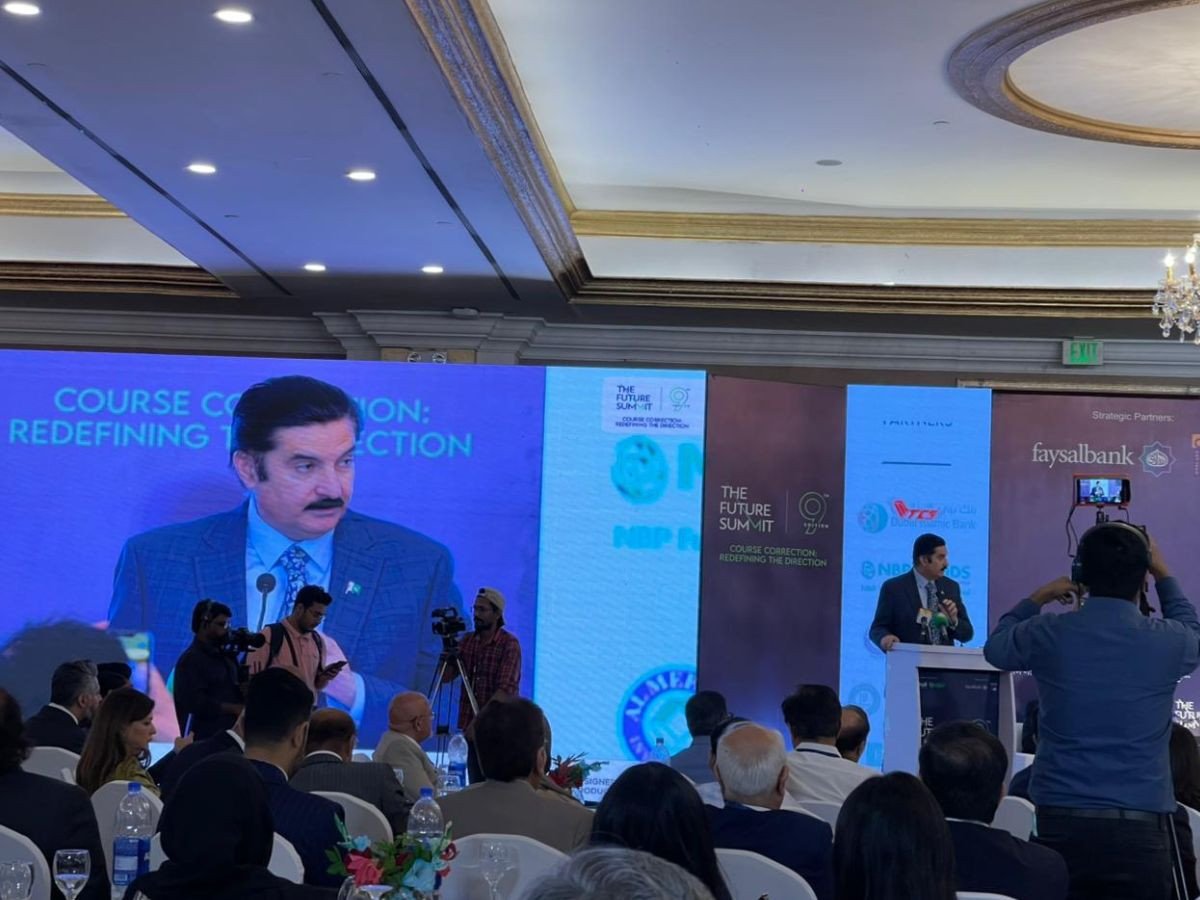
Sindh Chief Minister Murad Ali Shah called for inclusive, tech-driven growth and anticipatory governance to tackle economic and climate challenges. Speaking at the Future Summit in Karachi, he said the province was investing in energy transition, urban development and human capital, but federal delays tied to IMF conditions were holding up approval for IT parks and technology zones.
Shah said Sindh contributed over 30 per cent to Pakistan’s GDP, with Karachi accounting for nearly half of the country’s exports. He highlighted reforms to improve transparency, digital governance and ease of doing business, describing Sindh’s public-private partnership model as the strongest in the country.
He noted that Rs959 billion had been allocated for development projects in the current budget, while the proposed budget for next year stood at Rs3.45 trillion, including a record Rs523.7 billion for education.
With 60 per cent of its population under 30, Shah said Sindh was focused on digital and vocational training to help youth create jobs locally. Calling for collaboration between the government, private sector and civil society, he said: “We cannot stop global change, but we can correct our course and build a sustainable, inclusive future”.