Eight killed as bus collides with Iranian oil vehicle in Panjgur | The Express Tribune
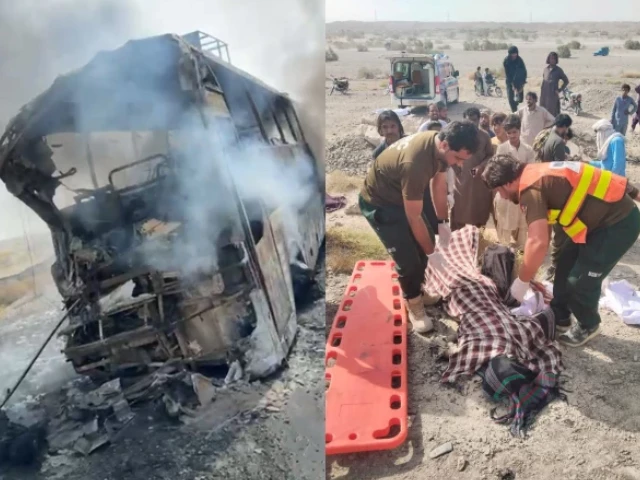
At least eight people were burnt to death and several others injured when a passenger bus collided with a vehicle carrying Iranian oil on the CPEC national highway in Balochistan’s Panjgur district on Saturday. According to police, the collision triggered a massive fire that engulfed both vehicles. The accident was initially reported to have claimed…
At least eight people were burnt to death and several others injured when a passenger bus collided with a vehicle carrying Iranian oil on the CPEC national highway in Balochistan’s Panjgur district on Saturday.
According to police, the collision triggered a massive fire that engulfed both vehicles. The accident was initially reported to have claimed five lives, but the toll rose to six after one of the injured succumbed before being shifted to the hospital. Later, two more critically wounded victims died, raising the death toll to eight.
Rescue officials said that the bodies and the injured were immediately transported to Panjgur Teaching Hospital, where treatment of the survivors is underway. They confirmed that the rescue operation at the site has been completed.
Police said an investigation has been launched into the incident, adding that “overspeeding is believed to be the primary cause of the crash.”
The tragedy has once again underscored the severe road safety challenges in Balochistan, where deteriorating infrastructure and poorly maintained vehicles frequently lead to fatal accidents. Residents and officials have urged the administration to implement stricter safety measures along the CPEC highway to prevent such incidents.
Earlier in June, a tragic incident took at least six lives and left more than ten others injured when a passenger bus suddenly caught fire near the Western Bypass in Quetta, the provincial capital of Balochistan.
Rescue teams rushed to the site and shifted the injured to nearby hospitals for urgent medical treatment.
According to eyewitnesses, the fire broke out during the journey, causing panic and chaos among the passengers. Rescue personnel managed to save several individuals through prompt action, but unfortunately, six individuals succumbed to their injuries.
Addis Ababa,Ethiopia is preparing to inaugurate what it claims will be the world’s largest dam, built on the River Nile, a project with far-reaching implications for the region. According to Ethiopian officials, the dam has the capacity to store more water than China’s Three Gorges Dam, currently the largest in the world. Citizens were reported…
KARACHI: With a concerning rise in heart attacks and cardiac deaths among younger adults, the Aga Khan University Hospital (AKUH) is calling for urgent lifestyle changes through its World Heart Day campaign, titled ‘Heart Over Habit’ — a movement encouraging people to break harmful routines and embrace heart-healthy living. Cardiovascular diseases, once considered illnesses of…
If US President Donald Trump really wants to win the Nobel Peace Prize, he needs to stop the war in Gaza, French President Emmanuel Macron said on Tuesday. Speaking to France’s BFM TV from New York, Macron said that only Trump has the power to put pressure on Israel to end the war. “There is…
China’s former defence attache in South Asia Cheng Xizhong on Sunday spurned India’s much-delayed claim that it had shot down six Pakistani aircraft during the May conflict, terming it “self-amusement”.
Having faced international coverage of its own craft being downed by Pakistan and scathing criticism from the opposition, India’s Air Chief Marshal Amar Preet Singh — three months after the conflict — claimed yesterday that his country had shot down five Pakistani fighter jets and one other military aircraft during those clashes.
While Pakistan had already denied that India downed any of its aircraft, Defence Minister Khawaja Asif swiftly rubbished Singh’s “belated assertions” yesterday.
Commenting on the matter today, Cheng said India’s allegations lacked strong evidence and have been “widely questioned by the international community, being considered groundless”, the Associated Press of Pakistanreported.
Singh’s remarks were “comical, implausible and unconvincing”. “We may call it self-amusement,” he said in a statement.
Pakistan said it downed six Indian planes during the conflict. India’s highest-ranking general has also acknowledged that its forces suffered losses in the air, but denied losing six aircraft.
“The Indian side has not presented any evidence, such as photos of the wreckage of the fighter jets, radar monitoring data, etc, while the Pakistani side had previously presented a large amount of relevant evidence of shooting down the Indian fighter jets,” Cheng noted.
The defence expert believed that everything should be based on sufficient evidence.
He highlighted that now, more than three months have passed since the India-Pakistan clash. New Delhi has never produced any evidence to prove that it had shot down Pakistani fighter jets, Cheng highlighted.
“In contrast, the Pakistan side immediately provided a detailed technical report to international media after the clash ended,” he added.
The Chinese expert also cited “confirmations from world leaders, senior Indian politicians, and foreign intelligence assessments that India suffered heavy losses of multiple aircraft”.
“It is thus evident that no Pakistani fighter jet was hit or destroyed by the Indian side. On the contrary, the Pakistani side shot down six Indian fighter jets and destroyed S-400 air defence positions, among other achievements, which is an indisputable fact,” he added.
Professor Cheng is currently a senior research fellow at the Chinese think tank Charhar Institute and has also served as a former United Nations senior military observer, according to CGTN.
In his claims yesterday, the Indian Air Force (IAF) chief did not mention the type of Pakistan’s fighter jets that he insisted were taken down.
Asif, responding to Singh, stated that “not a single Pakistani aircraft was hit or destroyed” by India. He declared that Pakistan took out six Indian jets, S-400 air defence batteries and unmanned aircraft of India while “swiftly putting several Indian airbases out of action”.
Former envoy to the United States Dr Maleeha Lodhi also termed Singh’s claim “laughable”, quipping that it took him “several months to count the planes to make this ridiculous assertion!”
Criticism also echoed from within India. Congress spokesperson Pawan Khera cast his doubts, saying: “The question we have after today’s information … when we had such a strong army and we were advancing, then under whose pressure did you stop Operation Sindoor?”
New Delhi had previously claimed it had downed “a few planes”, refusing to go into the specifics of it. US President Donald Trump has echoed the figure of “five jets” shot down during the military confrontation, albeit without specifying which side’s craft he was referring to.
India’s loss of jets affirmed globally
France’s air chief, General Jerome Bellanger, has previously said that he has seen evidence of the loss of three Indian fighters, including a Rafale. The IAF has not commented on those claims.
Days after the air combat, The Washington Post, based on visual evidence analysed by experts, reported that at least two French-made Indian fighter aircraft were shot down by the Pakistan Air Force (PAF).
India’s defence attache to Indonesia, Indian Navy Captain Shiv Kumar, acknowledged in June that the PAF downed Indian fighters, according to The Wire.
India’s intelligence failure was central to the hour-long air battle with Pakistan, which led to the downing of Rafale aircraft by the PAF’s J-10 fighters using PL-15 missiles, according to a Reutersreport.
In a press briefing two days after the May 7 air combat, Air Vice Marshal (AVM) Aurangzeb Ahmed, the deputy chief of operations of Pakistan Air Force (PAF), shared the locations where five Indian jets were downed — four along the Line of Control and one near Bathinda in northwest India. He also disclosed that one of the Indian jets was downed by Pakistani air defence systems.
According to a Dawnreport, which cited PAF officials, India’s three Rafales, one Su-30MKI and one MiG-29 were downed within a 40-minute span. Not a single Pakistani jet crossed the border or engaged in close combat.
Describing the engagement as a textbook case of modern aerial warfare, AVM Aurangzeb had said Pakistan had tracked over 70 Indian aircraft — including 14 Rafales — using its Electromagnetic Operational Environment and responded with a concentrated and pre-planned defensive counter-air strategy.
“Our side deployed 42 high-tech aircraft,” the PAF officer said. He noted that while India remained on its side of the border and launched air-to-ground weapons, Pakistani defences detected and engaged the threats instantly.
Gaza Peace Summit marked Pakistan’s re-emergence on the global stage, but sustaining momentum will depend on strategy At the ringing shores of Sharm el Sheikh last week, a moment unfolded that signalled a dramatic shift in Pakistan’s global standing. US President Donald Trump paused his own address at the Gaza Peace Summit and handed the…
Islamabad – The Islamabad High Court has suspended Justice Tariq Mahmood Jahangiri from judicial work pending a decision by the Supreme Judicial Council (SJC) on complaints against him. The two-member bench, led by Chief Justice Sarfraz Dogar and Justice Azam Khan, ruled that Justice Jahangiri will not perform judicial functions until the SJC issues its…