Empathy is complicated in a selfish, results-based business like NASCAR
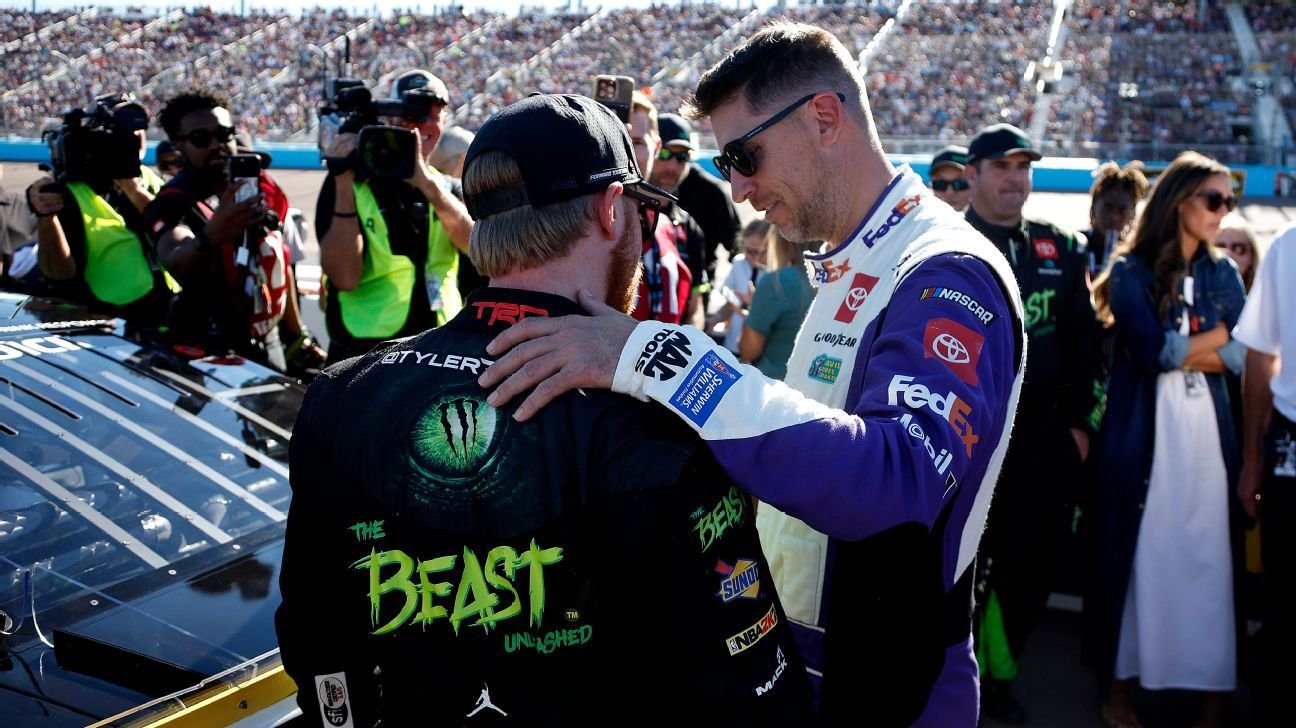
Mar 12, 2026, 09:46 AM ET Racing is a selfish business, but many NASCAR competitors often find themselves putting an arm around their competitors in difficult times.Sean Gardner/Getty Images On Nov. 2, 2025, underneath a setting sun at Phoenix Raceway, Kyle Larson is doing a burnout and celebrating his second NASCAR Cup Series championship with…
On Nov. 2, 2025, underneath a setting sun at Phoenix Raceway, Kyle Larson is doing a burnout and celebrating his second NASCAR Cup Series championship with his Hendrick Motorsports team. Larson then heads to the frontstretch for more celebrating and interviews, and that’s when his emotions change.
“I got done and I could see his car and team and him doing interviews, and it kind of hit me like, ‘Oh, man. I can’t imagine what he’s feeling right now,'” Larson later explained. “We’ve all gone through our down defeats, but I really can’t imagine what he’s feeling. It’s got to be something completely different than I ever felt before through any of my defeats.
“There’s definitely a large piece of me that feels really bad and sad, but at the same point, I’m happy. It’s such a weird feeling.”
Larson was referring to Denny Hamlin. Although Larson triumphed in the championship, doing so without leading a lap and without winning the race, it was Hamlin who had dominated the day. Hamlin, in his 20th season, was just three laps away from finally winning his first championship when a caution flew and sent the field to pit road. Larson and his Hendrick Motorsports team beat Hamlin and Joe Gibbs Racing on tire strategy.
The sudden turn of events left Larson balancing his celebratory emotions with his feelings for his friend.
On the one hand, it’s an understandable situation. On the other, it creates an interesting dynamic when the individuals involved are professional athletes whose careers hinge on their success.
It’s an ultra-competitive, results-based business.
“We’re definitely all selfish, but I certainly felt bad for Denny Hamlin last year in the championship,” Zane Smith said. “Man, that’s painful, and that’s a long career, he’s had a lot of success, a lot of wins, and in contention to win one. It was literally [a few laps] to go with plenty enough of a lead to win his first championship, and everything that was going on in his life.
“Man, I felt that one for him, but that’s racing.”
Hamlin was repeatedly mentioned when exploring whether drivers can feel bad for one of their fellow competitors. The garage veteran had come close in other years to winning the Cup Series title, but nothing like Phoenix. Another variable was that Hamlin’s father, Dennis, was in ill health, and the driver knew it was his last chance to win a championship that his father could see.
And so, if there is a conversation about drivers genuinely feeling compassion for one another, Hamlin is the new bar.
It is not uncommon to see a race decided by an untimely caution or a bad pit stop, even being collected in a crash not of one’s own doing, and drivers are empathic for their colleagues whose potential wins slipped through their fingers. Because sometimes things happen; it’s never over until it’s over.
“I got done with the race and was like, ‘Oh, he lost. Wow,'” Ross Chastain said of Hamlin. “I never thought I’d feel bad for that guy.”
Brad Keselowski has been in the Cup Series since 2009 and has experienced all the highs and lows racing can give a driver. A former series champion, he “absolutely” finds himself feeling bad for others and believes that has come with time and experience.
“I have had races where I’ve felt bad for people who did everything right and it doesn’t come together,” he said. “We’ll be running and see someone doing a great job, and it all falls apart for them. You’re like, ‘Ugh. Man, I hope that’s not me.’ Particularly, the more you do this and the more you have bad things happen to you, I think the more empathy you have for others.”
Not everyone feels the same way, though.
“I don’t feel bad for these guys,” said Chastain, who had the rare exception for Hamlin. “I feel happy for some of them. … I get excited for guys. I don’t really feel bad for them.
“I’m a professional loser. I’ve lost more races before I won — definitely before I won my first race in each series — than most of these guys. Yeah, I don’t feel bad for them when they lose because been there, done that. Most of them have not lost as many times before they’ve won and most of them, I don’t believe, would have kept going as long as I did.”
Ricky Stenhouse Jr. admitted he was thrilled for his buddy Larson last fall, but he is also friends with Hamlin and felt for his loss. It was the exception to Stenhouse’s adamant stance of, “I never really feel bad for anybody.” He believes that other drivers would probably say the same thing.
NASCAR is a sport rooted in community, as the same participants race every weekend and often stay within feet of each other in the infield motorhome compound. Although often called a traveling circus, industry members, from drivers, teams and crew members, do become quite familiar with each other and for the most part, Stenhouse said, get along.
Regardless, the focus needs to be on your team. It’s why Smith feels it’s rare that a driver feels genuine sympathy for someone else.
“It’s hard to have close friends in this industry because we’re all competing against each other every week,” Smith said. “But in that scenario [with Hamlin] where I’m not competing for a championship, and I don’t have a teammate that’s competing for it, and you see what unfolded at the end of the race, you’re like, ‘Holy cow.'”
Yes, racing is a selfish business. A racer’s livelihood is dependent on results. The dominant emotion is usually dictated by one’s own successes or failures, but there are times, rare it seems, when feeling something, something big in the case of Hamlin, outside their own bubble can break through.