
Ghost particles from space telescope wins 2026 Nobel Prize in Physics
On the rare occasions when a neutrino strikes an atomic nucleus, it produces fast-moving charged particles. It is these racing through the ice, which give off a blue glow, which sensitive light detectors can pick up. The pattern and timing of that light allow scientists to estimate the direction the neutrino came from — helping…
On the rare occasions when a neutrino strikes an atomic nucleus, it produces fast-moving charged particles. It is these racing through the ice, which give off a blue glow, which sensitive light detectors can pick up.
The pattern and timing of that light allow scientists to estimate the direction the neutrino came from — helping them trace its origins in the cosmos. But these interactions are so rare that the observatory needed an enormous volume of clear ice.
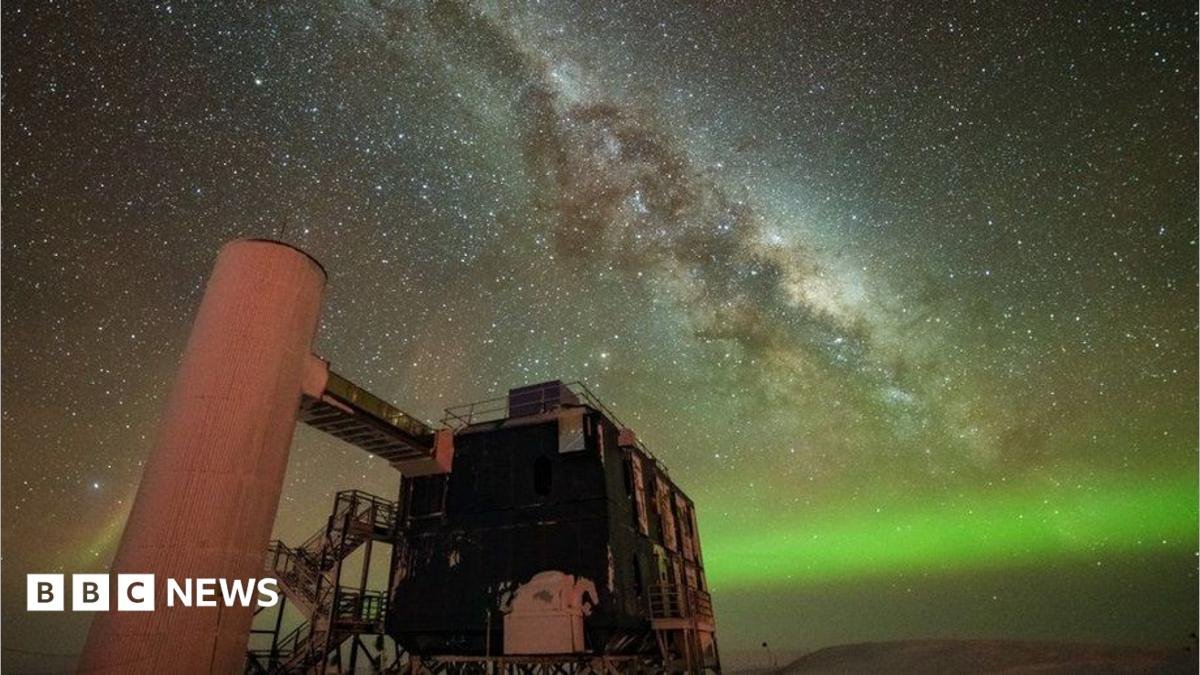
Halzen’s idea was to use a vast natural ice sheet in Antarctica. So began an audacious plan to build a neutrino observatory at the geographic South Pole, with thousands of light sensors embedded deep in the ice.
The neutrino’s ghostly nature, the very thing that makes it so hard to detect, also makes it a powerful messenger from the distant Universe.
Neutrinos rarely interact with material in its way, so they can go right through dense regions that light cannot easily penetrate.
And because they have no electric charge, magnetic fields do not bend their paths through space. That means their direction of arrival can point scientists back towards their source.
Their energies carry further insight into the processes that created them – helping scientists investigate how exploding stars and the environments around giant black holes accelerate particles to extraordinary energies.
Louis Barson, director of science at the Institute of Physics in London, said the IceCube Observatory had enabled astronomers to investigate phenomena that conventional telescopes cannot see.
“The discoveries that have followed are helping us understand some of the most energetic and mysterious processes in the universe – and that’s thanks to Professor Halzen’s work,” he added.
Prof Subir Sarkar, physicist from the University of Oxford, quoted the French novelist Marcel Proust in describing his assessment of Halzen’s contribution to science:
“‘The only true voyage of discovery, the only fountain of Eternal Youth, would be not to visit strange lands but to possess other eyes, to behold the universe through the eyes of another, of a hundred others, to behold the hundred universes that each of them beholds, that each of them is’.
“Francis Halzen has led the IceCube collaboration on just such a voyage of discovery and opened a new window on to our Universe”.


