U.S. and Pakistan Strengthen STEM Education Partnership Through Innovative Program
Karachi, Pakistan – December 19, 2025: The U.S. Mission in Pakistan, in collaboration with Vanderbilt University (Tennessee, USA), has successfully concluded the STEMpowered initiative, a $294,000 program designed to enhance science, technology, engineering, and mathematics (STEM) education in Pakistan. Implemented in partnership with Sukkur IBA (SIBA) University and Beyond the Classroom Education, the program included…
Karachi, Pakistan – December 19, 2025: The U.S. Mission in Pakistan, in collaboration with Vanderbilt University (Tennessee, USA), has successfully concluded the STEMpowered initiative, a $294,000 program designed to enhance science, technology, engineering, and mathematics (STEM) education in Pakistan.
Implemented in partnership with Sukkur IBA (SIBA) University and Beyond the Classroom Education, the program included a week-long immersion at Vanderbilt for SIBA faculty, focusing on advanced teaching methods, research practices, artificial intelligence in education, and practical solutions for classroom challenges.
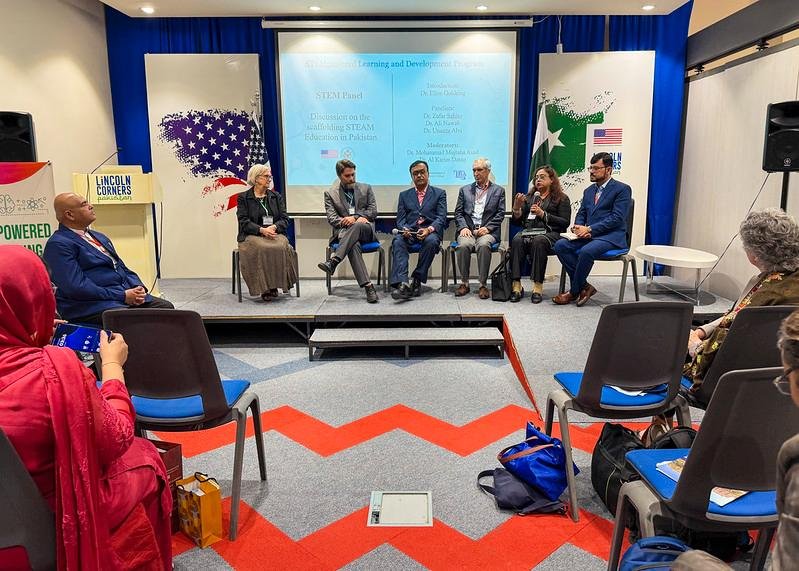
The initiative culminated in a four-day workshop hosted by the U.S. Consulate General in Karachi, in collaboration with Vanderbilt’s Peabody College of Education and Human Development. The workshop brought together 30 Pakistani STEM educators, four Peabody faculty, 11 SIBA faculty, and 16 students. Through interactive sessions and presentations, participants strengthened their teaching skills, developed professional networks, and collaborated on innovative STEM strategies.
The program also fostered stronger ties with peer institutions, including faculty from Aga Khan University, and reaffirmed U.S. leadership in global STEM education. As part of the initiative, participants developed a STEM Toolkit and a Curriculum Quality Assurance Framework to support the nationwide adoption of U.S. best practices in teaching.
A targeted pilot study across select classrooms in Sindh province showed significant results. Low-cost, inquiry-based teaching methods increased student confidence in STEM experiments by 60–80%, while culturally relevant approaches boosted girls’ participation and leadership in STEM by over 30%.
The STEMpowered initiative highlights the strength of the U.S.–Pakistan educational partnership, leveraging American expertise and rigorous methodology to drive systemic reforms and promote innovation in critical STEM fields.