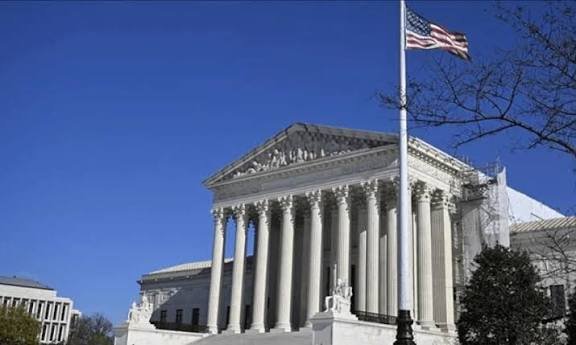
US Supreme Court Strikes Down Trump Tariffs in Historic Ruling; Trump Slams Decision as “Disgrace”
Washington D.C. — February 20, 2026The United States Supreme Court delivered a landmark blow to President Donald Trump on Friday, ruling 6-3 that his sweeping global tariffs — imposed under emergency powers — were unlawful and beyond his presidential authority.The majority opinion, authored by Chief Justice John Roberts, held that the International Emergency Economic Powers…
Washington D.C. — February 20, 2026
The United States Supreme Court delivered a landmark blow to President Donald Trump on Friday, ruling 6-3 that his sweeping global tariffs — imposed under emergency powers — were unlawful and beyond his presidential authority.
The majority opinion, authored by Chief Justice John Roberts, held that the International Emergency Economic Powers Act (IEEPA) of 1977 does not authorize the president to impose tariffs. The ruling immediately invalidates the centerpiece of Trump’s second-term economic agenda, which included steep tariffs on goods from dozens of nations including China, India, Pakistan, Brazil, and the United Kingdom.
The Legal Reasoning
Chief Justice Roberts wrote that Trump had claimed “the extraordinary power to unilaterally impose tariffs of unlimited amount, duration and scope,” adding that such a sweeping assertion of executive authority required a clear and explicit congressional mandate — one that IEEPA simply does not provide. The ruling also invoked the “major questions doctrine,” which holds that decisions of vast economic or political significance must be explicitly authorized by Congress.
Notably, the court pointed out that no president before Trump had ever used IEEPA to impose tariffs. Justices Neil Gorsuch and Amy Coney Barrett joined Roberts in the majority, alongside the three liberal justices. Justices Clarence Thomas, Samuel Alito, and Brett Kavanaugh dissented.
Trump’s Furious Response
Speaking at the White House shortly after the ruling, Trump harshly criticized the majority justices, calling the decision a “disgrace” and labeling the majority justices “very unpatriotic and disloyal to the Constitution.” Despite his anger, Trump announced he would pursue a 10% global tariff using alternative legal authorities, signaling that his trade war agenda is far from over.
The Refund Problem
The ruling raises the prospect of over $175 billion in tariff refunds to importers who paid duties under IEEPA. As of December 2024, the government had already collected more than $130 billion. However, the court’s opinion did not directly address refund eligibility, leaving that question to be resolved in lower courts. Justice Kavanaugh, in his dissent, warned that the ruling opened a “can of worms” for the economy.
What Remains and What’s Next
The decision does not affect all Trump tariffs. Duties on steel, aluminum, and automobiles imposed under separate legal authorities remain in force. Legal experts believe the Trump administration will pursue new legislation or alternative statutory authority rather than comply with mass refunds. The ruling is widely being described as the single biggest legal setback of Trump’s second term, setting a new precedent for the limits of presidential power in trade policy.
Stock markets rallied sharply following the announcement, reflecting investor relief over the removal of unpredictable trade barriers that had rattled global supply chains for months.