North Korea Tests Upgraded ICBM Engine Capable of Reaching U.S
. Mainland — Kim Jong Un Oversees TrialSEOUL / PYONGYANG North Korea on Sunday conducted a ground test of a newly upgraded, high-thrust solid-fuel rocket engine designed for intercontinental ballistic missiles capable of striking the United States mainland, raising fresh alarms across Washington, Seoul, and Tokyo.According to the Korean Central News Agency , the engine…
. Mainland — Kim Jong Un Oversees Trial
SEOUL / PYONGYANG
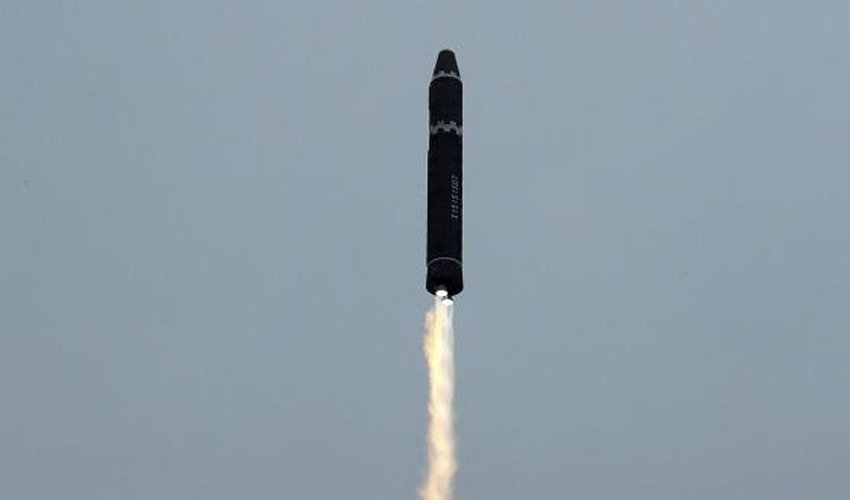
North Korea on Sunday conducted a ground test of a newly upgraded, high-thrust solid-fuel rocket engine designed for intercontinental ballistic missiles capable of striking the United States mainland, raising fresh alarms across Washington, Seoul, and Tokyo.
According to the Korean Central News Agency , the engine — built from composite carbon fiber material — produced a maximum thrust of 2,500 kilonewtons, a significant jump from the 1,971 kilonewtons recorded in a similar test last September.
North Korean leader Kim Jong Un personally observed the test and declared it a landmark achievement, saying it “fully conforms with the national strategy and the military demand for modernising the strategic forces.”
Analysts say the more powerful engine could allow North Korea to build smaller ICBMs launchable from submarines or mobile road vehicles, and could support efforts to place multiple warheads on a single missile — a move that could overwhelm existing U.S. missile defense systems.
Unlike older liquid-fuel systems that require lengthy fueling before launch, solid-fuel missiles can be fired rapidly and with far less warning, complicating detection and interception efforts for adversaries.
However, outside experts urge caution. Some analysts note that North Korea still faces significant technical hurdles — particularly ensuring warheads survive the extreme heat of atmospheric reentry — before possessing a fully operational ICBM. Additionally, North Korea’s own state media labeled the September test as the “ninth and final” ground trial, yet the expected test-launch of an ICBM has not materialized.
Some observers speculate the program may be experiencing delays, or that Pyongyang may be pursuing a more advanced engine design, possibly with Russian technical assistance — cooperation that has deepened as North Korea has supplied troops and weapons to support Russia’s war in Ukraine.
North Korea has aggressively expanded its nuclear arsenal since Kim’s high-profile diplomacy with President Trump collapsed in 2019. At a February party congress, Kim left the door open for renewed talks but insisted Washington abandon demands for North Korean denuclearization as a precondition.