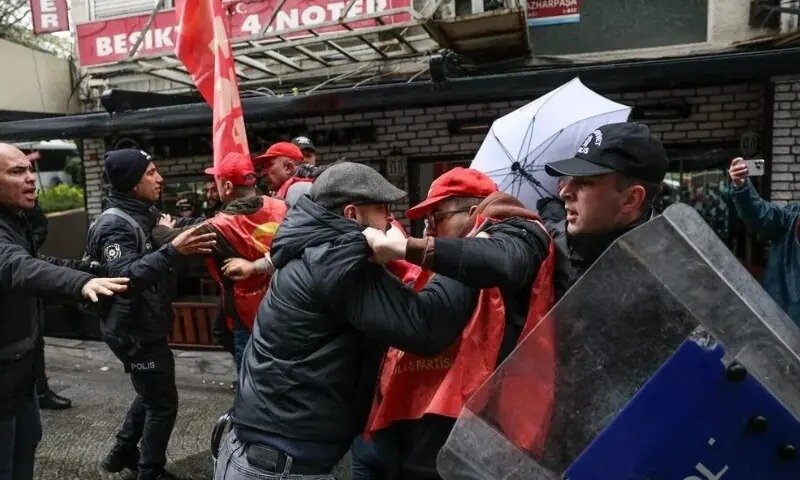
May Day Clashes in Istanbul: Police Fire Water Cannons at Protesters, Dozens Arrested
ISTANBUL: Turkish police clashed with labour union members and demonstrators in Istanbul on Thursday as workers attempted to march toward the iconic Taksim Square on International Labour Day, triggering a heavy-handed crackdown that left dozens arrested and renewed debate over civil liberties in the country.Authorities deployed water cannons and tear gas to disperse crowds that…
ISTANBUL: Turkish police clashed with labour union members and demonstrators in Istanbul on Thursday as workers attempted to march toward the iconic Taksim Square on International Labour Day, triggering a heavy-handed crackdown that left dozens arrested and renewed debate over civil liberties in the country.
Authorities deployed water cannons and tear gas to disperse crowds that had gathered across multiple districts of the city, determined to converge on Taksim Square — a location that holds deep symbolic significance for Turkey’s labour movement. Security forces had established a tight cordon around the square well in advance, effectively sealing it off from demonstrators.
Taksim Square remains a potent symbol for Turkish workers, most notably because of the May Day massacre of 1977, when gunfire erupted into a crowd of hundreds of thousands, killing dozens of people in one of the darkest episodes of Turkey’s modern history. In recent years, the government has imposed a blanket ban on protests at the square, citing security concerns — a restriction that unions and civil society groups have consistently condemned as an infringement on fundamental freedoms.
Labour unions swiftly denounced Friday’s police response as an assault on democratic rights and the freedom of assembly, demanding the immediate release of all detained activists and calling on the government to lift restrictions on Taksim Square for future May Day gatherings.
The scenes from Istanbul drew sharp reactions from opposition politicians and human rights organisations, who argued that the crackdown was emblematic of the Turkish government’s broader intolerance of public dissent and organized labour activism.