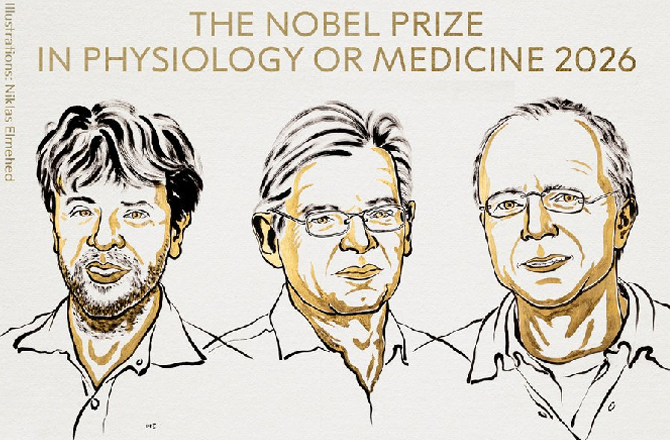
2026 Nobel Prize in Physiology or Medicine Awarded to Karl Deisseroth, Peter Hegemann and Georg Nagel
OSLO: The 2026 Nobel Prize in Physiology or Medicine has been awarded to Karl Deisseroth, Peter Hegemann and Georg Nagel for their discoveries concerning light-activated ion channels and optogenetics. Their research laid the foundation of optogenetics, which has made it possible to study neural activity linked to memory, emotions and behaviour in the brain.According to…
OSLO: The 2026 Nobel Prize in Physiology or Medicine has been awarded to Karl Deisseroth, Peter Hegemann and Georg Nagel for their discoveries concerning light-activated ion channels and optogenetics. Their research laid the foundation of optogenetics, which has made it possible to study neural activity linked to memory, emotions and behaviour in the brain.
According to Nobel Prize press materials, the announcement was made on Monday, 5 October, by Thomas Perlmann, Secretary of the Nobel Committee for Physiology or Medicine, at the Karolinska Institute in Stockholm. It is the first of six Nobel Prizes to be announced over eight days. The 2026 prize amount is 12 million Swedish kronor, and the formal ceremony will take place in December.
Deisseroth, born in 1971, is affiliated with Stanford University and the Howard Hughes Medical Institute, where he earned his PhD in 1998 and MD in 2000. His work on the channelrhodopsin protein helped turn the discovery into a practical way of controlling nerve cells with light. In 2005 he showed that blue light could trigger neural signals in modified nerve cells, and in 2007 he demonstrated that the technique could control neurons in the brains of living mice.
Hegemann, born in 1954, is Hertie Senior Professor of Neuroscience at Humboldt University of Berlin. He received his PhD in 1984 from the Max Planck Institute for Biochemistry in Martinsried, Germany. He studied how the single-celled alga Chlamydomonas senses light and moves toward it. His work with Nagel led to the discovery of channelrhodopsin, a light-sensitive protein central to optogenetics. The early discoveries were made at the Martinsried institute.