Spain: Trust in High-Speed Rail Shattered, Says Spanish PM After Rail Accident
Madrid: Spanish Prime Minister Pedro Sanchez expressed regret over the rail accident, saying that trust in high-speed rail has been shattered. At least 69 people were killed in the accident that occurred on Wednesday, making it the second major high-speed rail disaster in Spain this year. Spanish Prime Minister Pedro Sanchez acknowledged on Friday that…
Madrid: Spanish Prime Minister Pedro Sanchez expressed regret over the rail accident, saying that trust in high-speed rail has been shattered. At least 69 people were killed in the accident that occurred on Wednesday, making it the second major high-speed rail disaster in Spain this year.
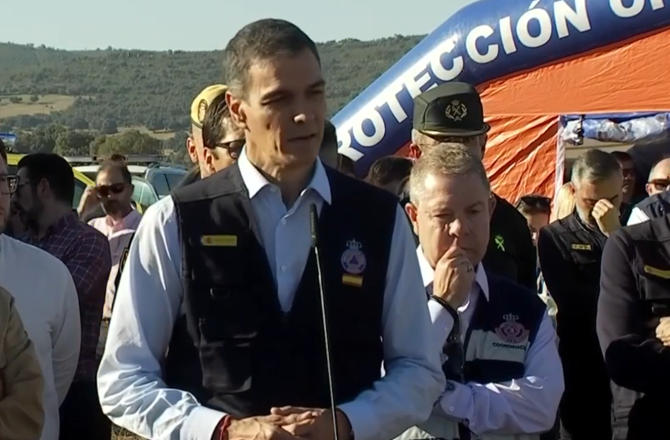
Spanish Prime Minister Pedro Sanchez acknowledged on Friday that “trust in high-speed rail has been shattered” after at least 69 people were killed and 110 injured in a deadly accident earlier this week. It may be recalled that the collision near Urda in central Spain on Wednesday was the country’s second major high-speed rail accident this year. In January, 46 people were killed when a train derailed and collided near the town of Adanero, with initial investigations pointing to a broken track. Sanchez said at a press conference, “For a country like Spain, which has such a strong high-speed rail system, suffering two accidents of this nature and severity in one year is unacceptable.” He later pledged to “provide solutions to further strengthen the high-speed rail system so that a tragedy of this kind does not happen again.”
According to the International Union of Railways, Spain has the world’s second-largest high-speed rail network after China and the largest in Europe. Emilian Garcia-Page, the regional president of Castilla-La Mancha, said on Friday that the death toll could rise slightly as identification work continues, while authorities had received reports of 70 missing people. He said that of the 110 people admitted to hospitals in the region, 39 were still hospitalised, with their condition considerably improved.
Investigation Into Failures Continues
Scrutiny is growing over the failures that led to Renfe’s high-speed train crashing into the back of a stationary Iryo train on the Madrid-Seville line. Transport Minister Oscar Puente said that a technical failure in the automatic signalling system halted several trains, after which controllers in Madrid had to take control. Puente said on Friday that similar glitches had occurred 160 times in Spain this year, adding that the figure was within the EU norm. According to Puente, a worker at the control centre then authorised the Renfe train to proceed at normal speed, up to 200 kilometres per hour, despite the stationary train ahead, which was a violation of safety protocols. Puente said, “If there are two trains in the same block section, the train behind should not move. Secondly, in these circumstances, if the first train is moving, the train should be authorised to travel at a maximum speed of 40 kilometres per hour.” Meanwhile, about five minutes before the accident, the stationary train had also contacted the control centre to warn that it was unable to move again. According to initial investigations, the Renfe train was travelling at approximately 160 to 200 kilometres per hour when it collided with the stationary train. However, the investigation has not yet determined final responsibility, and railway workers and experts have raised questions about whether the controller’s decision, which Puente described as “inexplicable,” reflects broader weaknesses.
Spanish news agency EFE reported that Vicente Almenar, a Renfe train driver affiliated with the UGT union, called for caution and warned of intense pressure to speed up operations to avoid delays. Antonio Tobal, UGT’s safety representative at Adif, warned against focusing solely on human error. He called for a review of working conditions, organisational procedures and staff training for emergencies.
Other experts have pointed to Spain’s rapid expansion of high-speed rail and relatively lower maintenance costs compared to other European countries. They have also questioned the delay in replacing the old automatic signalling system on the Madrid-Seville line with the European Rail Traffic Management System.
Spain’s Rail Safety Record
Spain’s accidents contrast with the strong safety records of high-speed rail elsewhere. Japan’s Shinkansen has recorded no passenger fatalities from collisions or derailments since services began in 1964. Meanwhile, 41 people were killed in China’s two documented fatal high-speed accidents. In addition, France, which has the second-largest high-speed network in Europe, recorded 14 deaths in three accidents, including 11 during a test run. Meanwhile, at least 115 people have been killed in Spain’s two accidents this year. A further 80 people were killed in a derailment in Santiago de Compostela in 2013. Meanwhile, Spain’s transport minister has rejected calls to resign.