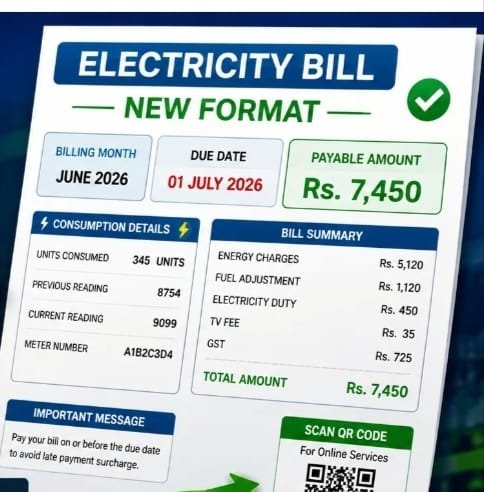
New Electricity Bill Format Undermines Transparency, Consumer Rights: PHMA
– PHMA Calls for Restoration of Previous Detailed Electricity Bill Format By Dr. Ansab AliLahore, Pakistan LAHORE: The Pakistan Hosiery Manufacturers and Exporters Association (PHMA) has urged Prime Minister Shehbaz Sharif to take immediate notice of the reduced consumer information in the new electricity bill format introduced from the June 2026 billing cycle, describing the…
– PHMA Calls for Restoration of Previous Detailed Electricity Bill Format
By Dr. Ansab Ali
Lahore, Pakistan
LAHORE: The Pakistan Hosiery Manufacturers and Exporters Association (PHMA) has urged Prime Minister Shehbaz Sharif to take immediate notice of the reduced consumer information in the new electricity bill format introduced from the June 2026 billing cycle, describing the move as a serious setback to transparency, accountability, and consumer rights.
In a letter addressed to the Prime Minister, PHMA North Zone Chairman Abdul Hameed said the revised electricity bills contain significantly less information, making it difficult for consumers to independently verify meter readings, electricity consumption, tariff calculations, and statutory charges.
He maintained that the changes appear to have been introduced without following the mandatory regulatory process under the National Electric Power Regulatory Authority (NEPRA) framework. According to him, neither the Power Division nor the electricity distribution companies filed a petition before NEPRA seeking approval for the revised format, while consumers were not invited to submit objections or participate in a public hearing.
Abdul Hameed said the revised bill format is inconsistent with the principles of transparency, public participation, and consumer protection enshrined in the NEPRA Act and raises concerns regarding compliance with the NEPRA Consumer Service Manual, particularly Chapter 6 dealing with meter reading and billing.
He pointed out that Clause 6.4.1 requires essential consumer information, including the date of connection or meter installation, to be displayed on electricity bills. However, this information has been omitted from the new format.
The PHMA chairman also expressed concern over the removal of the meter-reading snapshot, saying consumers can no longer verify whether the recorded meter reading matches the actual reading taken at their premises. Information regarding the meter reader as well as the date and time of meter reading has also been removed.
He further stated that while the new bills include a QR code, it cannot replace essential information that should be clearly printed on the bill. He noted that senior citizens, rural residents, and low-income consumers may lack smartphones, internet access, or the digital literacy required to retrieve billing details electronically.
Abdul Hameed also highlighted the omission of several operational details, including the name of the concerned electricity division, the address of the relevant subdivision, and the contact numbers of the Sub-Divisional Officer (SDO) and Executive Engineer, making it more difficult for consumers to seek clarification or lodge complaints.
He added that the revised bills no longer display important information such as the age of outstanding arrears, separate units consumed, and the detailed breakup of statutory charges, including Fuel Price Adjustment (FPA), FC Surcharge, Quarterly Tariff Adjustment, fixed charges, electricity duty, General Sales Tax (GST), GST on FPA, income tax, and income tax on FPA.
The PHMA chairman also pointed to the non-reflection of the Annual Distribution Margin Component and said that the provisions of Clause 6.4.2, which provide for segregated billing to ensure consumers receive slab benefits when billing periods exceed one month, are also not being properly implemented.
He said previous electricity bills provided detailed calculations, including GOP tariff multiplied by units consumed, peak and off-peak consumption, tariff calculations, net-metering import and export units, accumulated reading periods, and meter replacement details. The removal of this information has significantly reduced consumers’ ability to verify the accuracy of their electricity bills.
Abdul Hameed urged Prime Minister Shehbaz Sharif to direct the Power Division to restore all consumer-related information previously available on electricity bills and ensure compliance with all mandatory provisions of the NEPRA Consumer Service Manual.
He further called for any future changes affecting consumer rights to be implemented only after following the legal regulatory process, including filing a petition before NEPRA, inviting public comments, conducting public hearings, and obtaining formal regulatory approval.
He also requested the Prime Minister to order an inquiry into who authorized the removal of statutory and consumer-related information from electricity bills and whether all mandatory legal and regulatory procedures were followed before the implementation of the new billing format.
He stressed that transparency in electricity billing is essential for public accountability and that every consumer has the right to know how electricity consumption is measured, how each charge is calculated, and under what legal authority every amount is imposed.