Meta accused of systematically suppressing pro-Palestine content: report
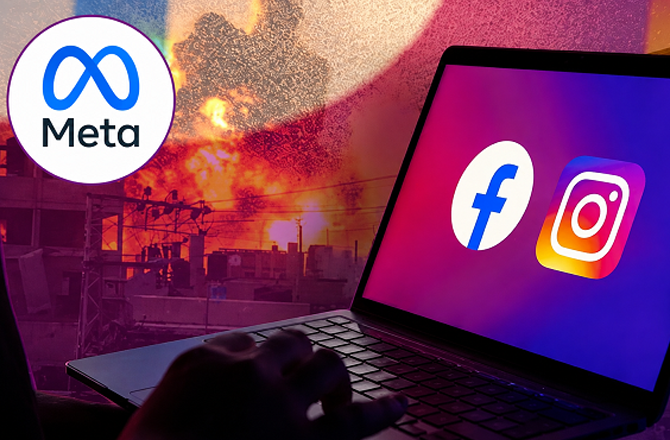
Study finds account suspensions, reduced reach and content restrictions on Facebook and InstagramLondon/Ramallah — A report by Palestinian digital rights group 7amleh and a researcher at Utrecht University alleges that Meta has systematically suppressed pro-Palestine content on Facebook and Instagram, citing account suspensions, post removals, restrictions on live streaming and reductions in content distribution. Titled…
Study finds account suspensions, reduced reach and content restrictions on Facebook and Instagram
London/Ramallah — A report by Palestinian digital rights group 7amleh and a researcher at Utrecht University alleges that Meta has systematically suppressed pro-Palestine content on Facebook and Instagram, citing account suspensions, post removals, restrictions on live streaming and reductions in content distribution. Titled “Platform-side of Palestine 2021–2025,” the study reviews 3,520 incidents submitted to 7amleh’s Palestinian Digital Rights Observatory between January 2021 and December 2025.
The report argues that Meta’s moderation mechanisms structurally limited Palestinian presence and participation on its platforms. While the authors do not conclude that Meta engaged in deliberate, individual-level censorship in every case, they contend that repeated enforcement actions cannot be dismissed as isolated technical or moderation errors. Only 32.5 percent of documented incidents involved a clearly identifiable policy violation.
Where a reason was provided, Meta’s “dangerous organizations and individuals” policy accounted for 57.2 percent of enforcement actions, and that rate rose to 71.1 percent in cases involving journalists. Although the policy is intended to curb support for terrorist or violent groups, the report says it has been applied broadly to journalists, media organizations, activists and civil-society groups covering Palestine and the Gaza conflict.
Account suspensions were the most common action recorded, affecting roughly one-third of documented cases. The research also flagged less visible restrictions — reductions in reach and recommendation filtering — often referred to by users as “shadow-banning.” About half of 2,828 appeals submitted by affected users to Meta received no response, the report found.
Meta has previously said it is working to improve Arabic-language moderation accuracy, route content to Arabic-speaking reviewers, and provide clearer explanations for enforcement decisions. The report calls on Meta to commission an independent human-rights review, reform the application of its “dangerous organizations and individuals” policy, and strengthen safeguards for journalistic and public-interest content.