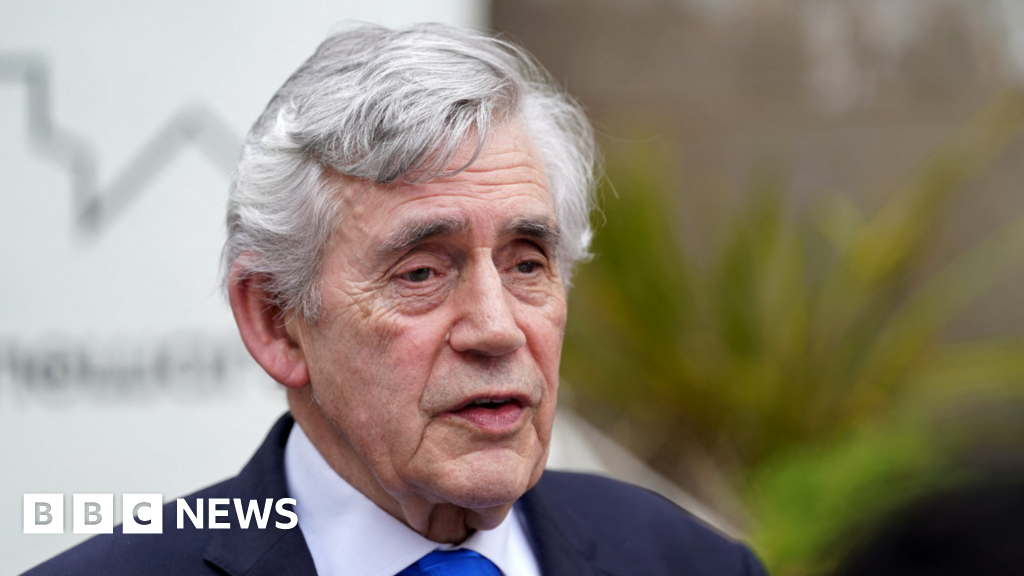
Gordon Brown urges Rachel Reeves to hike gambling taxes at Budget

Similar Posts

  • Tense phonecall on Pak-India ceasefire reason for deterioration in Trump-Modi relations: report

    A tense phone call on the ceasefire between Pakistan and India became the basis for the current breakdown in relations between Prime Minister Narendra Modi and United States President Donald Trump, Bloomberg reported on Friday.

    Trump on Wednesday imposed an additional 25 per cent tariff on Indian goods, citing New Delhi’s continued imports of Russian oil in a move that sharply escalated tensions between the two nations after trade talks reached a deadlock. The new import tax, set to come into place in three weeks, will raise duties on some Indian exports to as high as 50pc — among the highest levied on any US trading partner.

    While the rupture in US-India ties was abrupt, there have been strains in the relationship. Delhi has repeatedly rebutted Trump’s repeated statements that the US brokered a ceasefire between India and Pakistan after four days of fighting between the nuclear-armed neighbours in May. Trump also hosted Pakistan’s army chief at the White House in the weeks following the conflict.

    The two leaders spoke over the phone at the insistence of Trump on the sidelines of June’s G7 summit in Canada, which Modi attended as a guest. The call lasted 35 minutes.

    “PM Modi told President Trump clearly that during this period, there was no talk at any stage on subjects like India-US trade deal or US mediation between India and Pakistan,” Indian Foreign Secretary Vikram Misri had said of the talk. “Talks for ceasing military action happened directly between India and Pakistan through existing military channels, and on the insistence of Pakistan. Prime Minister Modi emphasised that India has not accepted mediation in the past and will never do,” he said.

    Bloomberg reported today that “tensions came to a head” between the two leaders in the call with Trump’s repeated claiming of credit and India’s downplaying of the matter.

    “Modi felt like he needed to set the record straight in the call after his aides discovered that Trump planned to host a lunch the following day at the White House for Pakistani Army Chief Asim Munir,” the report cited officials in New Delhi familiar with the matter, who requested anonymity to speak about confidential discussions.

    “While India had no problem if Trump met Pakistan’s civilian leaders, hosting Munir was seen as giving legitimacy to a military that Modi’s government accuses of supporting militant groups, they said. Wary that Trump would look to orchestrate a meeting between Munir and Modi, the Indian leader turned down an invitation to stop by the White House on the way back from Canada, they said, adding that he was also committed to visiting Croatia,” the report said.

    It added that since the phone call, “India saw a shift in tone from the White House after that phone call, according to the officials in New Delhi” despite the US not making a direct request for Modi to acknowledge Trump’s role.

    “Once Trump began publicly attacking India, they added, it was clear the episode marked a turning point in the broader relationship,” the report said.

    Modi said a day ago he would not compromise on the agriculture sector.

    For New Delhi, one of the main sticking points in trade negotiations has been Washington’s demand to access India’s vast agricultural and dairy market. India has remained steadfast about its labour-intensive agricultural sector, unwilling to risk angering farmers, a powerful voting bloc.

    “We will not compromise with the interests of our farmers, our dairy sector, our fishermen,” Modi said during a speech at a conference in New Delhi, his remarks widely seen as his first public response to the tariffs.

    “I know I will have to pay a personal price for this, but I am ready for it,” he added, without giving further details.

    In February, Trump said that he found a “special bond” with Modi when he visited Washington — complimenting Modi as being a “much tougher negotiator” than he was.

    Successive US administrations have seen India — the world’s most populous nation and fifth-largest economy — as a key partner, with like-minded interests in the face of powerful China.

    India and neighbouring China have long been intense rivals competing for strategic influence across South Asia.

    Now, India is bracing for a bumpy ride, as the US is its largest trading partner, with New Delhi shipping goods worth $87.4 billion in 2024.

  • A taste of Swedish island life – but on the mainland, near Stockholm

    Stockholm’s 30,000-strong archipelago is rightly famous, but the sandy beaches and cabins just down the coast are more accessible and full of local flavour

    I moved to Stockholm from London for work a decade ago. As a newcomer with a passion for nature, I remember being eager to soak up the region’s archipelago of 30,000 islands and rocky outposts. But I was overwhelmed by complex public ferry timetables to dozens of places ending in the letter “ö” (the Swedish word for island) and uninterested in pricey cruise boats packed with tour groups.

    Then a former flatmate recommended Nynäshamn, which is on the mainland but embodies much of the nature and spirit of Stockholm’s archipelago. It’s home to a tasteful waterfront of colourfully painted bars and restaurants and a harbour packed with boats every summer, from simple dinghies to luxury yachts. Beyond, you can look across a clean, calm stretch of Baltic Sea, towards the island of Bedarön, flanked by pine trees and a smattering of dark red detached houses.

    Continue reading…

  • PTI’s leaders of opposition in NA, Senate removed from posts

    PTI’s Opposition Leader in the National Assembly Omar Ayub Khan and Opposition Leader in the Senate Shibli Faraz, were removed from their seats, according to notifications by the respective houses’ secretariats that came to light on Friday.

    On Tuesday, the Election Commission of Pakistan (ECP) had disqualified the Senate and National Assembly opposition leaders, Sunni Ittehad Council chief Hamid Raza and other PTI lawmakers following their convictions in cases related to the May 9 riots.

    According to the notification by the National Assembly Secretariat dated August 7, “ Consequent upon disqualification and de-notification of Leader of the Opposition Omar Ayub Khan from being a member of the National Assembly (NA-18 Haripur) under Article 63 of the Constitution of the Islamic Republic of Pakistan … the office of the Leader of the Opposition in the National Assembly has become vacant with effect from August 5th, 2025.“

    A similar notification for Faraz was issued by the Senate Secretariat: “Consequent upon disqualification and de-notification of Leader of the Opposition in the Senate Senator Syed Shibli Faraz, from being a member of the Senate under Article 63 of the Constitution of the Islamic Republic of Pakistan … the office of the Leader of the Opposition in the Senate has become vacant with effect from 5th August”.

    The Peshawar High Court (PHC) on Wednesday halted ECP from taking any action against PTI leaders Faraz and Ayub.

    A notification from the ECP had said Faraz, Ayub, Kharal, Raza, MNA Rai Hassan Nawaz Khan, Gul, MPA Muhammad Ansar Iqbal, MPA Junaid Afzal Sahi and MPA Rai Muhammad Murtaza Iqbal were now disqualified under Article 63(1h) (a person shall be disqualified from being elected [if] … he has been, on conviction for any offence involving moral turpitude, sentenced to imprisonment for a term of not less than two years) of the Constitution and their seats were vacant.

    On May 9, 2023, PTI supporters, protesting the party founder Imran Khan’s arrest, staged violent protests throughout the country, vandalising military installations and state-owned buildings, while also attacking the Lahore corps commander’s residence. Following the riots, thousands of protesters, including party leaders, were arrested.

    Last month, an anti-terrorism court (ATC) in Faisalabad senten­ced over 100 leaders and workers of the PTI, including several key opposition figures, to jail terms of up to 10 years in connection with the May 9 riots.

    NA Opposition Leader Khan, Senate Opposition Leader Faraz, MNA Zartaj Gul, Raza, Sheikh Rashid Shafique (nephew of former interior minister Sheikh Rashid), Kanwal Shauzab, Farah Agha, Rai Haider Kharal and Muhammad Ahmad Chattha were among those sentenced to 10 years of rigorous imprisonment.

    Ayub had lambasted the ATC’s “bogus verdict” in a post on X, saying that he would contest it and the ECP’s disqualification in court.

    He also posted a video of himself at the Peshawar High Court with other PTI leaders and lawyers, saying the court had given him a few days and bail would be granted to him on filing his appeal.

    The ECP disqualification followed other recent disqualifications of PTI leaders and lawmakers.

    On July 29, the ECP had disqualified MNA Abdul Latif from the NA-1 constituency (Upper and Lower Chitral), raising questions over the haste with which a flurry of similar decisions were taken in recent days.

    On July 28, the commission had disqualified Senator Ejaz Chaudhry, MNA Mohammad Ahmed Chatta and MPA Ahmad Khan.

    On December 21 and 26 last year, a military court had sentenced over 50 PTI leaders and activists, including Imran Khan’s nephew Hassaan Niazi, to up to 10 years for their involvement in the May 9 riots.

    The ATCs have been hearing May 9-related cases daily to meet a deadline set by the Supreme Court for the conclusion of trials by August.

  • Dozens of migrants detained under ‘one in, one out’ deal with France

    Nick Eardley Political correspondent Getty Images A UK Border Force vessel brought migrants into Dover port on Wednesday after intercepting a crossing in the channel Several dozen migrants have been detained and could be returned to France within weeks, a government source has told the BBC. Earlier Home Secretary Yvette Cooper declined to say how…