Nine killed, 27 injured as confiscated explosives detonate at police station in IIOJK | The Express Tribune
Policemen, officials and forensic staff died while examining explosives, the region’s police chief said Mubarak Shah, a caretaker, inspects damage to a building near the site of an explosion at a police station in Srinagar, Indian Kashmir, November 15, 2025. PHOTO: REUTERS At least nine people were killed and 27 injured when a pile of…
Policemen, officials and forensic staff died while examining explosives, the region’s police chief said
Mubarak Shah, a caretaker, inspects damage to a building near the site of an explosion at a police station in Srinagar, Indian Kashmir, November 15, 2025. PHOTO: REUTERS
At least nine people were killed and 27 injured when a pile of confiscated explosives blew up at a police station in Indian Illegally Occupied Jammu and Kashmir (IIOJK), the region’s police chief said on Saturday, days after a car blast in New Delhi killed eight people.
The dead included policemen, government officials and forensic staff who were examining the explosives at the time, Nalin Prabhat, director general of police for the IIOJK , told a news conference.
He said the cause of the blast late on Friday and the extent of the damage were being investigated.
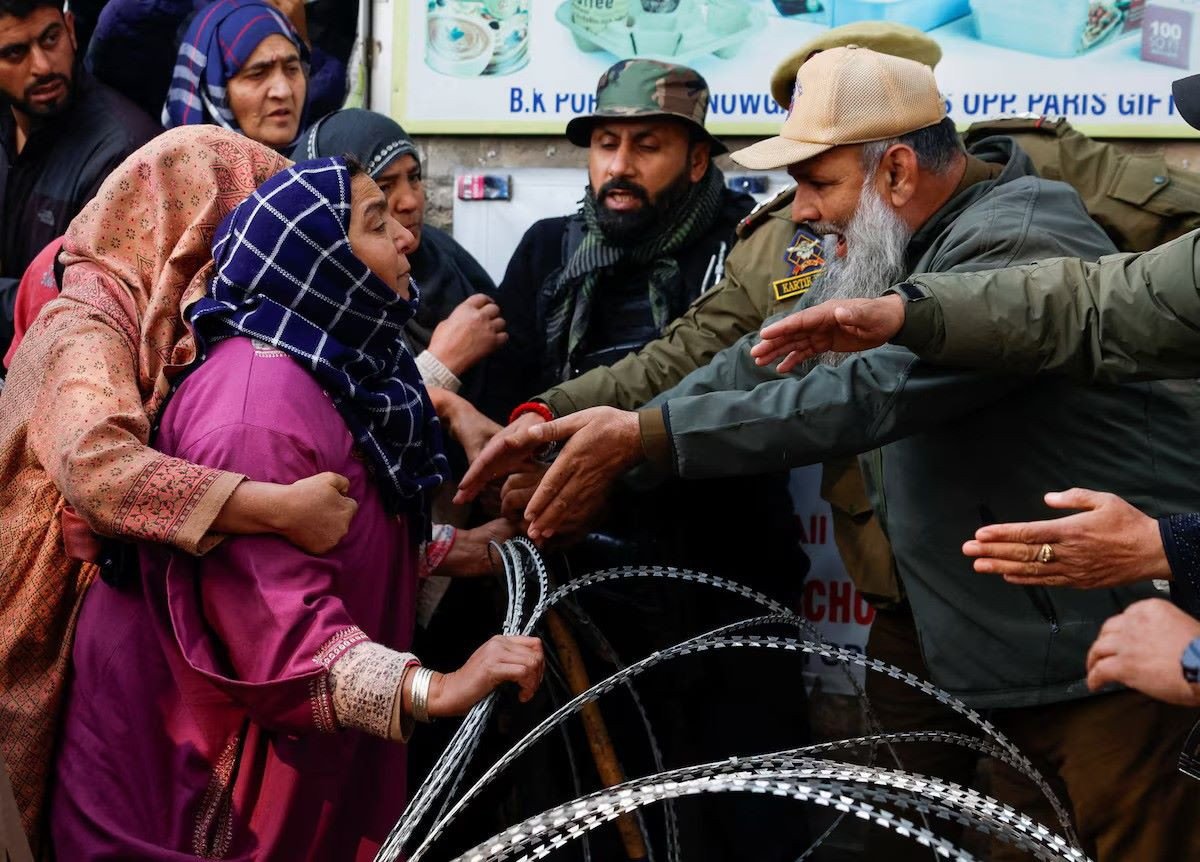
A woman urges Indian security personnel to release the body of her brother, Muhammad Shafi Parry, who was killed in an explosion at a police station in Srinagar, Indian Kashmir, November 15, 2025. PHOTO: REUTERS
Indicating there was no militant involvement in the incident, Prabhat said forensic and chemical examinations of previously recovered explosive materials were under way when “an accidental explosion” occurred on Friday night.
“Any other speculation into the cause of this incident is unnecessary,” he said. The identification of the bodies was under way, as some have been completely burnt, a police source said.
“The intensity of the blast was such that some body parts were recovered from nearby houses, around 100-200 metres away from the police station,” the source said.
Earlier, a local police official told Reuters an explosion had ripped through Nowgam police station. The official said fire had engulfed the compound and fire tenders had been rushed to the spot.
The blast occurred four days after a deadly car explosion in the Indian capital New Delhi killed at least eight people in what the government has called a terrorist incident.
Nuclear-armed neighbours India and Pakistan have for decades fought periodic wars over the disputed region and Pakistan claims IIOJK as per UN resolution.
Minister of State for Interior Talal Chaudhry accused the Tehreek-e-Labbaik Pakistan of attempting to incite unrest under the pretext of demonstrating for Gaza, despite the recent announcement of a peace plan and ceasefire aligning with Palestinian demands. Speaking to reporters outside Parliament House on Thursday, Chaudhry claimed that TLP’s planned march from Faizabad to the…
Aurangzeb praises overseas Pakistanis, reaffirms resolve to engage them in national development Pakistan and the International Finance Corporation have agreed to expedite the financial closure of the Reko Diq project, as Minister for Finance Muhammad Aurangzeb began a series of high-level engagements with global financial institutions in Washington. During a meeting with Riccardo Puliti, International…
Geneva/London: Prime Minister Shehbaz Sharif met former Prime Minister and PML-N leader Nawaz Sharif in Geneva before heading to London and briefed him on the details of the recently signed Pakistan-Saudi Arabia defense agreement. After concluding his visit to Saudi Arabia, PM Shehbaz arrived in London, making a brief stopover in Geneva to inquire about…
Growth projected to cool that reflects impact of higher tariffs, weak labour market KARACHI: The US economy, though still resilient, is showing unmistakable signs of fatigue. After two years of surprisingly strong expansion, growth is now projected to cool to around 1.6-1.8% in 2025, according to the Organisation for Economic Co-operation and Development (OECD) and…
LONDON: Rangers fired manager Russell Martin on Sunday after a dismal 1-1 draw at newly-promoted Falkirk left him with just one win from his first seven league matches in charge. Martin had to be escorted from Falkirk’s stadium by security guards after police dispersed Rangers fans that had tried to block their team bus from…
China’s former defence attache in South Asia Cheng Xizhong on Sunday spurned India’s much-delayed claim that it had shot down six Pakistani aircraft during the May conflict, terming it “self-amusement”.
Having faced international coverage of its own craft being downed by Pakistan and scathing criticism from the opposition, India’s Air Chief Marshal Amar Preet Singh — three months after the conflict — claimed yesterday that his country had shot down five Pakistani fighter jets and one other military aircraft during those clashes.
While Pakistan had already denied that India downed any of its aircraft, Defence Minister Khawaja Asif swiftly rubbished Singh’s “belated assertions” yesterday.
Commenting on the matter today, Cheng said India’s allegations lacked strong evidence and have been “widely questioned by the international community, being considered groundless”, the Associated Press of Pakistanreported.
Singh’s remarks were “comical, implausible and unconvincing”. “We may call it self-amusement,” he said in a statement.
Pakistan said it downed six Indian planes during the conflict. India’s highest-ranking general has also acknowledged that its forces suffered losses in the air, but denied losing six aircraft.
“The Indian side has not presented any evidence, such as photos of the wreckage of the fighter jets, radar monitoring data, etc, while the Pakistani side had previously presented a large amount of relevant evidence of shooting down the Indian fighter jets,” Cheng noted.
The defence expert believed that everything should be based on sufficient evidence.
He highlighted that now, more than three months have passed since the India-Pakistan clash. New Delhi has never produced any evidence to prove that it had shot down Pakistani fighter jets, Cheng highlighted.
“In contrast, the Pakistan side immediately provided a detailed technical report to international media after the clash ended,” he added.
The Chinese expert also cited “confirmations from world leaders, senior Indian politicians, and foreign intelligence assessments that India suffered heavy losses of multiple aircraft”.
“It is thus evident that no Pakistani fighter jet was hit or destroyed by the Indian side. On the contrary, the Pakistani side shot down six Indian fighter jets and destroyed S-400 air defence positions, among other achievements, which is an indisputable fact,” he added.
Professor Cheng is currently a senior research fellow at the Chinese think tank Charhar Institute and has also served as a former United Nations senior military observer, according to CGTN.
In his claims yesterday, the Indian Air Force (IAF) chief did not mention the type of Pakistan’s fighter jets that he insisted were taken down.
Asif, responding to Singh, stated that “not a single Pakistani aircraft was hit or destroyed” by India. He declared that Pakistan took out six Indian jets, S-400 air defence batteries and unmanned aircraft of India while “swiftly putting several Indian airbases out of action”.
Former envoy to the United States Dr Maleeha Lodhi also termed Singh’s claim “laughable”, quipping that it took him “several months to count the planes to make this ridiculous assertion!”
Criticism also echoed from within India. Congress spokesperson Pawan Khera cast his doubts, saying: “The question we have after today’s information … when we had such a strong army and we were advancing, then under whose pressure did you stop Operation Sindoor?”
New Delhi had previously claimed it had downed “a few planes”, refusing to go into the specifics of it. US President Donald Trump has echoed the figure of “five jets” shot down during the military confrontation, albeit without specifying which side’s craft he was referring to.
India’s loss of jets affirmed globally
France’s air chief, General Jerome Bellanger, has previously said that he has seen evidence of the loss of three Indian fighters, including a Rafale. The IAF has not commented on those claims.
Days after the air combat, The Washington Post, based on visual evidence analysed by experts, reported that at least two French-made Indian fighter aircraft were shot down by the Pakistan Air Force (PAF).
India’s defence attache to Indonesia, Indian Navy Captain Shiv Kumar, acknowledged in June that the PAF downed Indian fighters, according to The Wire.
India’s intelligence failure was central to the hour-long air battle with Pakistan, which led to the downing of Rafale aircraft by the PAF’s J-10 fighters using PL-15 missiles, according to a Reutersreport.
In a press briefing two days after the May 7 air combat, Air Vice Marshal (AVM) Aurangzeb Ahmed, the deputy chief of operations of Pakistan Air Force (PAF), shared the locations where five Indian jets were downed — four along the Line of Control and one near Bathinda in northwest India. He also disclosed that one of the Indian jets was downed by Pakistani air defence systems.
According to a Dawnreport, which cited PAF officials, India’s three Rafales, one Su-30MKI and one MiG-29 were downed within a 40-minute span. Not a single Pakistani jet crossed the border or engaged in close combat.
Describing the engagement as a textbook case of modern aerial warfare, AVM Aurangzeb had said Pakistan had tracked over 70 Indian aircraft — including 14 Rafales — using its Electromagnetic Operational Environment and responded with a concentrated and pre-planned defensive counter-air strategy.
“Our side deployed 42 high-tech aircraft,” the PAF officer said. He noted that while India remained on its side of the border and launched air-to-ground weapons, Pakistani defences detected and engaged the threats instantly.