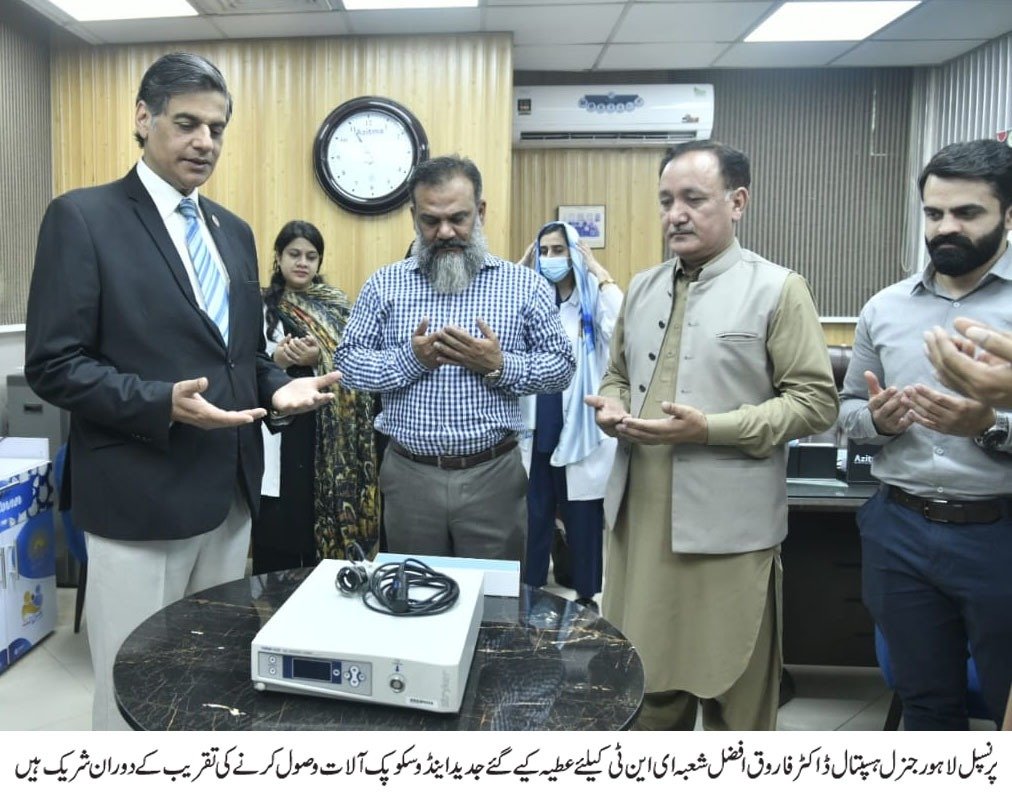
LGH ENT Department Equipped with Advanced Endoscopic Technology to Facilitate Complex Skull Base Surgeries
By Farzana Chaudhry | Lahore, PakistanLAHORE, May 6: The ENT Department of Lahore General Hospital (LGH) has been equipped with advanced endoscopic technology, enabling the facility to perform complex skull base surgeries with greater precision and safety.Principal of the Postgraduate Medical Institute (PGMI), Prof. Dr. Farooq Afzal, stated that the donation of modern endoscopic equipment…
By Farzana Chaudhry | Lahore, Pakistan
LAHORE, May 6: The ENT Department of Lahore General Hospital (LGH) has been equipped with advanced endoscopic technology, enabling the facility to perform complex skull base surgeries with greater precision and safety.
Principal of the Postgraduate Medical Institute (PGMI), Prof. Dr. Farooq Afzal, stated that the donation of modern endoscopic equipment by the Society of Rhinology and Endoscopic Skull Base Surgery (SORESS) represents a significant step toward integrating cutting-edge technology into the hospital’s clinical framework.
During a briefing, Head of ENT Unit I, Dr. Amer Ayub, and Head of ENT Unit II, Dr. Muhammad Ilyas, shared that the equipment was donated in recognition of the department’s professional excellence and the successful organization of the International Rhinoplasty Workshop held during last year’s RhinoCon conference. The ceremony was attended by Medical Superintendent LGH, Prof. Dr. Faryad Hussain, along with young doctors and healthcare professionals.
Prof. Dr. Farooq Afzal highlighted that the availability of advanced endoscopic technology will significantly enhance diagnostic and treatment standards. He noted that complex skull base surgeries can now be carried out with improved accuracy, reduced patient discomfort, and enhanced safety, ultimately providing better outcomes for patients requiring specialized care.
He further emphasized that acquiring state-of-the-art medical equipment and training young surgeons in internationally recognized techniques remain top priorities for PGMI and AMC. Such initiatives, he said, ensure that the benefits of medical advancements are delivered directly to the public, making quality healthcare more accessible.
Prof. Afzal also commended the collaboration between academic institutions and medical societies, noting that it plays a crucial role in strengthening professional training for junior doctors and advancing modern, safe healthcare services for citizens.