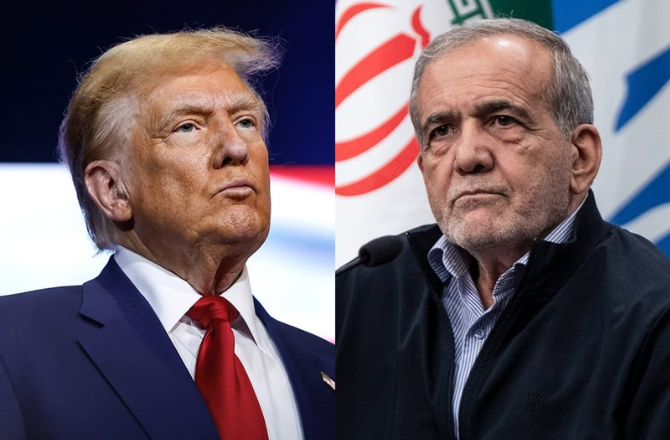
Pezeshkian Urges Trump to Avoid Stirring Turmoil, Says Dialogue Can Resolve Issues
Iranian President Accuses Israel of Sowing Discord Among Muslim Nations, Calls for Broader Islamic UnityTehran/Washington: Iranian President Masoud Pezeshkian on Saturday urged US President Donald Trump to refrain from making inflammatory and destabilizing statements, saying the ongoing dispute between the two countries could be resolved through dialogue and implementation of the Memorandum of Understanding (MoU)…
Iranian President Accuses Israel of Sowing Discord Among Muslim Nations, Calls for Broader Islamic Unity
Tehran/Washington: Iranian President Masoud Pezeshkian on Saturday urged US President Donald Trump to refrain from making inflammatory and destabilizing statements, saying the ongoing dispute between the two countries could be resolved through dialogue and implementation of the Memorandum of Understanding (MoU) between them.
Addressing a gathering in Tehran, Pezeshkian said: “If we move forward through dialogue and on the basis of the memorandum of understanding, we will resolve the issues and protect our rights.” He added that it was in everyone’s interest that “Trump does not create turmoil, and Israel does not become a source of instability and aggression.”
The Iranian president stressed that Iran does not want war but will respond firmly to any attack, and that no power can force Iran to surrender. He also accused Israel of trying to sow discord among Muslim nations and called for broader Islamic unity to counter such efforts. On domestic matters, he described maintaining industrial production through the coming winter as a “red line,” pledging that any restrictions on gas, electricity, or water would be applied first to government offices rather than the public.
Iran Still Open to Diplomacy
Six months into the conflict, Iran has signaled it remains open to diplomacy — but only if Washington abandons its pressure campaign. Iranian Foreign Minister Abbas Araghchi wrote on X: “Getting diplomacy back on track is not impossible. It depends on the US grasping one simple fact: pressure does not work.” He urged the US to “restore trust, speak with respect, recognize our rights, and honor its commitments.” Following a week of talks with Oman and Pakistan, Araghchi met his Qatari counterpart in Tehran on Thursday to discuss the Strait of Hormuz, which Iran had shut at the start of the war.
Iran Acknowledges Economic Damage from US Sanctions
In a notable shift, Pezeshkian acknowledged in a state television interview on Friday that US sanctions are damaging Iran’s economy — reversing his earlier insistence that they had no effect. He said: “Some people say sanctions have no impact; I really don’t know what to say to them. We are in a state of war, and we must acknowledge these wartime conditions.” His remarks came days after US Treasury Secretary Scott Bessent outlined plans to economically “strangle” Iran and warned of consequences for countries that do not join the US pressure campaign.
The Iranian cabinet on Saturday reaffirmed its resolve to resist what it called “unjust sanctions” and “conspiracies” imposed by the United States, saying its diplomacy would be guided by the principles of “dignity, wisdom, and expediency,” while standing firm against “American-Zionist arrogance.”