China Replaces Commercial Billboards with Scientists’ Portraits in National Science Popularization Campaign
Shopping malls, metro stations, high-speed rail terminals display images of Qian Xuesen, Yuan Longping, Tu Youyou and other researchers; Indian industrialist Harsh Goenka praises move, questions why India’s hoardings dominated by politicians and film stars Beijing/Shandong, — In a unique public campaign across China, advertising spaces typically reserved for commercial products, film stars and brands…
Shopping malls, metro stations, high-speed rail terminals display images of Qian Xuesen, Yuan Longping, Tu Youyou and other researchers; Indian industrialist Harsh Goenka praises move, questions why India’s hoardings dominated by politicians and film stars
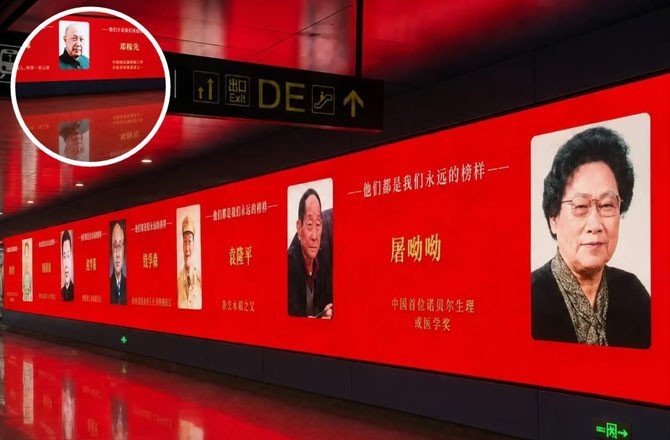
Beijing/Shandong, — In a unique public campaign across China, advertising spaces typically reserved for commercial products, film stars and brands are being replaced with portraits of the country’s leading scientists. Large LED screens, billboards, shopping malls, metro stations, high-speed rail stations and train interior displays are showing images of prominent Chinese scientists along with their achievements and brief introductions.
The campaign features rocket scientist Qian Xuesen, nuclear scientist Deng Jiaxian, agricultural scientist Yuan Longping, Nobel Prize-winning medical researcher Tu Youyou, radio astronomy expert Nan Rendong, and other distinguished researchers including Lin Qiaozhi, Qian Sanqiang, Gu Fangzhou, Wu Mengchao and Cheng Kaijia.
The initiative began prominently in Heze, Shandong province, where commercial centers put up large posters of scientists at prime advertising locations. It then spread to multiple cities in Shandong including Zibo, Binzhou, Tai’an, Dongying and Jinan, before reaching Hulunbuir in Inner Mongolia, Hefei in Anhui, Ji’an in Jiangxi, Zhengzhou in Henan and other regions.
In Jinan, the campaign has taken on a particularly large scale. Metro Line 4 is running a special train titled “Journey Toward Light, Promoting the Spirit of Scientists” with six carriages showcasing achievements from ancient Chinese scientific figures to modern-era distinguished scientists. A permanent thematic wall for scientists has also been built at one metro station.
Shandong’s campaign has been linked to the “10,000 Screens Interconnection” project, with 25 high-speed rail stations’ large screens, 212 high-speed trains’ interior screens and approximately 8,700 Jinan metro screens displaying content about scientists’ contributions. Videos about scientists are also being broadcast in security screening areas at Shandong airports.
A notable feature of the campaign is that many posters use youthful photos of scientists. Organizers and supporters say the aim is to make young people realize that those now remembered as great names in national science history were once dream-seeking youth like themselves. The effort seeks to make scientific achievement part of daily urban life rather than limiting it to books and museums.
Chinese sources have described this as giving scientists the most prominent place in public visibility. A passenger in Jinan told media that seeing so many scientists in the metro was unexpected, and highlighting their contributions in public spaces would allow more people to learn about them.
September is being used across China as National Science Popularization Month for large-scale activities. The Shandong Science Association and other institutions have planned activities across the province for the 2026 National Science Month under the theme “Technology Changes Life, Innovation Wins the Future.”
The China Association for Science and Technology (CAST), together with 34 government departments and organizations, launched the 2026 National Science Popularization Month on Tuesday, kicking off a month of exhibitions, hands-on activities and public science programs across China.
The campaign has attracted attention beyond China. Indian industrialist Harsh Goenka raised the question on social media on August 31, citing China’s example, asking why India’s large public advertising spaces are mostly filled with politicians and film stars.
He emphasized the need to highlight scientists, teachers, doctors, innovators and other figures who contribute to nation-building. “The society that prominently praises certain people affects children’s aspirations and role models,” Goenka said.
Supporters of the Chinese campaign say the real change is not just replacing advertising posters for one day, but ensuring children and young people repeatedly see names and faces in daily life whose recognition comes not from fame or wealth but from research, discovery and public service. Bringing scientists to the city locations where the most eyes fall is an attempt to give practical shape to this thinking.