
Switzerland Tests Sheep’s Wool to Protect Melting Glaciers in Eco-Friendly Alternative to Plastic Covers
‘Keep It Wool’ project on Tsanfleuron Glacier shows wool blankets limit melting as effectively as synthetic geotextiles; 40-70% of Swiss sheep wool discarded annually now put to useSwiss researchers are conducting an unusual experiment in the Alps to see whether sheep’s wool can help protect the country’s shrinking glaciers. The “Keep It Wool” project, led…
‘Keep It Wool’ project on Tsanfleuron Glacier shows wool blankets limit melting as effectively as synthetic geotextiles; 40-70% of Swiss sheep wool discarded annually now put to use
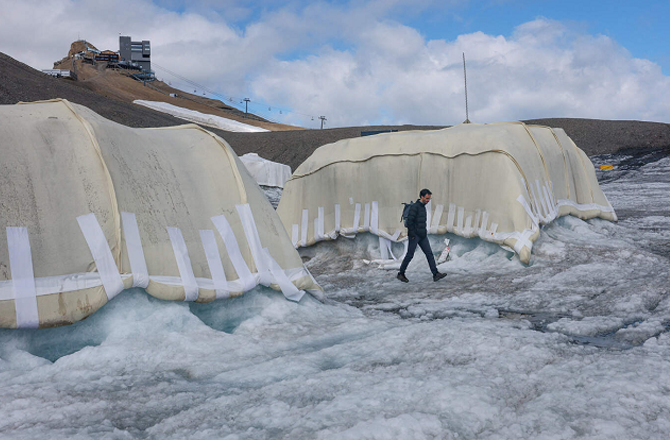
Swiss researchers are conducting an unusual experiment in the Alps to see whether sheep’s wool can help protect the country’s shrinking glaciers. The “Keep It Wool” project, led by environmental group Summit Foundation and the University of Lausanne, is using wool to slow the melting of the Tsanfleuron Glacier in western Switzerland.�
In June, two prototype wool blankets made by Swiss firm Fisolan were laid on 200 square meters of the Tsanfleuron Glacier. Throughout the summer, researchers compared their performance with that of a conventional geotextile cover. Early results have exceeded expectations, with measurements taken every two weeks showing the wool covers limited melting as well as the synthetic ones.�
Typically, glacier ice is covered with artificial blankets to prevent it from absorbing solar heat. However, these artificial covers are non-biodegradable and place an additional burden on the environment. The research team decided to use sheep’s wool as an insulating and heat-reflecting layer to test an environmentally friendly, biodegradable alternative.�
Project manager Timothee Steiner said the team wanted to explore a biodegradable alternative while finding a use for Swiss wool, 40 to 70 percent of which is discarded each year. Using sheep’s wool offers two major benefits: first, plastic materials are no longer necessary for protecting ice, and second, wool that would otherwise be wasted can be put to a new purpose.�
Eliott Gapieu, a University of Lausanne student involved in the project, said: “Now we have an environmentally friendly solution that can not only be imagined but also seen and touched.”�
Although researchers have obtained positive results from using sheep’s wool, they have made clear this is not a solution to global warming. Reducing greenhouse gas emissions remains extremely necessary to protect glaciers from large-scale melting.�
The Tsanfleuron Glacier, where the experiment is being conducted, spans approximately 3.5 kilometers. The wool covers reduced ice loss by 50-70 percent, comparable to synthetic fiber blankets, according to the Summit Foundation.�
The issue of glacier melting has gained urgency following devastating floods in Nepal. The flooding was caused by a sudden release of water accumulated in a glacial lake, known as a “Glacial Lake Outburst Flood” (GLOF).
Scientists have warned that the Himalayan region is warming faster than other parts of the world, with temperatures in Nepal’s glacier collapse area having increased 4.7 degrees Fahrenheit since 1940, twice the average global warming rate. Many other glaciers face similar risks.
According to recent research by the International Centre for Integrated Mountain Development (ICIMOD), glaciers across the Hindu Kush Himalaya region are melting at an accelerating rate, with ice loss rates doubling since 2000. Between 1990 and 2020, Hindu Kush Himalaya glaciers lost about 12 percent of their total area and 9 percent of their estimated ice reserves.
Around 200 glacier lakes across the entire Hindu Kush Himalaya are deemed dangerous, with 47 glacial lakes across Nepal’s Koshi, Gandaki and Karnali river basins classified as Potentially Dangerous Glacial Lakes. Nepal’s own glaciers lost close to a quarter of their surface area between 1977 and 2010, and that pace has almost certainly accelerated since.
Scientists monitoring the pace of change have found that glaciers across the region lost mass around 65 percent faster during the 2010s than in the decade before. ICIMOD’s most recent assessment found that even if the world holds warming to the Paris Agreement’s most ambitious target of 1.5 degrees Celsius, the region would still see roughly 30 percent of its glacier volume disappear by 2100.


