Israel election: Netanyahu unveils new security plan; opposition calls it a collection of ‘empty slogans’
Jerusalem (Staff Reporter) — Ahead of Israel’s parliamentary elections scheduled for October 27, Prime Minister Benjamin Netanyahu has presented a new plan based on 10 principles of national security, emphasising preemptive military strikes, buffer zones along borders, stronger intelligence and investment in advanced technology. However, opposition leader Yair Lapid dismissed it as “superficial” and “bizarre,”…
Jerusalem (Staff Reporter) — Ahead of Israel’s parliamentary elections scheduled for October 27, Prime Minister Benjamin Netanyahu has presented a new plan based on 10 principles of national security, emphasising preemptive military strikes, buffer zones along borders, stronger intelligence and investment in advanced technology. However, opposition leader Yair Lapid dismissed it as “superficial” and “bizarre,” mocking that it appeared to have been written by the free version of an AI chatbot, while former military chief Gadi Eisenkot called it “pages filled with empty slogans” and a manifestation of a “strategic vacuum” in Israel’s security policy.
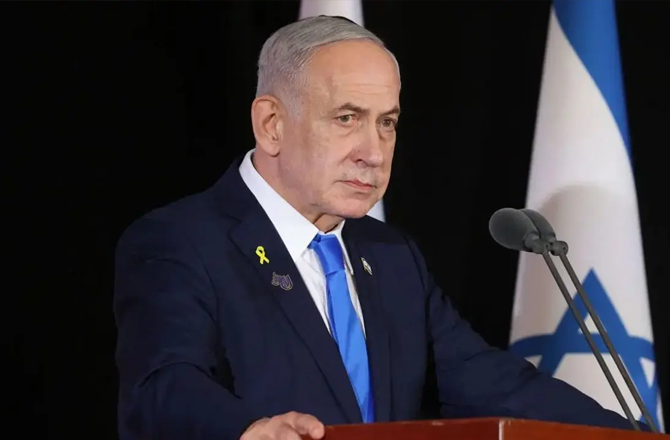
Israeli Prime Minister Benjamin Netanyahu released a new document on national security on Sunday, emphasising a shift in the country’s defence strategy towards preemptive military action, border buffer zones and achieving military superiority. The three-page document presents 10 principles.
The plan came just nine days before the October 27 parliamentary elections, prompting opposition leaders to question it and accuse the prime minister of using security as an election campaign issue to divert attention from past security failures. The document, published on the Israeli government’s website, is titled “Prime Minister Benjamin Netanyahu’s Security Doctrine.”
Netanyahu claimed in it that Israel’s military operations in Gaza, Lebanon, Yemen and Iran had broken the encirclement around the country, which he had long described as an Iranian-led siege. According to him, these operations also eliminated the immediate threat of “nuclear annihilation.” In this context, the document supports a strategy of launching preemptive military strikes when necessary, rather than responding defensively after threats emerge. These are Netanyahu’s claims, while the opposition is challenging his government’s position on military successes.
The new plan also prioritises making intelligence systems more effective, increasing domestic arms production and investing in advanced technologies such as artificial intelligence and quantum computing. It also supports establishing buffer zones along Israel’s borders when necessary and expanding settlements in areas Netanyahu describes as “Israeli land.” However, the document does not specify where these buffer zones would be established or what measures could be taken in neighbouring areas for this purpose.
Opposition leader Yair Lapid mocked the document’s release, calling it “superficial” and “bizarre.” He said it felt as though the document had been prepared by the free version of an AI chatbot. According to Lapid, listing principles on a few pages is not equivalent to presenting a comprehensive national security strategy.
He pointed to contradictions between the plan’s claims and Netanyahu’s actual policies, criticising the exemption of ultra-Orthodox Jews from military service, the deterioration of Israel’s international relations and the decision not to establish a state commission of inquiry into security failures before the October 2023 attack.
Former Israeli military chief and leader of the opposition Yashar party, Gadi Eisenkot, also rejected the plan. Describing it as “pages filled with empty slogans,” he said it reflected a “strategic vacuum” in Israel’s security policy.
According to Eisenkot, publishing the document days before the elections was an attempt to divert public attention from the government’s performance and security failures. He accused Netanyahu of exploiting public fears and anxiety for electoral gain.
Eisenkot also challenged the prime minister’s claim that Israeli military operations had eliminated the threats facing the country. According to him, Hamas still maintains an armed presence in Gaza, while Hezbollah is reorganising its capabilities in Lebanon.
He said that as long as these threats exist and a comprehensive inquiry into the security failures of October 2023 has not been conducted, a document consisting merely of principles and announcements cannot be called a complete national security strategy. Eisenkot pledged that if a government is formed under opposition leadership, a formal and comprehensive national security strategy will be prepared and approved within 150 days of taking office.
National security, accountability for the failures of October 2023, the outcomes of military operations and Israel’s international relations remain key issues in Israel’s election campaign. Netanyahu’s new document has further highlighted the ongoing political differences over these matters.