Nobel Prize in Chemistry goes to Henri Kagan and Kenso Soai for solving a century-old molecular puzzle
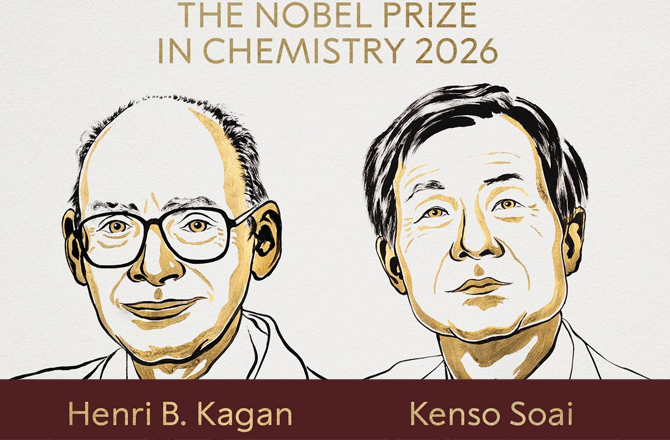
Stockholm, The 2026 Nobel Prize in Chemistry has been awarded to French scientist Henri B. Kagan and Japan’s Kenso Soai. The Royal Swedish Academy of Sciences announced on Wednesday, October 7, that the two were honored for “the discovery of non-linear effects and autocatalysis in asymmetric organic synthesis.”Their research made key progress on a long-standing…
Stockholm,
The 2026 Nobel Prize in Chemistry has been awarded to French scientist Henri B. Kagan and Japan’s Kenso Soai. The Royal Swedish Academy of Sciences announced on Wednesday, October 7, that the two were honored for “the discovery of non-linear effects and autocatalysis in asymmetric organic synthesis.”
Their research made key progress on a long-standing scientific puzzle: why living systems almost always use only one of the two mirror-image forms of certain molecules. This property is called homochirality. Some molecules can exist in forms that are mirror images of each other, just as a person’s left and right hands are reflections but not identical. In chemistry, such molecules are called chiral. According to the Nobel Committee, the basic building blocks of life, including amino acids, exist in such forms, but biological systems generally prefer just one of them.
How nature favors one mirror-image form over the other had been one of chemistry’s major puzzles for more than a century. Kagan and Soai’s work showed ways to control chemical reactions so that one particular chiral form is produced in greater quantity than the other. The committee said the work helped explain how homochirality can arise spontaneously.
In the 1980s, Kagan worked on chemical reactions that can amplify a slight initial imbalance in a molecule, helping show how a small advantage of one mirror-image form in a reaction can be magnified. In the 1990s, Soai made further important advances through experiments on autocatalysis, or self-driven reactions. The Soai reaction, named after him, showed how a particular chiral molecule can act as a catalyst that promotes the formation of more molecules of the same structure.
Heiner Linke, chair of the Nobel Committee for Chemistry, said Kagan and Soai have offered a solution to this century-old puzzle of how homochirality can arise spontaneously. He called the chemical reactions the two developed extraordinary.
The importance of the research goes beyond basic science. The two mirror-image forms of a molecule may look chemically alike, but their effects in the human body can differ. When developing a drug, scientists must determine which form produces the desired effect. One form may be therapeutic while the other is less effective or even harmful. For this reason, chiral chemistry has become an important part of modern drug development.
The historic case of thalidomide shows why the distinction matters. In the early 1960s, the drug was linked to severe birth defects, and later research turned attention to the biological effects of the different mirror-image forms of the molecule. The episode underlined the importance of understanding molecular structure and chirality in pharmaceuticals.
Kagan is 95 and has been associated with France’s Paris-Sud University. He has done prominent work in asymmetric organic synthesis and chiral chemistry for decades. Soai is 76 and has been affiliated with the Tokyo University of Science. In a phone conversation with the Nobel Committee when the prize was announced, Soai said he was very excited and called it one of the “most exciting days” of his life. He said he was shopping near his home when the committee contacted him.
This year’s chemistry prize is the third major science prize of Nobel week, following the medicine and physics awards. The literature and peace prizes are also to be announced this week. Kagan and Soai will share the prize money of 12 million Swedish kronor, and will also receive a gold medal and a diploma. The formal Nobel ceremony will take place in Stockholm on December 10, the anniversary of Alfred Nobel’s death.