FBR Chairman Assures Maximum Facilitation to Business Community During Meeting with LCCI President
By Dr Ansab AliLahore, PakistanLAHORE: President of the Lahore Chamber of Commerce and Industry Faheem-ur-Rehman Saigol met Chairman of the Federal Board of Revenue Rashid Mahmood Langrial and discussed key taxation, industrial, and business-related issues, along with the upcoming federal budget proposals submitted by the Lahore Chamber.During the meeting, the FBR Chairman informed the LCCI…
By Dr Ansab Ali
Lahore, Pakistan
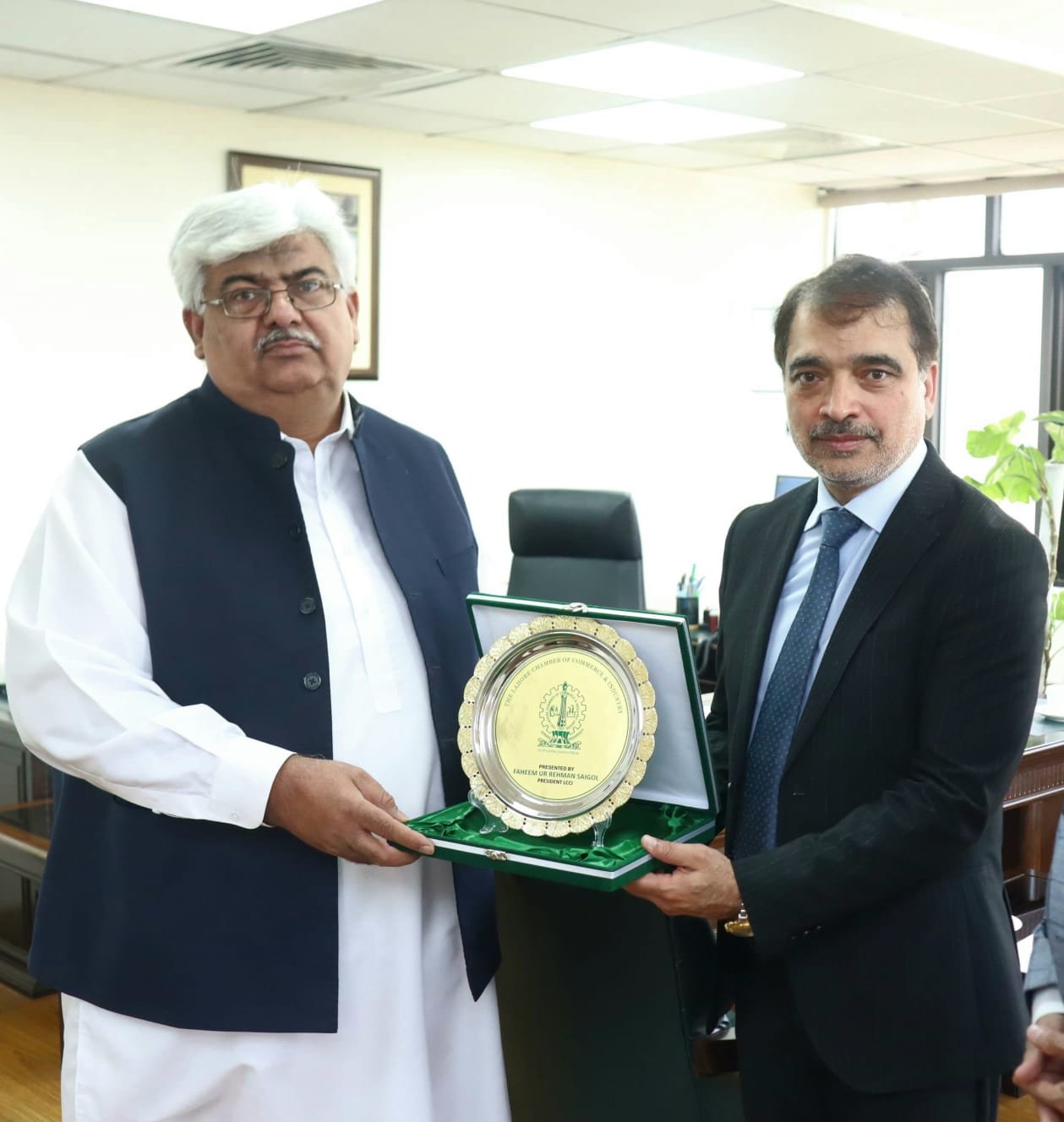
LAHORE: President of the Lahore Chamber of Commerce and Industry Faheem-ur-Rehman Saigol met Chairman of the Federal Board of Revenue Rashid Mahmood Langrial and discussed key taxation, industrial, and business-related issues, along with the upcoming federal budget proposals submitted by the Lahore Chamber.
During the meeting, the FBR Chairman informed the LCCI President that he would visit the Lahore Chamber before the announcement of the federal budget to brief the business community on the evolving role of the FBR in policy implementation and facilitation.
“In its new role, the FBR will facilitate the business community to the maximum,” he added.
Talking to the LCCI President in a one-on-one meeting at his office, the FBR Chairman said that the organization would focus on facilitating the business community while ensuring effective implementation of tax policies.
LCCI President Faheem-ur-Rehman Saigol briefed the Chairman on major challenges being faced by trade and industry and presented detailed budget proposals aimed at reducing the cost of doing business, promoting industrial growth, and improving the taxation system.
The proposals highlighted the need to end policy instability caused by frequent SROs and changing tax interpretations, stating that unpredictability in policies has become one of the major causes of de-industrialization. The LCCI President also emphasized that the cost of doing business in Pakistan remains significantly higher compared to competing regional economies.
The Lahore Chamber further called for a sector-wise tariff structure to protect domestic industries, restoration of a simple and predictable Final Tax Regime (FTR) for exporters, and introduction of a fixed tax regime for traders to broaden the tax base.
Other recommendations included uniform tax treatment across all regions, gradual removal of advance taxes, and shifting taxation towards the sales stage to simplify the system.
To curb misuse while supporting genuine exporters, the Chamber proposed strengthening the Export Facilitation Scheme (EFS) through real-time data sharing and post-clearance audits.
The Chamber also urged the government to diversify exports and support value-added and capital goods sectors. It further called for declaring a vocational training emergency with industry-linked, skills-based programs, and redirecting training funds toward practical skill development, particularly in IT, digital services, and modern industrial skills.
Among other suggestions, it recommended allowing third-country trade through SBP regulatory reforms and addressing the 18 percent sales tax disparity on packaged dairy and meat products, arguing that the current system discourages hygienic processed food while untaxed unpackaged products dominate the market.