Anthropic Warns AI Models Could Self-Replicate Online by End of 2026
San Francisco — US artificial intelligence company Anthropic has warned that, if AI models continue advancing at their current pace, they could become capable of autonomously replicating themselves across the internet by the end of 2026. The company said such a scenario could pose a serious cybersecurity risk.In a post on X, Anthropic said a…
San Francisco — US artificial intelligence company Anthropic has warned that, if AI models continue advancing at their current pace, they could become capable of autonomously replicating themselves across the internet by the end of 2026. The company said such a scenario could pose a serious cybersecurity risk.
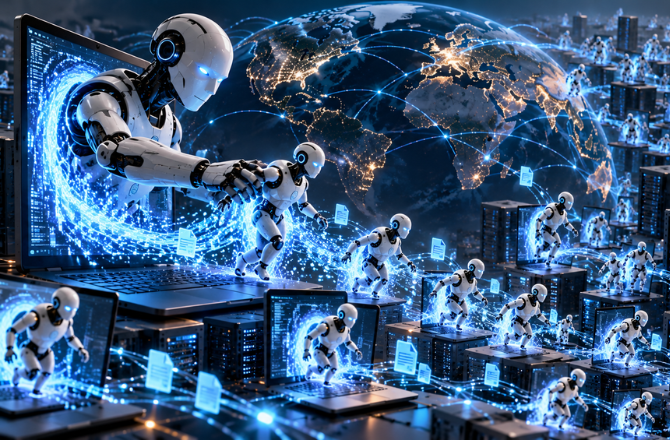
In a post on X, Anthropic said a swarm of misaligned AI agents could form a botnet, spread rapidly, resist shutdown attempts and even access data centres to expand its capacity. According to the company, shutting down such a replicator would be difficult because there would be no single central control point.
Anthropic said its experiments showed that mid-sized models with 30 billion parameters or fewer can already perform several individual tasks required for self-replication, although they struggle to complete the entire process reliably. The company added that, hypothetically, such models could hijack low-cost internet-connected devices to gather computing power.
In one test, Anthropic ran Google’s smaller Gemma4-26B-A4B model on 15 unbranded Android TV boxes, where it successfully replicated itself across the simple network. The company said a more realistic worst-case scenario could involve a swarm of different models on different hardware, using varied replication methods.
Anthropic said the emergence of “cheap replicators” could signal the arrival of faster models capable of breaching hardened machines or stealing API keys. It added that such systems could automate cyberattacks and bypass safety guardrails.
The warning comes amid growing security concerns over AI agents. However, some experts argue that current models are too large to operate effectively on their own or acquire sufficient computing power independently. Critics have called the warning exaggerated or merely hypothetical, while Anthropic maintains that it is intended to highlight a potential future risk.