US Confirms Loss of Expensive MQ-4C Triton Spy Drone in Strait of Hormuz
Washington (April 15, 2026) — The United States Navy has officially confirmed the loss of one of its most advanced and expensive surveillance drones, the MQ-4C Triton, which crashed on April 9, 2026, near the Strait of Hormuz in the Persian Gulf.The MQ-4C Triton, valued at approximately $240 million, disappeared from flight tracking websites while…
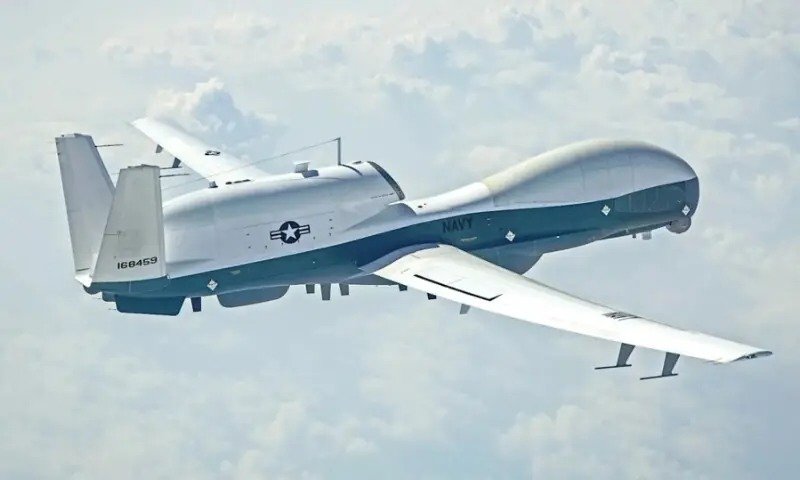
Washington (April 15, 2026) — The United States Navy has officially confirmed the loss of one of its most advanced and expensive surveillance drones, the MQ-4C Triton, which crashed on April 9, 2026, near the Strait of Hormuz in the Persian Gulf.
The MQ-4C Triton, valued at approximately $240 million, disappeared from flight tracking websites while on a routine maritime surveillance mission over the strategically vital waterway. According to open-source data from FlightRadar24 and other trackers, the drone suddenly squawked emergency code 7700, turned toward Iranian airspace, and began a rapid descent from its cruising altitude of around 52,000 feet. Its transponder signal was lost after dropping below 10,000 feet.
On April 14-15, the U.S. Naval Safety Command released a brief mishap report stating:
“9 Apr 2026 (Location Withheld – OPSEC) MQ-4C crashed; no injury to personnel.”
The incident has been classified as a Class A mishap, indicating total loss of the aircraft.
The exact cause remains unknown. While some reports and analysts have speculated possible Iranian air defense involvement, electronic warfare, GPS jamming, or a technical failure, the U.S. Navy has provided no further details and has withheld the precise location for operational security reasons.
The MQ-4C Triton, manufactured by Northrop Grumman, is the U.S. Navy’s premier high-altitude, long-endurance unmanned surveillance platform. It is capable of flying missions lasting over 30 hours and provides critical intelligence, reconnaissance, and maritime domain awareness.
The loss comes amid a fragile ceasefire between the U.S. and Iran and heightened tensions in the Strait of Hormuz — a chokepoint through which nearly 20% of global oil supplies pass. Analysts describe the incident as a significant operational setback for U.S. surveillance capabilities in the region.
No personnel were injured in the crash, as the Triton is an unmanned aerial system. The Pentagon has so far declined to comment on possible recovery efforts or further investigation details.