

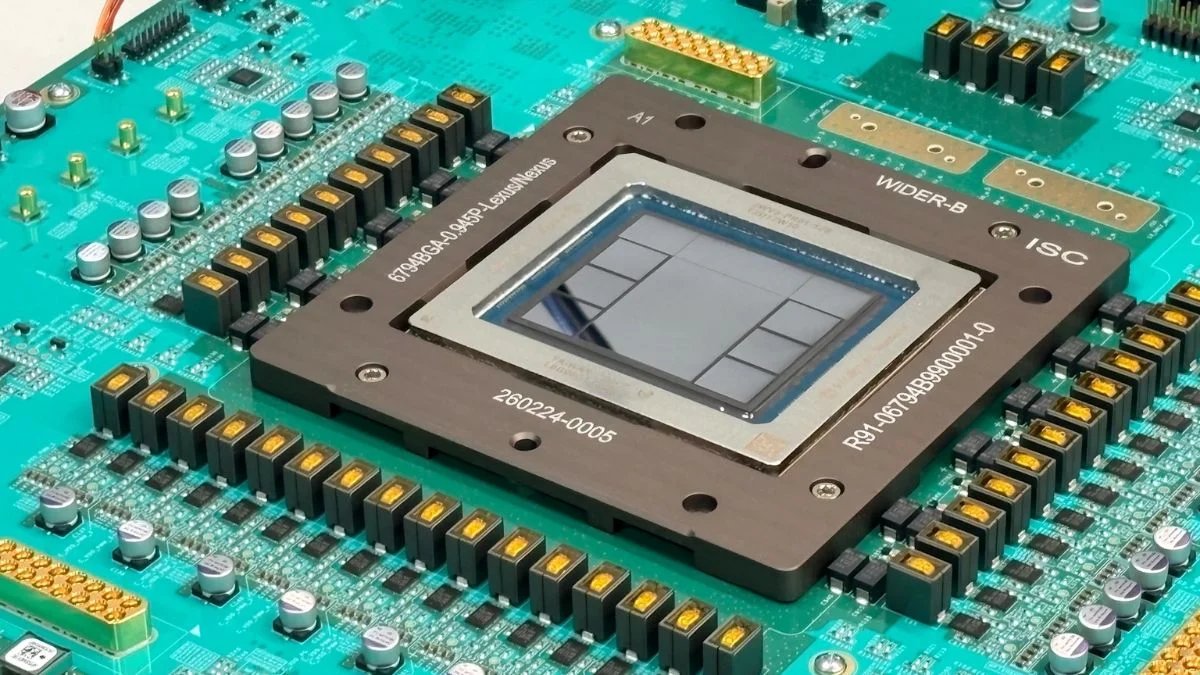
OpenAI has shared benchmark results for Jalapeno, its custom inference chip made with Broadcom. The data shows Jalapeno outperformed Nvidia’s Blackwell Ultra-based GB300 in both speed and power efficiency.
Jalapeno uses 700 watts of power, while the GB300 uses 1,400 watts. This highlights Jalapeno’s efficiency advantage even before considering performance.
Jalapeno was tested against rival systems using InferenceX, a public benchmark from SemiAnalysis that measures end-to-end AI request serving. Results were obtained from three large language models: GPT-OSS 120B, DeepSeek R1 670B, and Kimi K2.5 1T.
For all three models, Jalapeno delivered 1.5 to 1.9 times as much AI work per watt at peak performance as its competitors. It also lowered latency by 1.7 to 3.6 times.
With highly interactive tasks like agents, Jalapeno’s performance increased to 2.1 to 4.1 times higher. On the largest model, Kimi K2.5, Jalapeno achieved about 1.5 times better performance per watt and 3.4 times lower latency than the other hardware.
OpenAI explained that it used each chip’s published power rating to guarantee fair comparisons. Jalapeno is rated at 700 watts, but during testing, its actual power use stayed at or below 550 watts.
Jalapeno’s design focuses on the two main phases of language-model inference: prefill, which needs a lot of computing power, and decode, which relies more on memory bandwidth.
OpenAI pointed out that Jalapeno stores model state and cache data locally within one connected system. This reduces data transmission delays that typically slow inference when data moves between chips.
AI also helped build the chip. OpenAI said its models assisted in designing Jalapeno, which reduced the time from concept to tapeout to nine months.
Engineers used OpenAI’s Codex tool to quickly improve the performance of three more open-weight models in just two months. For some model parts, AI-generated code ran up to 1.8 times faster than code written by human engineers.
OpenAI plans to start using Jalapeno in its own infrastructure by the end of the year. This chip is the first in a series, with future versions already being developed. The company also said it will continue buying chips from Nvidia and other suppliers to meet growing demand.
It’s worth noting that Jalapeno was not tested against Nvidia’s newer Vera Rubin chips, which have only just started shipping. Jalapeno is also designed only for inference, not for the model-training tasks where Nvidia remains ahead.