

Researchers have created a new type of speaker that sends sound directly to one person, which could make private listening a normal part of daily life.
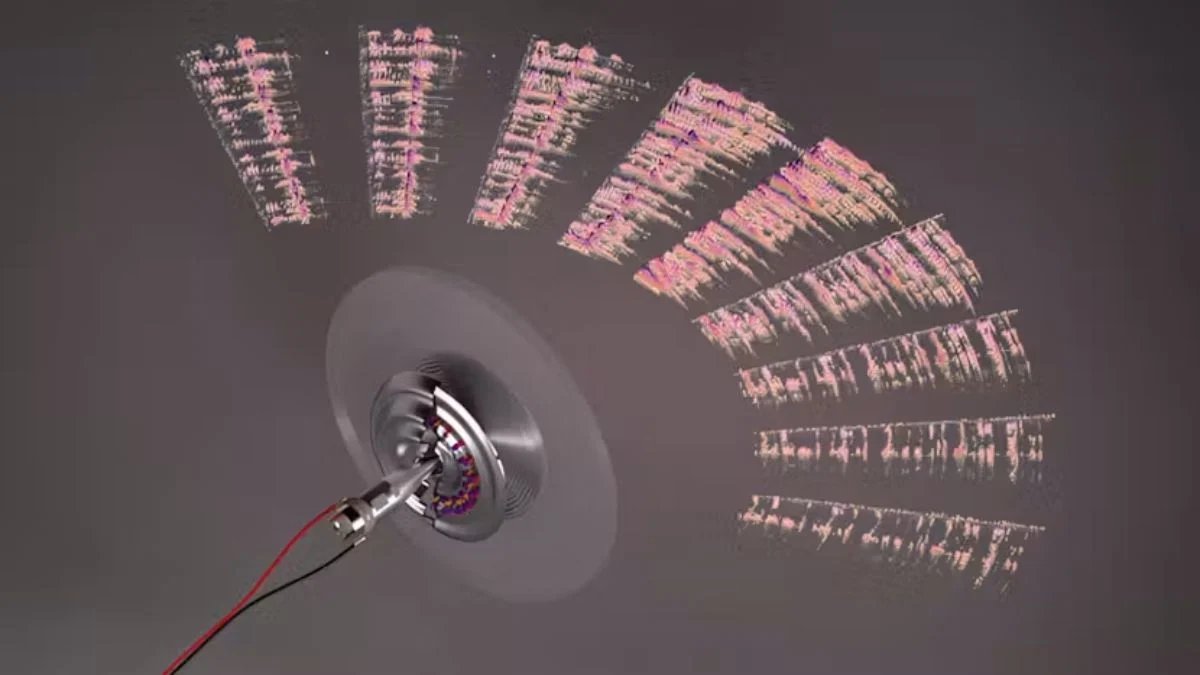
A team at Pohang University of Science and Technology (POSTECH) designed a low-cost speaker called MiPAL. It uses special materials to focus sound and prevent it from leaking out the sides.
This technology could let people enjoy personal audio in public without adding noise. For example, you could watch an action movie on a busy subway without headphones, and the person next to you would not hear a thing. Since the system prevents sound from leaking, it also avoids bothering nearby people.
Previous methods were often too expensive. Standard parametric array speakers require hundreds of costly parts to focus sound, while simpler designs often let sound leak out of the sides.
These problems are hence solved by MiPAL by using ultrasound waves mixed with regular audio. This takes advantage of how sound travels in air, sending audio directly to a single listener, similar to how a flashlight casts a beam.
It combines two specialized materials into a single device. At the front, an acoustic metasurface acts like a lens, focusing the sound into a narrow beam. At the back, elastic units stop unwanted vibrations, so no sound flees to the sides.
A metasurface is a very thin, flat material made to control light and other waves at a tiny scale.
“By designing the metamaterials and the ultrasonic device as a single system, we overcame the limitations of cost, complexity and design flexibility at the same time,” said Professor Junsuk Rho, professor at Dept. of Mechanical Engineering, POSTECH, and lead researcher.
“Research on acoustic and elastic metamaterials has largely remained at the stage of validating principles and demonstrating concepts. This study is the first to integrate metamaterials into functional device and demonstrate their potential for practical use.”
The device can play sounds from 500 Hz to 10 kHz, which covers more than four octaves of what people can hear. In tests that used real music and broadcast signals in airplane seating setups, adding the elastic units made the sound much more focused. This shows the system can give each passenger their own audio.
The device is also easy to make and customize. Since its parts are 3D-printed, engineers can quickly change the design for different seat layouts, sound directions, or other needs.
Rho pointed out that this is the first time metamaterials have been used in a working device, showing they can do more than just prove a concept. In the future, people on trains, in museums, or traveling could enjoy their own audio without headphones.