Pakistan is working with South Korea to increase the local production of disease-free and certified potato seed, in an effort to reduce reliance on imports and improve agricultural productivity.
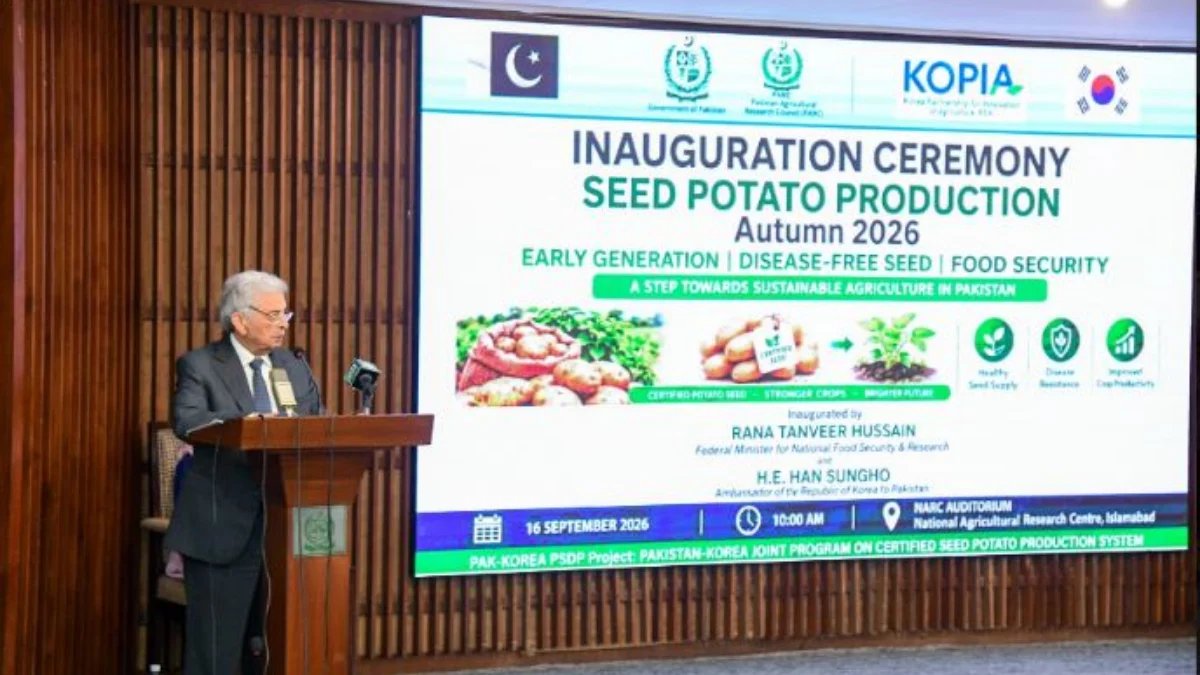
Federal Minister for National Food Security and Research Rana Tanveer Hussain said cooperation between the two countries in agricultural research and technology was helping Pakistan strengthen its capacity to produce disease-free and quality potato seed locally, reduce dependence on imported seed and improve agricultural productivity.
Speaking at an event at the National Agricultural Research Centre (NARC), the minister said the Pakistan-Korea Collaborative Project on Certified Seed Potato Production was an important step towards establishing a sustainable local seed system.
He said the use of modern technologies, particularly aeroponic production, would help ensure the availability of healthy and quality planting material for farmers and contribute to enhanced potato yields and food security.
The project is being implemented with support from the South Korean government and the Korea Program on International Agriculture (KOPIA).
It focuses on producing and supplying certified potato seed, developing aeroponic production facilities and training technical staff.
The Minister said Pakistan had set a target of producing 160,000 tonnes of certified potato seed annually, which would help meet a significant portion of the country’s seed requirement through local production.
Tanveer Hussain said technologies developed at research centers should be transferred to farmers and private companies rather than remain confined to laboratories.
He said this would help strengthen links between agricultural research and farming practices and support the development of the potato value chain.
The minister also thanked South Korea and KOPIA for their technical assistance, saying bilateral cooperation could help address practical challenges facing Pakistan’s agriculture.
He said Pakistan wanted to expand cooperation with South Korea in areas including smart farming, horticulture, livestock and agricultural mechanization.
Ambassador of the Republic of Korea appreciated the longstanding cooperation between Pakistan and Korea in agriculture, research and technology.
He said the certified seed potato project was a practical example of bilateral cooperation that could directly benefit farmers. He expressed his support for further collaboration in modern agricultural technologies, knowledge sharing and capacity building.
On this occasion, Chairman Pakistan Agricultural Research Council (PARC), Dr. Murtaza Hassan Andrabi, said that PARC and NARC were committed to developing research-based solutions for Pakistan’s agricultural challenges.
He said the Pakistan-Korea partnership was strengthening the country’s certified seed production system and introducing modern technologies that could improve productivity and reduce reliance on imported planting material.
He also emphasized the potential for expanding cooperation into agricultural mechanization, smart farming, livestock and horticulture.
The participants reviewed progress under the Pakistan-Korea Certified Seed Potato Project and visited the aeroponic and screen-house facilities at NARC, where they were briefed on ongoing research, seed multiplication and technology development activities.