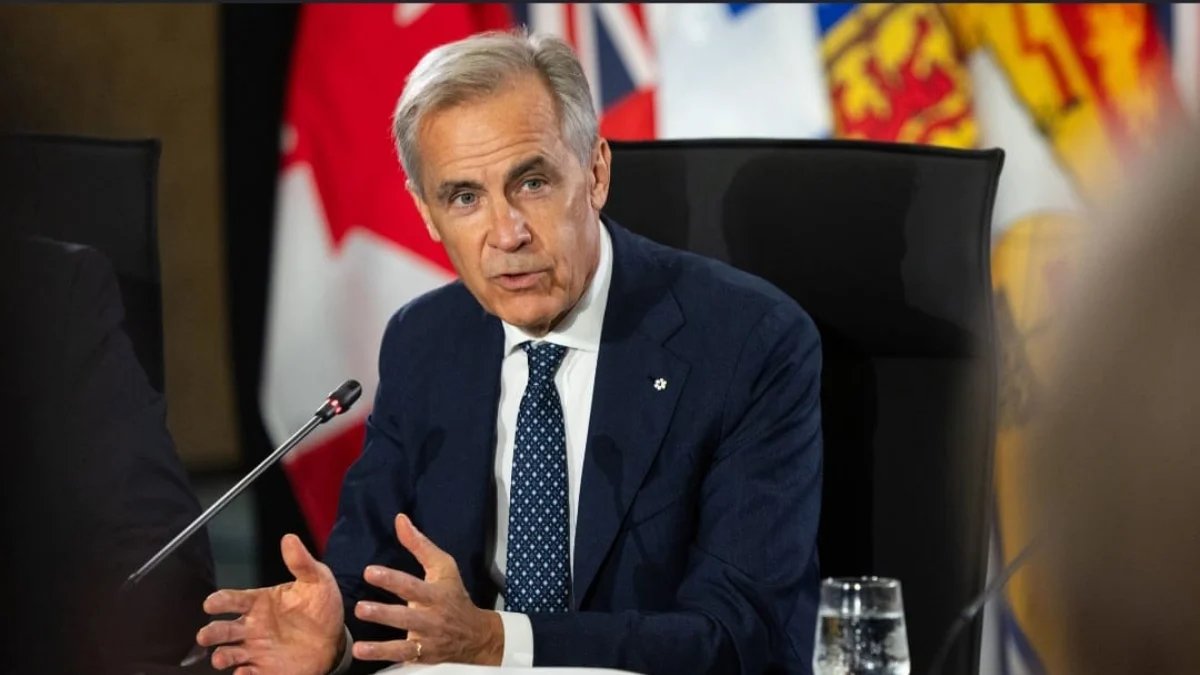
Canadian Prime Minister Mark Carney, in a wide-ranging interview with The New York Times, said there is “some evidence” tied to security concerns involving India and acknowledged he cannot guarantee that India-linked crime will not occur again in Canada.
The remarks, published in a full transcript released Sept. 27, mark Carney’s most direct public comment on the issue since he moved to restore ties with New Delhi after years of rupture under Justin Trudeau. They come as Prime Minister Narendra Modi is expected to visit Canada later this year.
Asked whether transnational repression and alleged Indian interference had “so radically changed” that they no longer posed a threat to Canadians of Indian descent, including Sikhs, Carney replied:
“First off, we think, and there’s some evidence, and I’ll leave it since I don’t want to delve into specific prosecutions, but there’s some evidence of heightened coordination and implications of that heightened coordination for protecting Canadians and protecting others.”
He added that security cooperation, which “could not take place in a rupture,” had deepened and was “helpful and good.” But he refused to offer a guarantee:
“You asked your question a bit like, almost, can I guarantee that no crime will occur in Canada? I can’t guarantee that no crime will occur in Canada.”
The interview was conducted Sept. 23 at The Times’s New York headquarters by a panel of 10 journalists and editors after Carney’s United Nations appearances. Canada bureau chief Matina Stevis-Gridneff led the India portion. The Times later summarized that Carney called increased security cooperation positive but “could not rule out further India-linked crime on Canadian soil.”
Nijjar killing and the diplomatic freeze
Hardeep Singh Nijjar, a Sikh activist and Khalistan Referendum organizer, was shot dead outside Guru Nanak Sikh Gurdwara in Surrey, British Columbia, on June 18, 2023. India had designated him a terrorist; supporters called him a community leader and political activist.
On Sept. 18, 2023, then-Prime Minister Justin Trudeau told the House of Commons that Canada had intelligence linking agents of the Indian government to the killing. India called the allegation absurd and denied any role. Diplomats were expelled on both sides. High commissioners were withdrawn. Trade talks stalled.
In October 2024, the RCMP held an unusual public briefing linking agents of the Government of India to a pattern of violent activity in Canada, including homicide, arson, extortion and intimidation.
Canada later identified persons of interest and expelled Indian diplomats and consular officials. Three Indian nationals have been charged in connection with Nijjar’s killing.
Canadian government lawyers have sought to withhold some evidence in court, arguing disclosure would harm international relations and national security.
India has consistently rejected the accusations and accused Ottawa of sheltering Sikh separatists. Canadian officials have also said they are not aware of evidence linking Prime Minister Modi, External Affairs Minister S. Jaishankar or National Security Adviser Ajit Doval personally to the crimes — a distinction that matters in diplomacy even as Ottawa maintained that Indian state agents were involved.
The legal picture remains contested. In July 2026, reporting cited RCMP Deputy Commissioner Lisa Moreland saying an organized-crime investigation and related U.S. charges against the Bishnoi network did not, in that track, charge Indian officials.
That statement does not erase earlier Canadian intelligence claims; it reflects parallel tracks — gang prosecutions versus state-agent allegations — that have not been fully reconciled in public.
Carney’s reset with New Delhi
After taking office, Carney made repairing the India relationship a priority as Canada sought partners beyond the United States amid trade conflict with Washington. He met Modi at the G7 in Canada, at the G20, and in New Delhi in March 2026. Ottawa and New Delhi restored high commissioners, revived security and law-enforcement talks, advanced a Comprehensive Economic Partnership Agreement target for late 2026, and announced a major uranium supply arrangement.
Carney said there had been more government-to-government engagement in one year than in the previous two decades.
During that reset, a senior official speaking on background before the India trip said Ottawa was “confident that that activity is not continuing.” Carney’s New York Times answer is more cautious: cooperation has improved, but no guarantee.
Sikh advocacy groups argue the rapprochement has outpaced accountability. Gurpatwant Singh Pannun, general counsel of Sikhs for Justice, said Carney’s “some evidence” line corroborates Trudeau’s 2023 parliamentary statement.
SFJ continues to name Indian officials it alleges were involved; those claims have not been tested as courtroom findings against those officials.
Amarnath Amarasingam, a Queen’s University scholar of transnational repression, told the National Post that Carney’s inability to guarantee safety can sound “a little bit dismissive” to diaspora communities who see threats as a Canadian public-safety problem, not an imported foreign quarrel.
What the interview does and does not settle
Carney did not announce new charges, name officials, or say the Nijjar case is closed. He declined to “delve into specific prosecutions.” He framed dialogue with New Delhi as more useful than “preaching from afar.”
The political tension is now explicit: Canada wants trade, energy and security cooperation with India, while still holding that serious crimes on Canadian soil remain possible and that evidence of earlier state-linked activity exists.
Modi’s expected visit will test whether Ottawa presses that file in public or keeps it inside law-enforcement channels. India is likely to repeat its denial. Canadian courts, not interviews, will decide what evidence is shown.