Qatar and Germany have voiced strong opposition to any action to halt or prevent transit through the Strait of Hormuz, saying global maritime trade corridors and trade routes must remain open, free and accessible to all without tolls or impediments.
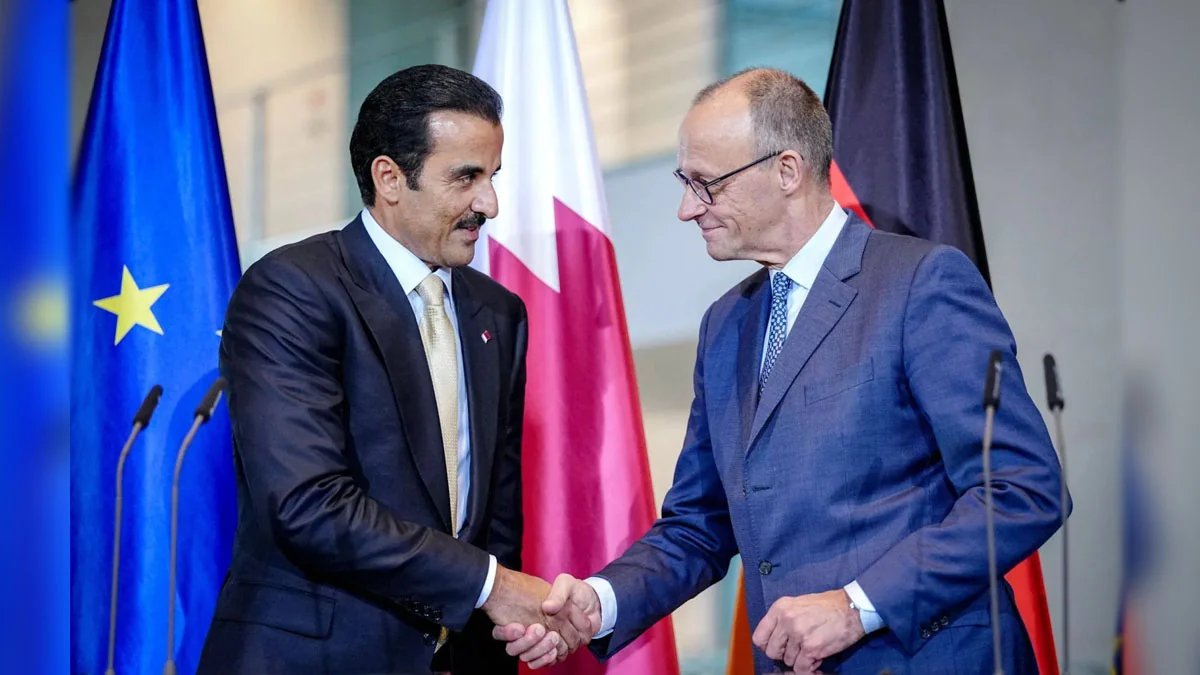
The joint statement, issued at the conclusion of Qatari Emir Sheikh Tamim bin Hamad Al Thani’s state visit to Berlin for talks with German Chancellor Friedrich Merz, strongly denounced Iranian acts of aggression and threats against merchant ships, saying this endangers international maritime safety and global trade.
Both nations also condemned Iranian strikes against Qatar and its neighbours as violations of sovereignty, international law and the UN Charter that would destabilise the region.
Doha and Berlin called for Iran to respect the UN Security Council Resolution 2817 and the freedom of navigation, condemning their neighbours’ attacks for their support of Saudi Arabia and Yemen and denouncing missile strikes by the Houthis on Saudi Arabia and the rebel group’s hold on Yemen.
They also called for the Houthis to stop military operations and assaults on commercial shipping and to resume the political negotiations, as well as demanding Iran to cease the use of ballistic missiles, their supply and funding of armed groups on the region and explicitly calling for an end to the arms supply to the Houthis.
They also reaffirmed support of Yemen’s territorial integrity, acknowledged UN envoy Hans Grundberg”s efforts to bring peace to Yemen and reaffirmed the wish that Iran will not obtain nuclear capabilities and urged the full compliance with the Non-Proliferation Treaty and International Atomic Energy Agency safeguards.
Aside from security issues in the Gulf, the joint statement underlined mutual diplomatic concerns on a host of other major crises, including support for a negotiated two-state solution on Palestine, full implementation of the Gaza conflict resolution roadmap and unhindered humanitarian access.
On Ukraine, they reaffirmed their support for Ukraine’s sovereignty and territorial integrity, welcomed Ukraine’s willingness to cooperate for an immediate ceasefire, and highlighted important negotiations about a peace settlement as well as reconstruction of the country’s energy infrastructure while seeing the Syrian financial and economic recovery as an imperative for the Middle East stability and the return of its refugees.
Recognising that diplomacy, dialogue, and mediation are the foundations for a sustainable peace, the two sides welcomed the signing of a military cooperation agreement and two security agreements for internal security, and agreed to hold the seventh round of meetings for the Joint Committee for Economic and Trade Cooperation in 2027 given the burgeoning trade and investments between them.