
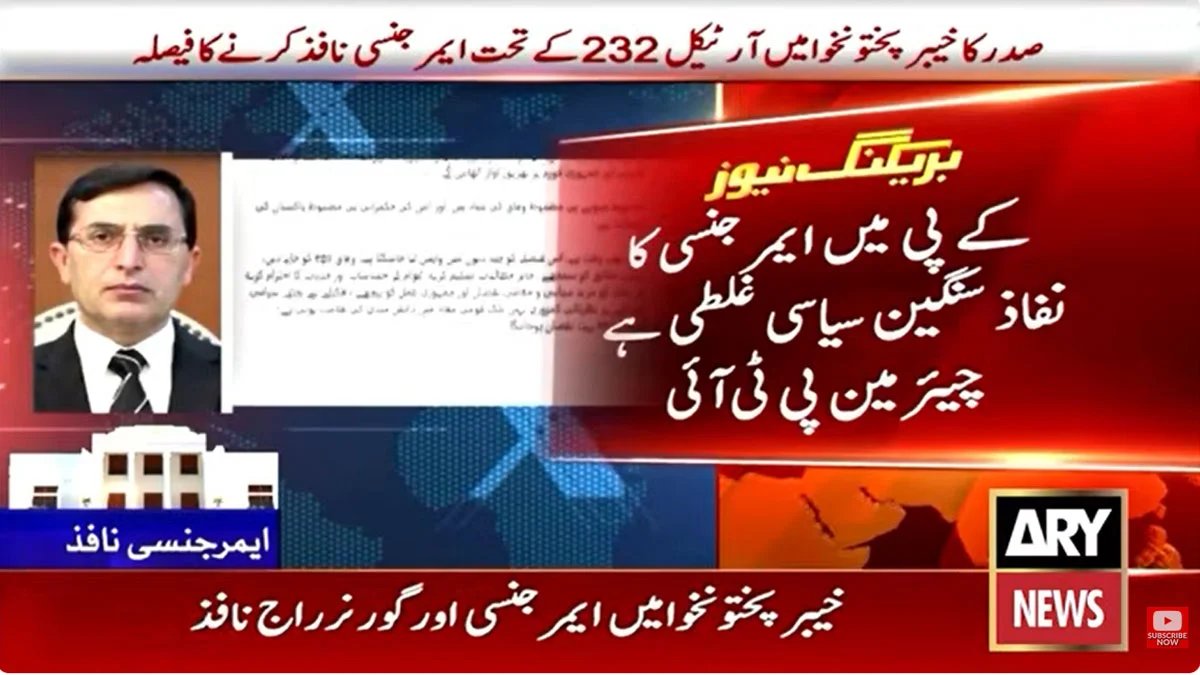
ISLAMABAD: Pakistan Tehreek-e-Insaf (PTI) Chairman Barrister Gohar Ali Khan has rejected the imposition of an emergency in Khyber Pakhtunkhwa, describing the decision as a serious political mistake and urging the federal government to reconsider it.
In his statement, Barrister Gohar said the people of Khyber Pakhtunkhwa would never accept measures that undermine their rights. He maintained that the province’s electoral mandate was a constitutional and legal right that must be respected.
He argued that peace could not be established by weakening provincial autonomy, adding that confrontation between the federal and provincial governments would not resolve the country’s problems.
The PTI chief stressed that there was no disagreement over the need to eliminate terrorism. However, he said the fight against terrorism could not be used as a justification for suppressing public voices.
“Combating terrorism is only possible through national unity,” he said, emphasising that weakening the provinces would not strengthen the federation.
Barrister Gohar maintained that the solution to the country’s challenges lay not in the use of force but in upholding the Constitution. He called for meaningful negotiations between the federal government and the provincial leadership to address outstanding issues.
Read more: Governor’s rule, emergency enforced in KP after president’s approval
He said PTI would raise its voice at every constitutional forum to protect democratic rights and urged the federal government to set aside its ego and accept legitimate demands.
The PTI chairman also said the decision to impose an emergency in Khyber Pakhtunkhwa could be reversed within days. He called on the authorities to respect public sentiment and prevent further political and economic damage to the country.
He added that reviewing political decisions should not be viewed as a sign of weakness but as a demonstration of wisdom in the national interest.
Barrister Gohar warned that failure to reconsider the decision could cause significant harm to the country, reiterating that strong provinces were the foundation of a strong federation.