
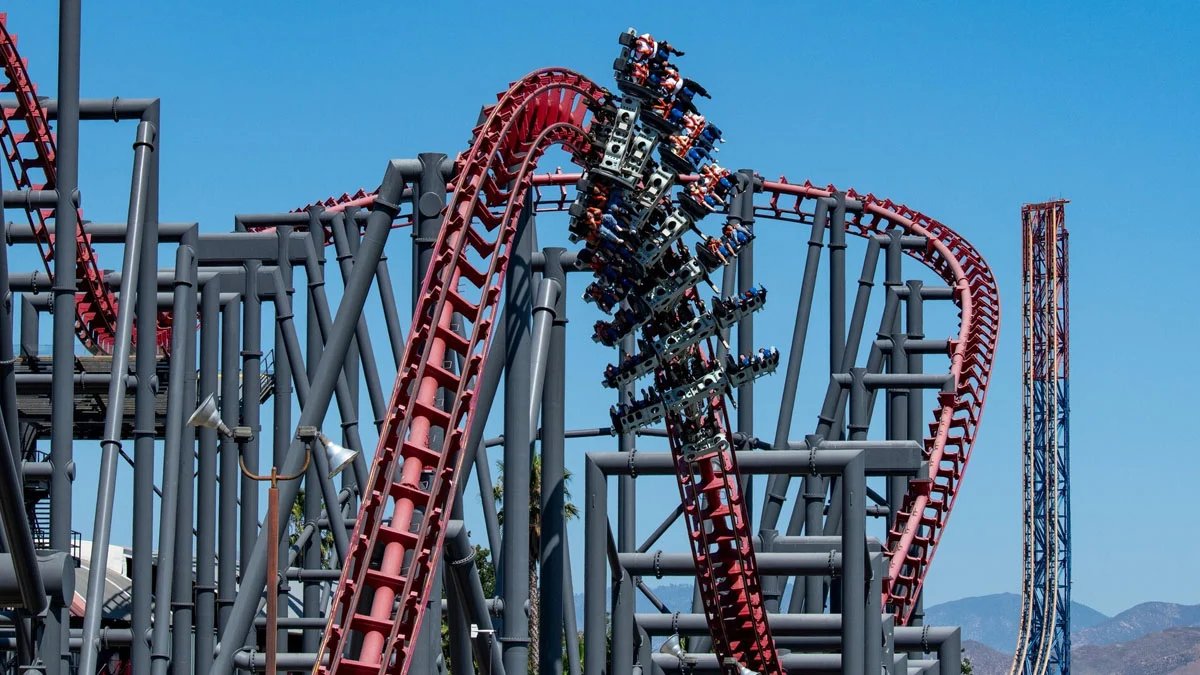
Six Flags Magic Mountain’s flagship thrill ride, X2, the Valencia, CA based roller coaster is under a massive spotlight today after reports surfaced that the notorious ride has been linked to over a dozen life-threatening emergency room trips and two deaths over the past two decades.
Officials have closed the extreme ride since mid-July of 2026, after two separate riders suffered near-fatalities on the ride in the span of six days apart.
Two recent injuries led to the closure of the ride, and have resulted in major attention and investigation. On July 5, 2026 Pamela Guilln, 40, fell victim of consecutive blunt impacts to the headrest of her ride, resulting in severe cerebral trauma, a subdural hematoma and two-week medically induced coma for surgery.
This event occurred just days before a second, similar tragic accident on July 11, 2026 of Naomi Greer-Wilkinson, 25, who lost consciousness immediately after exiting the ride and remains in the hospital in a coma.
Neurosurgeons from the medical teams treating each patient to the outside investigative teams concluded that extreme sudden decelerations of brain tissue to skull bone resulted in both injuries. The coaster remained in operation until a shutdown on the evening of July 12th, after both incidents.
Twenty Years of Medical Emergencies Associated with X2
The two recent incidents have brought significant attention, but these were far from being isolated incidents, according to a plethora of internal documents:
- 2010, a 28-year-old mother tragically died from an aneurism rupturing that was induced by G-forces on X2 according to the county medical examiner.
- In 2022, a healthy, athletic 22-year-old college graduate succumbed to hemorrhaging brain damage, or gross brain injuries sustained on the same ride.
- Internal records indicate, that in the 3 years prior to the 2022 fatality, Six Flags logged over 70head and neck injury complaints for X2.
According to legal filings, officials for Six Flags, to avoid negative publicity or prejudice amongst any future jury pool, attempted to petition courts to keep their internal medical incident reports and first aid log of operations a public secret.
Engineering Behind the Trauma
First opened in 2002 as “X” and later reconfigured and opened with its updated model in 2007 as “X2”, the ride utilizes unique engineering. It is known as one of the rarest of designs, a 4th dimension roller coaster that features trains with seats cantilevered on the sides that rotate forward and backward in what is referred to as the seats perpendicular axes, allowing for full, 360 degree rotation of the seats.
This, combined with the traditional movements of a roller coaster and two inversions, allows the ride’s designer, Arrow Dynamics, to deliver a unique thrill that allows for near head first and often upside down trajectories as well as any kind of motion the ride engineers could dream up.
Of all the coasters in the world, only one other has the exact same configuration (Eejanaika at Japan’s Fuji-Q Highland theme park).
Amusement park consultants stated that the traditional 2nd and sometimes 3rd dimension tests that most states rely on to gauge their safety are wholly inadequate for understanding the full dynamic of what a human body is subjected to when experiencing forces applied perpendicular to the direction of travel (i.e., rotation along perpendicularaxes), head accelerations caused from the movement of headrests back and forth (or up and down).