

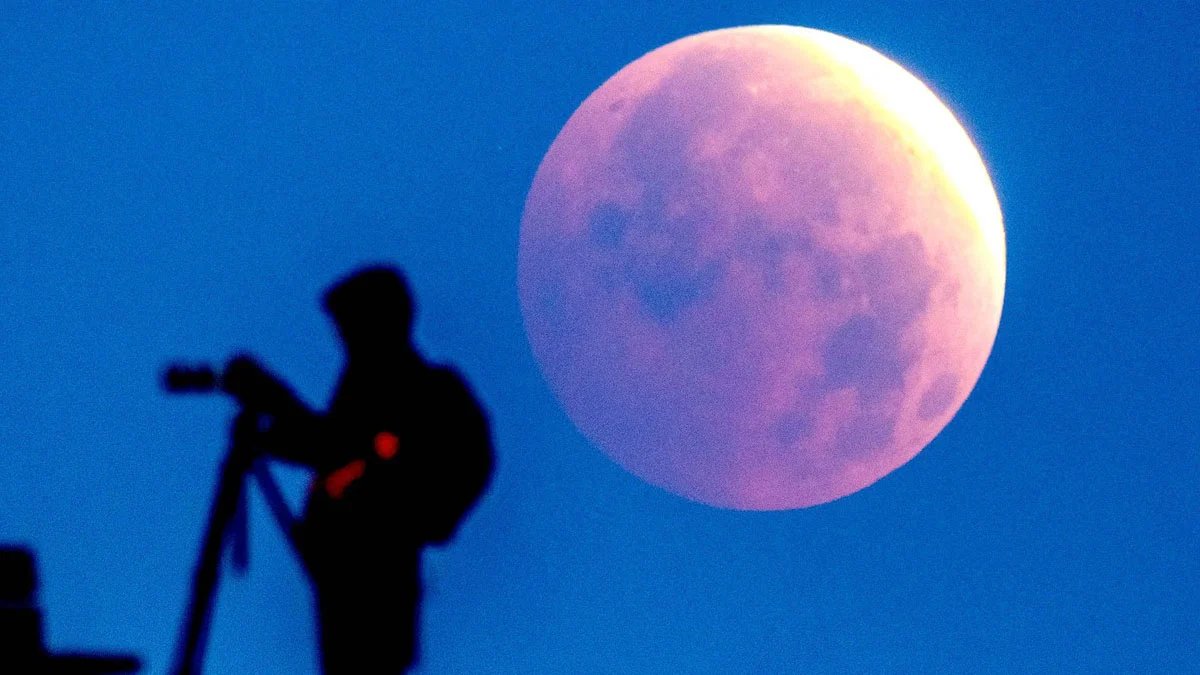
Stargazers across multiple continents were treated to a vivid astronomical event on August 28, 2026, as a partial lunar eclipse turned the moon a deep reddish-copper hue. The astronomical spectacle—often referred to as a “Blood Moon”—was visible across North and South America, Europe, Africa, and parts of Asia under clear night skies.
The phenomenon occurs when the Earth passes directly between the Sun and the Moon, casting its shadow across the lunar surface.
Why Does a Lunar Eclipse Turn the Moon Red?
Despite being classified as a partial lunar eclipse, the event delivered striking visual results due to atmospheric light filtering:
Rayleigh Scattering: Sunlight passing through Earth’s atmosphere loses shorter blue wavelengths while longer red and orange wavelengths bend toward the Moon.
Atmospheric Conditions: Dust and clouds within Earth’s atmosphere amplify the deep copper-red tone projected onto the lunar disk during peak shadow alignment.
Astronomers noted that night skies offered ideal viewing conditions in high-altitude and low-light regions, allowing astrophotographers to capture detailed imagery of the transition.
Global Viewing Highlights and Public Reaction
Observatories and amateur skywatchers turned out in large numbers to document the alignment. Unlike solar eclipses, lunar eclipses are safe to view directly without special protective eye equipment:
In the Americas, the best views came during the late evening when the Moon was fully covered in deep red.
Across Europe and Africa, the eclipse showed up in the early hours before dawn. Conditions were especially clear over Southern Europe and Northern Africa, giving sharp visibility.
For sky watchers, binoculars and backyard telescopes made it easy to catch the details, with the umbral shadow edge slowly creeping across the Moon’s craters.
Looking Ahead: Next Astronomical Events
Astronomers point out that while full total lunar eclipses are relatively rare, partial eclipses offer equally distinct visuals due to the high contrast between the shadowed and sunlit portions of the lunar surface. Skywatchers can anticipate further planetary conjunctions and meteor showers scheduled across the 2026 celestial calendar.