

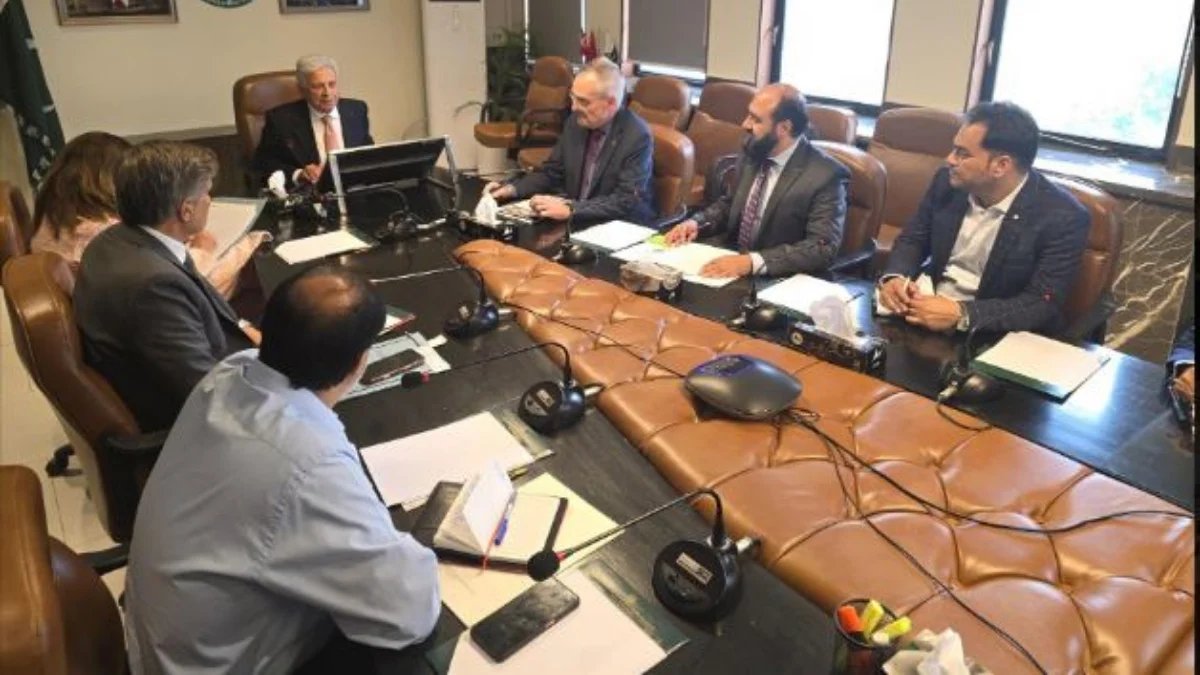
The minister for food security of Pakistan has called for stronger cooperation with the international agricultural research organization CIMMYT to increase wheat production and build a sustainable surplus for export.
Rana Tanveer Hussain said Pakistan needed to move beyond self-sufficiency and develop the capacity to supply international markets and food-deficit countries.
He was speaking during a meeting with Dr Flavio Breseghello, director of CIMMYT’s Global Wheat Program, and Dr Sajid Ali, the organization’s senior scientist and country representative for Pakistan, at the Ministry of National Food Security and Research.
Rana Tanveer Hussain stressed the need to substantially enhance wheat production to meet the food requirements of a population of around 260 million.
Referring to the recent need for wheat imports, he said Pakistan must address its productivity gap through better seed, stronger research and wider adoption of modern agricultural technologies.
He highlighted a wheat yield target of 3.5 tonnes per hectare and called for increased engagement with private partners to support national food security objectives.
Hussain said research partnerships and practical innovations would be increasingly important as farmers faced rising input costs and the effects of climate change.
The minister called on CIMMYT to expand its support for Pakistan’s wheat research, including through improved crop varieties, genomic research, hybrid wheat, gene-editing technologies and advanced breeding methods.
He said stronger research facilities and better-trained scientists were needed to develop wheat varieties that could withstand climate pressures and provide improved nutritional value.
Acknowledging six decades of the CIMMYT–Pakistan partnership, Rana Tanveer Hussain appreciated CIMMYT’s historic contribution to the country’s agricultural development, including the role of MAXIPAK varieties in Pakistan’s Green Revolution.
He said future cooperation should place greater emphasis on advanced technologies and innovations that could deliver further gains in productivity.
The minister also welcomed CIMMYT’s support for upgrading laboratories, providing research equipment and supplying machinery to agricultural research institutions.
Dr Sajid Ali told the meeting that facilities had been upgraded at five major wheat research institutions during 2026, including the National Agricultural Research Centre in Islamabad. Research machinery had also been provided to 11 national research partners.
Fifteen scientists had received training in Kenya, Nepal, Ethiopia and Mexico, alongside training programs held in Pakistan, he said.
CIMMYT had also helped establish 21 seed banks across 20 districts in Punjab, Sindh, Balochistan and Khyber Pakhtunkhwa, including the merged districts. The initiative aims to support resource-poor and vulnerable farming communities.
Climate-smart zero-tillage seed-cum-fertilizer drills had been distributed to five partner organizations, including the Green Pakistan Initiative and the National Rural Support Program.
Dr. Breseghello highlighted Pakistan’s longstanding partnership with CIMMYT and the contribution of genetic improvement to sustained wheat yield growth.
He explained that ongoing support aimed to strengthen breeding programs, improve seed processing and field research, and accelerate the development of wheat varieties suited to changing climatic conditions and nutritional needs.
Both sides discussed the potential of hybrid wheat and opportunities for deeper collaboration with Pakistani research institutions and other partners.
The Minister assured the delegation of the Government’s continued facilitation and expressed readiness to support a more substantive CIMMYT contribution to Pakistan’s agriculture sector.
The proposed Host Country Agreement was also discussed, and the meeting was informed that the document had been finalized and was ready for signing.
Rana Tanveer Hussain reaffirmed the Government’s commitment to strengthening agricultural research, innovation and climate resilience, emphasizing that cooperation with CIMMYT should help close Pakistan’s wheat productivity gap and secure lasting improvements in national food security.