

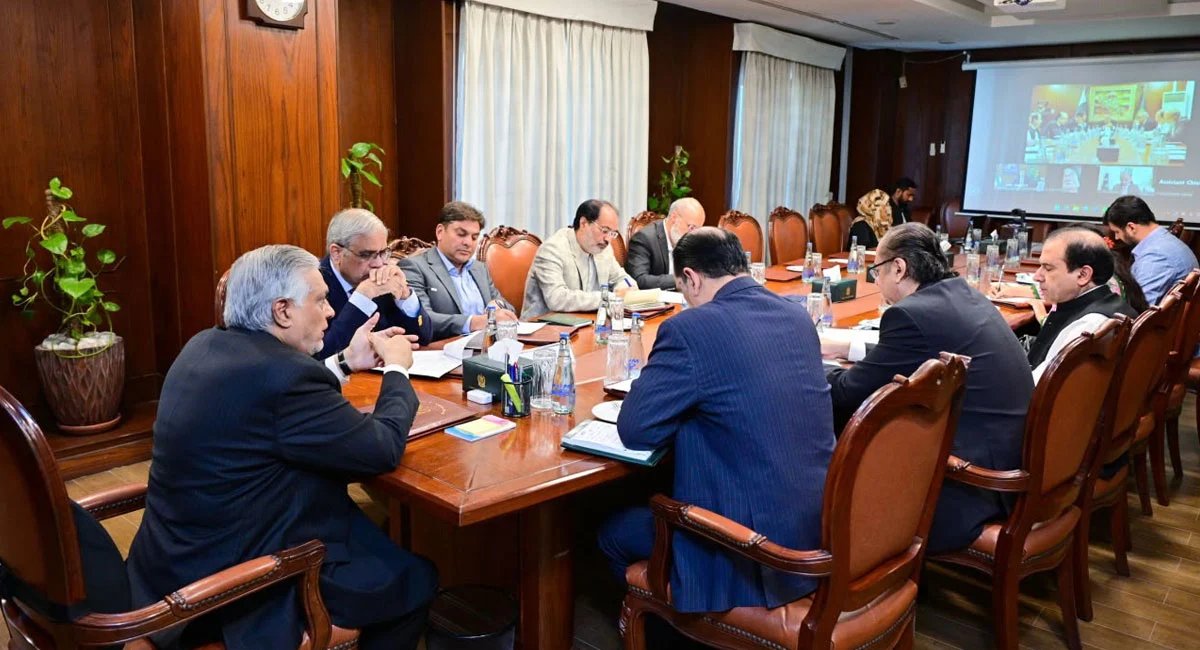
ISLAMABAD: Deputy Prime Minister and Foreign Minister Senator Mohammad Ishaq Dar on Monday directed relevant authorities to take practical measures to address bottlenecks and facilitate the export of surplus commodities while ensuring adequate domestic supplies and price stability.
Dar issued the directives while chairing a meeting to review the domestic supply and demand of essential commodities, prevailing market conditions and opportunities to access international markets.
Participants discussed measures to maintain sufficient availability of essential commodities in the domestic market, ensure price stability and facilitate trade, according to an official statement.
The deputy prime minister directed all concerned authorities to take practical steps to remove constraints and facilitate exports of surplus commodities.
The meeting was attended by the ministers for national food security and research and climate change, Special Assistant to the Prime Minister Tariq Bajwa, the secretaries of commerce and national food security and research, and senior officials from federal and provincial departments.
Read Also: Pakistan’s seafood exports hit record $568mn
Earlier, Federal Minister for Maritime Affairs Muhammad Junaid Anwar Chaudhry said Pakistan’s seafood exports had reached a record $568 million in the financial year 2025-26, including $62 million from shrimp exports.
He added that seafood exports had reached $125.4 million in the first quarter of the current financial year.
Junaid Chaudhry called for developing a comprehensive and sustainable value chain to transform aquaculture and shrimp farming into an export-oriented industry and boost foreign exchange earnings.
Chairing the first meeting of the Prime Minister’s Subcommittee on Aquaculture and Shrimp Value Chain, the minister stressed the need for coordinated efforts to increase production, improve quality and strengthen Pakistan’s competitiveness in international markets.
He said the subcommittee would work towards establishing an integrated system covering shrimp production, processing, quality testing and access to international markets.
The minister noted that a substantial share of Pakistan’s seafood exports still came from wild-caught marine resources, underscoring the need to develop shrimp farming as an organised and sustainable source of production.